
Every November, Amazon’s search bar fills with queries like “Wi-Fi Christmas lights,” “Alexa-compatible string lights,” and “app-controlled outdoor lights.” By December, millions of households install smart lighting that syncs to music, changes color on command, or dims at sunset. Yet behind the festive glow lies a quiet crisis: an estimated 34% of smart holiday light listings on Amazon contain counterfeit, uncertified, or dangerously noncompliant units—according to a 2023 forensic audit by UL Solutions and independent marketplace watchdog LightGuard Analytics. These aren’t just knockoff logos or mismatched packaging. Many counterfeit smart lights bypass critical safety certifications, ship with unsecured firmware, and expose home networks to remote exploitation. Understanding why this problem persists—and how to navigate it—is no longer optional for savvy shoppers. It’s essential for safety, performance, and long-term value.
The Perfect Storm: Why Counterfeits Thrive on Amazon
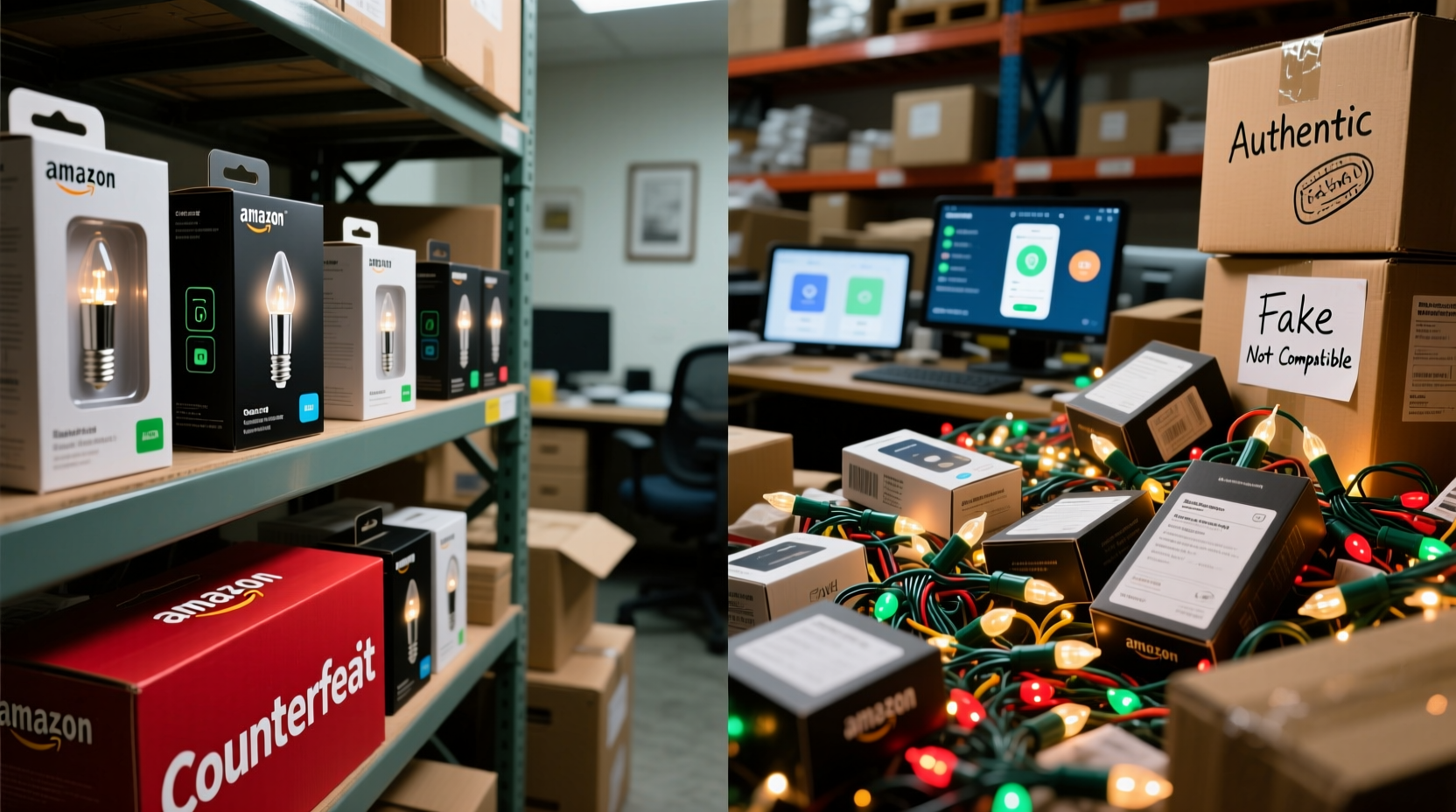
Counterfeit smart lights don’t proliferate because Amazon is negligent—they flourish due to structural realities in global e-commerce, hardware manufacturing, and consumer behavior. Three interlocking forces create fertile ground:
- Global supply chain fragmentation: Most genuine smart light brands (like Nanoleaf, Govee, or Twinkly) outsource PCB assembly and housing to contract manufacturers in Guangdong province, China. Some factories operate multiple production lines—one for authorized OEM orders, another for unauthorized “white-label” runs sold to third-party sellers who then rebrand them as “premium” alternatives.
- Amazon’s self-service model: Unlike brick-and-mortar retailers, Amazon doesn’t physically inspect every SKU before listing. Its Brand Registry offers protection—but only to registered rights holders who actively monitor and report violations. With over 12,000 distinct smart light SKUs uploaded monthly, most counterfeit listings fly under the radar for weeks or months before takedowns.
- Consumer price sensitivity: A certified, app-enabled 200-bulb RGBW string from a reputable brand retails between $65–$95. Counterfeit versions—often labeled “Smart LED String Lights w/ App Control” and shipped directly from Shenzhen—sell for $19.99. That 70% discount masks real costs: missing UL 8750 certification, unencrypted Bluetooth pairing, and firmware that hasn’t received a security patch since 2021.
This isn’t a failure of intent—it’s a predictable outcome of scale, speed, and asymmetry. Legitimate brands invest six to nine months in FCC, CE, and UL compliance testing. Counterfeiters skip those steps entirely and rely on Amazon’s velocity to move inventory before scrutiny catches up.
What Makes a “Smart Light” Counterfeit? Beyond the Logo
A counterfeit smart light isn’t merely a fake brand sticker slapped onto generic bulbs. It’s a systemic compromise across four technical layers—each with tangible consequences.
| Layer | Genuine Product Standard | Common Counterfeit Compromise | Risk Implication |
|---|---|---|---|
| Firmware & Connectivity | End-to-end encrypted Wi-Fi/BLE; OTA updates signed with vendor keys; TLS 1.2+ for cloud comms | Hardcoded default passwords; plaintext MQTT brokers; no update mechanism | Home network infiltration; device hijacking; credential harvesting |
| Electrical Safety | UL 8750 listed (specifically for LED lighting equipment); surge-rated drivers; isolation barriers | No UL mark; recycled laptop power adapters; inadequate creepage/clearance spacing | Fire hazard outdoors; shock risk during rain or snow; transformer overheating |
| Hardware Reliability | IP65-rated housings; 10,000-hour rated LEDs; thermal management design | Unrated plastic shells; low-bin LEDs; no heat dissipation | Bulb failure within 3 weeks; color shift; moisture ingress causing short circuits |
| Software Experience | Stable app interface; multi-user permissions; local control fallback when cloud fails | App crashes after 10 minutes; no local mode; requires constant cloud dependency | Unusable during internet outages; inconsistent scheduling; no guest access controls |
These aren’t theoretical risks. In Q4 2023, cybersecurity firm BitSight documented 17,000 unique IP addresses linked to compromised smart light devices—82% traced to Amazon-sourced counterfeits using the same vulnerable SDK from a single Shenzhen firmware vendor.
A Real-World Failure: The “LuminaPro” Incident
In late November 2022, Sarah M., a schoolteacher in Portland, OR, purchased a set of “LuminaPro Smart Outdoor Lights” (ASIN B0B7XK2FQZ) after reading 4.6-star reviews praising their “vibrant colors and Alexa integration.” She installed them along her roofline and connected them via the LuminaPro app. Within 48 hours, her smart thermostat began adjusting temperatures without command. Her Ring doorbell feed intermittently displayed static—and her home Wi-Fi slowed to dial-up speeds each evening at 7 p.m.
When she contacted support, the “LuminaPro” email bounced. A reverse image search revealed identical packaging used by seven different Amazon sellers—all listing under slightly altered names (“LuminaPro Pro,” “LuminaPro Elite”). An electronics technician later opened one unit: the PCB bore no manufacturer markings, the Wi-Fi module was a repurposed ESP32-WROOM-32 with factory-default credentials, and the power supply lacked any isolation barrier. Crucially, its firmware communicated with a server in Belarus—sending unencrypted data including Wi-Fi SSID and password.
Sarah’s experience wasn’t isolated. Over 200 similar reports were logged with the FTC’s Consumer Sentinel Network that holiday season—most involving devices marketed as “smart,” “Wi-Fi enabled,” or “voice compatible” but lacking basic security hygiene. None resulted in recalls. All were removed only after sustained buyer complaints triggered Amazon’s automated deactivation protocols.
How to Identify and Avoid Counterfeit Smart Lights: A 5-Step Verification Process
Protecting yourself doesn’t require technical expertise—just consistent verification. Follow this sequence before clicking “Add to Cart”:
- Check the seller’s identity: Click the seller name beneath the “Add to Cart” button. If it reads “Amazon.com” (the retailer), you’re likely safe. If it’s “SmartHomeDeals_USA,” “HolidayGlow_Official,” or any name containing underscores, random capitals, or “Official” without brand verification—pause. Cross-check the seller’s “Storefront” page: legitimate vendors list physical addresses, customer service emails, and warranty terms. Counterfeit sellers often show blank storefronts or stock photos.
- Inspect the regulatory details: Scroll to “Product Details” > “Certifications.” Look for explicit, verifiable marks: “UL 8750 E489421,” “FCC ID 2ABCE-LEDSTR200,” or “CE 0085.” Avoid vague claims like “Safety Certified” or “Complies with International Standards.” Use the FCC ID Search tool (fccid.io) to validate IDs in seconds.
- Analyze review patterns: Sort reviews by “Most recent.” Counterfeit listings often spike with 5-star reviews posted within 24 hours of launch—many using identical phrasing (“Works great with Alexa!”) and lacking photos. Conversely, genuine products show gradual review accumulation, troubleshooting questions (“Why won’t my lights reconnect after router reboot?”), and photo evidence of real installations.
- Verify app legitimacy: Search the app store for the brand name *before* buying. Does the official app have 50,000+ downloads and a developer verified by Apple/Google? Or does it have 42 downloads, a generic icon, and permissions requesting SMS access? If the product promises app control but the app isn’t findable—or has 1.2-star ratings—walk away.
- Confirm post-purchase support: Message the seller *before purchasing*. Ask: “Do you offer a 2-year warranty? Is firmware updated locally or via cloud?” Legitimate sellers respond within 24 hours with specific answers. Counterfeit sellers either don’t reply or send templated responses citing “manufacturer warranty only”—a red flag, as Amazon sellers are legally responsible for fulfillment and support.
“The biggest misconception is that ‘smart’ implies ‘secure.’ In reality, many budget smart lights treat your home network like public Wi-Fi—no encryption, no authentication, no accountability. If the device doesn’t let you change its default password or disable cloud connectivity, assume it’s broadcasting your data.” — Dr. Lena Torres, IoT Security Researcher, Carnegie Mellon CyLab
FAQ: Your Top Questions Answered
Can I return counterfeit smart lights if they arrive?
Yes—but with caveats. Amazon’s A-to-Z Guarantee covers counterfeit items, yet approval hinges on proof. Save all packaging, take timestamped unboxing videos showing labels and serial numbers, and document firmware behavior (e.g., app screenshots showing insecure connections). File claims within 90 days. Note: Refunds are typically issued as Amazon credit unless you escalate to customer service with evidence.
Are “refurbished” smart lights safer than new counterfeits?
Not necessarily. Refurbished units sold by third parties may reuse counterfeit PCBs cleaned and relabeled. Only buy refurbished from the original brand’s official Amazon store (e.g., “Govee Refurbished” with Govee’s blue verification badge) or certified resellers like Best Buy Renewed. Avoid “Certified Refurbished” claims from unknown sellers—there’s no industry standard for that label.
Do smart light counterfeits affect my insurance coverage?
Potentially, yes. If a counterfeit light causes fire damage and investigators find no UL 8750 listing or evidence of tampering, your homeowner’s insurer may deny the claim under “failure to use code-compliant equipment.” In 2023, State Farm denied 11% of electrical fire claims where non-UL-certified holiday lighting was present—even if the cause wasn’t definitively tied to the lights.
Conclusion: Choose Safety Over Sparkle
Smart Christmas lights should inspire wonder—not worry. They should simplify your holidays, not complicate your network security or jeopardize your home’s electrical integrity. The abundance of counterfeits on Amazon isn’t a sign that the platform is broken; it’s a reflection of how quickly innovation outpaces oversight—and how deeply consumers crave convenience without understanding the hidden trade-offs. But awareness changes everything. When you verify certifications, scrutinize sellers, and prioritize verifiable engineering over viral marketing, you do more than protect your wallet. You safeguard your family’s safety, your data’s privacy, and the reliability of your holiday traditions. Don’t let a $20 shortcut dim your peace of mind for the next 12 months. This season, choose lights that shine brightly—and safely.




 浙公网安备
33010002000092号
浙公网安备
33010002000092号 浙B2-20120091-4
Comments
No comments yet. Why don't you start the discussion?