
Dog lovers around the world marvel at the incredible variety among canines—from the tiny Chihuahua that fits in a handbag to the towering Great Dane that stands taller than a toddler. With over 340 recognized breeds by the Fédération Cynologique Internationale (FCI), dogs exhibit more physical and behavioral variation than any other land mammal. But why are there so many types of dogs? The answer lies in thousands of years of evolution, domestication, and deliberate human intervention. This article explores the biological, historical, and cultural forces that shaped dog breed diversity and continue to influence it today.
The Evolutionary Roots of Canine Diversity
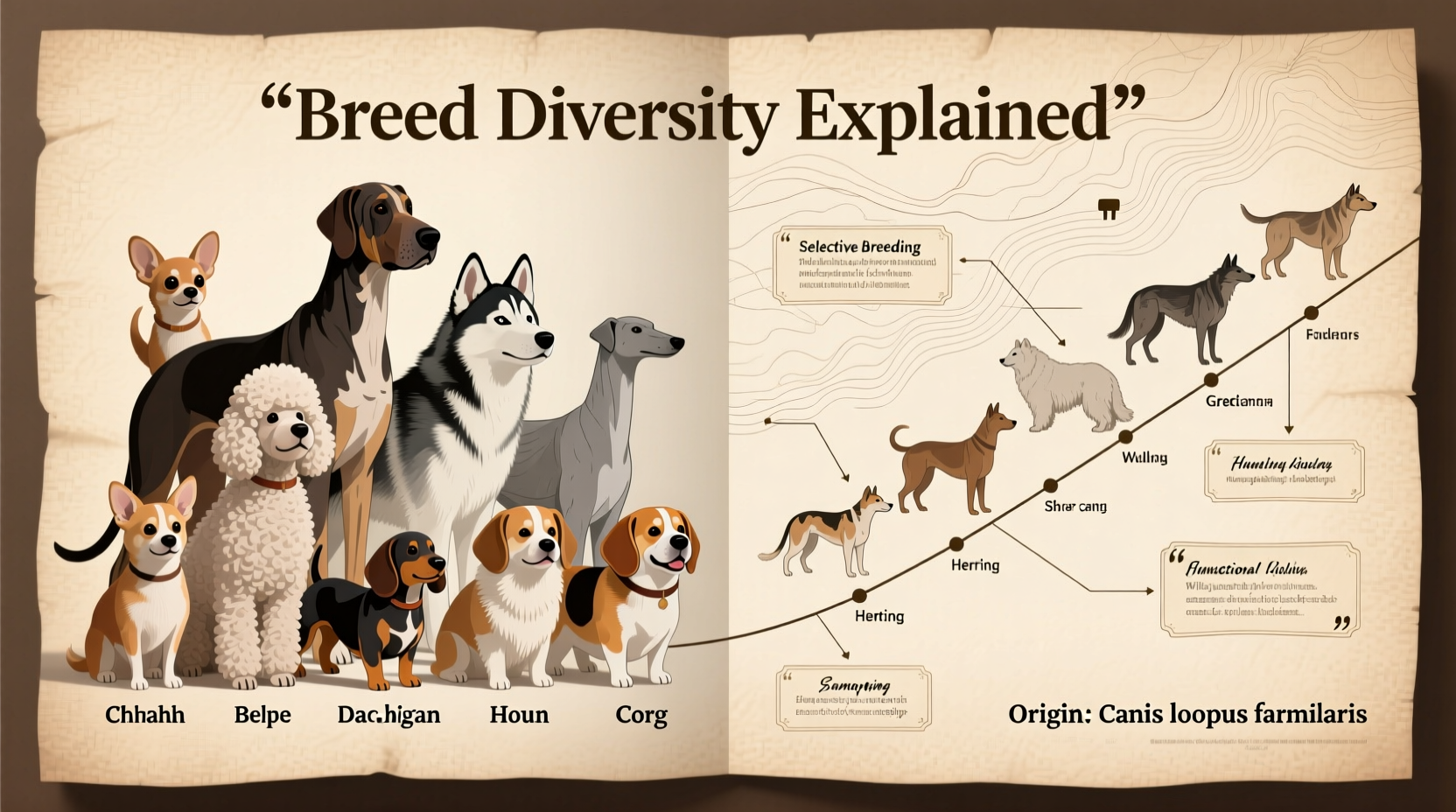
All modern dogs descend from the gray wolf (*Canis lupus*), with genetic evidence pointing to domestication beginning between 15,000 and 40,000 years ago. Early humans didn’t set out to create hundreds of breeds; instead, they favored wolves with less aggressive tendencies and greater social tolerance. Over generations, these traits were naturally selected, leading to tamer animals better suited to human coexistence.
As human societies evolved—shifting from nomadic hunting to agriculture and settlement—so did the roles dogs played. They guarded livestock, pulled sleds, herded sheep, hunted game, and provided companionship. Each role required different physical attributes and temperaments, setting the stage for early selective breeding.
“Dogs are the product of both natural adaptation and artificial selection. Their diversity reflects our changing needs across time and geography.” — Dr. Karen Becker, Veterinary Geneticist
Human-Driven Selective Breeding: The Engine of Breed Proliferation
Selective breeding is the primary reason behind the vast number of dog breeds. Unlike natural selection, where survival determines which traits persist, artificial selection allows humans to choose which characteristics get passed on. Farmers needed fast, intelligent herding dogs. Hunters wanted keen-nosed retrievers. Royalty desired lap-sized companions with luxurious coats.
In the 19th century, the concept of “purebred” dogs emerged, especially in Victorian England. Kennel clubs began formalizing breed standards—detailed descriptions of ideal size, coat, color, and temperament. This period saw an explosion in breed creation, as enthusiasts sought to refine and stabilize specific traits.
Geographic and Cultural Influences on Dog Breeds
Different regions developed distinct breeds based on local climates, terrain, and societal needs. For example:
- Northern Climates: Breeds like the Siberian Husky and Samoyed evolved thick double coats and high endurance to thrive in Arctic conditions.
- Mediterranean Regions: Sighthounds such as the Greyhound and Borzoi developed lean builds and explosive speed for open-field hunting.
- Asian Cultures: Small companion breeds like the Shih Tzu and Pekingese were bred for nobility, emphasizing elegance and affectionate demeanor.
Cultural preferences also played a role. In Japan, the Akita was revered as a symbol of loyalty, while in pre-colonial Africa, Basenjis were prized for their barkless communication and hunting skill. These regional specializations contributed significantly to global breed diversity.
Genetic Flexibility: Why Dogs Are So Malleable
Dogs possess a unique genetic architecture that makes them highly responsive to selective breeding. Research shows that relatively few genes control major physical traits like leg length, skull shape, and coat type. A mutation in the *IGF1* gene, for instance, is largely responsible for small body size in toy breeds.
Additionally, dogs have a high degree of phenotypic plasticity—the ability of one genotype to produce multiple physical expressions depending on environmental or selective pressures. This flexibility allowed breeders to achieve dramatic changes in appearance and function within just a few generations.
| Trait | Gene Involved | Breed Example |
|---|---|---|
| Short Legs | *FGF4* retrogene | Dachshund, Corgi |
| Curly Coat | *KRT71* | Poodle, Bichon Frise |
| Brachycephaly (Flat Face) | *BMP3* | Bulldog, Pug |
| Wire Hair | *RSPO2* | Wirehaired Fox Terrier |
Modern Challenges and Ethical Considerations
While breed diversity is impressive, it comes with consequences. Many purebred dogs suffer from inherited health issues due to narrow gene pools and extreme conformation. Bulldogs struggle with breathing, German Shepherds often develop hip dysplasia, and Cavalier King Charles Spaniels are prone to heart disease.
In recent years, veterinary organizations and animal welfare groups have called for reforms in breeding practices. Emphasis is shifting toward health testing, outcrossing (introducing unrelated bloodlines), and prioritizing function over exaggerated appearance.
“We must balance aesthetic goals with ethical responsibility. A beautiful dog should also be a healthy one.” — Dr. Jessica Hekman, Canine Geneticist and DVM
Mini Case Study: The Revival of the Swedish Vallhund
The Swedish Vallhund, an ancient herding breed nearly extinct after World War II, serves as a model for responsible breed recovery. By the 1940s, only about 60 individuals remained. Dedicated breeders worked with national kennel clubs to identify healthy specimens, avoid excessive inbreeding, and reintroduce working ability into the lineage. Today, the breed thrives with improved genetic diversity and fewer congenital disorders—a testament to what thoughtful stewardship can achieve.
Step-by-Step Guide: How New Breeds Are Developed
Creating a new dog breed is a long-term commitment involving careful planning and consistency. Here’s how it typically unfolds:
- Define the Purpose: Identify the need—e.g., hypoallergenic service dogs or drought-resistant herders.
- Select Foundation Stock: Choose parent breeds with complementary traits (e.g., Poodle + Labrador for Labradoodles).
- Breed and Evaluate: Produce multiple generations, assessing temperament, health, and conformation.
- Stabilize Traits: After 5–7 generations, aim for consistent appearance and behavior.
- Seek Recognition: Register with kennel clubs and meet documentation requirements for official status.
Frequently Asked Questions
Are mixed-breed dogs healthier than purebreds?
On average, yes. Mixed-breed dogs often benefit from greater genetic diversity, which can lower the risk of inherited conditions. However, individual health depends on lineage, care, and environment—not just breed status.
How many dog breeds are officially recognized?
The FCI recognizes over 340 breeds. The American Kennel Club (AKC) currently registers 201 breeds, with new additions evaluated annually based on population, documentation, and standardization.
Can a new dog breed emerge naturally?
True breeds require human-directed stabilization. While landraces (regional types like the Carolina Dog) evolve semi-independently, they lack the uniformity of formal breeds without intentional breeding.
Checklist: Evaluating Breed Diversity Responsibly
- ✅ Prioritize health testing in breeding programs
- ✅ Avoid breeding for extreme features (e.g., ultra-flat faces)
- ✅ Support outcrossing initiatives to expand gene pools
- ✅ Educate buyers about breed-specific needs and risks
- ✅ Advocate for updated breed standards that emphasize well-being
Conclusion
The extraordinary diversity of dog breeds is a testament to the deep, evolving partnership between humans and canines. From ancient working partners to modern family members, dogs have adapted to fill countless roles across cultures and centuries. Yet with great power comes responsibility—especially in how we shape their genetics and future.
Understanding why there are so many types of dogs isn't just a lesson in biology or history; it's a call to ensure that breed diversity continues in a way that honors both heritage and health. Whether you're a breeder, owner, or admirer, your choices matter. Let curiosity lead to compassion, and tradition guide innovation.




 浙公网安备
33010002000092号
浙公网安备
33010002000092号 浙B2-20120091-4
Comments
No comments yet. Why don't you start the discussion?