
One of the most persistent questions about evolution is deceptively simple: If humans evolved from monkeys, then why are there still monkeys? This question reflects a widespread misunderstanding of how evolutionary biology works—not because people are uninformed, but because the process is often oversimplified in public discourse. The truth is both more nuanced and far more fascinating than a linear progression from monkey to human.
Evolution doesn’t work like a ladder with rungs leading from “primitive” to “advanced.” Instead, it’s better visualized as a branching tree, where species diverge over time due to environmental pressures, genetic variation, and natural selection. Humans didn’t evolve from modern monkeys; rather, humans and monkeys share a common ancestor that lived tens of millions of years ago. That ancestor was neither a monkey nor a human, but an early primate whose descendants followed different evolutionary paths.
The Misconception Behind the Question
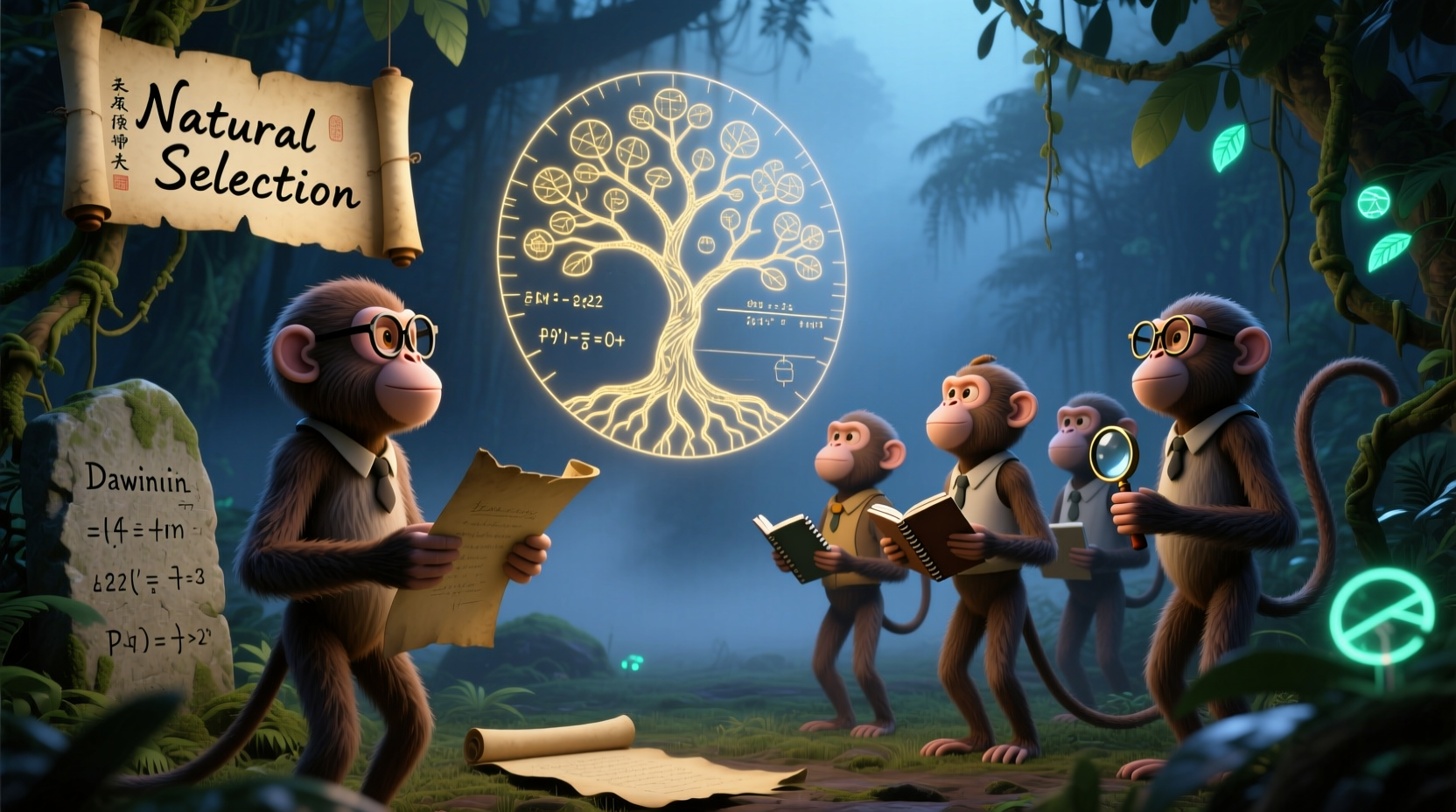
The assumption that evolution implies replacement—that once a new species evolves, the old one must vanish—is fundamentally flawed. Evolutionary change occurs within populations over generations, not as a wholesale transformation of one species into another. When a population becomes isolated or faces new selective pressures, it may gradually develop traits that differentiate it from its ancestors. Over time, this can lead to speciation—the emergence of a new species—while the original lineage continues unchanged or evolves along a separate path.
In this context, modern monkeys are not our ancestors. They are our distant cousins. Just as you and your cousin both descend from the same grandparents but did not evolve from each other, humans and monkeys both descended from a shared ancestral primate population that no longer exists.
Timeline of Primate Evolution
To understand the divergence between humans and other primates, consider this simplified evolutionary timeline:
- 65–55 million years ago (Mya): Earliest primates appear after the extinction of dinosaurs.
- 35–30 Mya: The split between Old World monkeys (like baboons) and the lineage leading to apes and humans.
- 25–20 Mya: First hominoids (apes) emerge in Africa and Eurasia.
- 7–6 Mya: Last common ancestor between humans and chimpanzees/bonobos.
- 2–3 Mya: Genus Homo appears, including early human ancestors like Homo habilis.
- 300,000 years ago: Anatomically modern Homo sapiens evolve in Africa.
This sequence shows that monkeys existed long before humans and continued evolving independently. The survival of monkeys today is not evidence against evolution—it's consistent with it.
Why Monkeys Still Exist: Natural Selection in Action
Monkeys thrive because they are exquisitely adapted to their environments. Whether swinging through tropical canopies or navigating rocky cliffs, species like capuchins, macaques, and spider monkeys occupy ecological niches where their physical and behavioral traits give them a competitive edge. Evolution favors survival and reproduction, not “progress” toward human-like intelligence or bipedalism.
From an evolutionary standpoint, success isn’t measured by brain size or technological innovation. It’s measured by reproductive fitness—how well an organism passes on its genes. By this metric, many monkey species are extraordinarily successful. Some, like the rhesus macaque, have even expanded their range due to adaptability and resilience.
| Species | Adaptation | Habitat |
|---|---|---|
| Baboon | Social hierarchies, ground foraging | Savannas of Africa |
| Howler Monkey | Vocalizations for territory defense | Central and South American forests |
| Mandrill | Bright coloration for social signaling | Tropical rainforests |
| Capuchin | Tool use, problem-solving skills | Varied forest types |
Each of these species has undergone its own evolutionary journey, shaped by unique pressures. Their continued existence underscores the diversity and adaptability of life—not a failure of evolution to “move forward.”
Expert Insight: What Biologists Say
“People often think evolution is a march toward perfection, culminating in humans. But evolution has no goal. It’s about adaptation to local conditions. Monkeys are just as ‘evolved’ as we are—they’ve simply adapted to different challenges.” — Dr. Jane Karanja, Evolutionary Biologist, University of Cape Town
“The idea that humans ‘came from’ monkeys is outdated and misleading. We share a common ancestor, much like two branches growing from the same trunk. One branch didn’t turn into the other.” — Prof. Alan Weiss, Paleoprimatology, Yale University
Common Misunderstandings About Evolution
Several myths contribute to confusion about why monkeys still exist. Here’s a quick checklist to clarify key points:
- ❌ Humans evolved from monkeys → No. Humans and monkeys share a common ancestor.
- ❌ Evolution always leads to more complex organisms → No. Simpler organisms often outlast complex ones.
- ❌ If evolution is true, older species should disappear → No. Multiple species can coexist indefinitely.
- ❌ Monkeys are ‘less evolved’ than humans → No. All living species have been evolving for the same amount of time.
- ❌ Evolution has a purpose or direction → No. It’s driven by random mutations and environmental selection.
Real Example: The Case of the Japanese Macaque
A compelling example of ongoing primate adaptation is the Japanese macaque, also known as the snow monkey. Living in some of the coldest climates inhabited by any non-human primate, these monkeys developed behaviors such as soaking in natural hot springs to survive harsh winters. This cultural transmission—learned behavior passed through generations—shows how evolution operates not only through genetics but also through social learning.
Despite sharing a distant ancestor with humans, the snow monkey hasn’t “turned into” a human or even tried to. Instead, it has specialized in ways that maximize survival in its specific environment. This is evolution in action: diversification, not replacement.
Frequently Asked Questions
If we came from apes, why are there still apes?
We didn’t come from modern apes. Humans and modern apes (like chimpanzees and gorillas) evolved from a common ancestor that lived around 6–7 million years ago. That ancestor population split into different lineages—one leading to modern humans, others to modern apes. Both lines continued evolving independently.
Are monkeys less intelligent than humans?
Intelligence is context-dependent. While humans excel in abstract reasoning, language, and technology, many monkeys demonstrate remarkable cognitive abilities. Capuchin monkeys use tools, macaques learn complex social rules, and some species show self-awareness in mirror tests. Intelligence evolves based on ecological needs, not as a universal scale.
Could monkeys ever evolve into humans?
No. Evolution doesn’t repeat itself or aim for predetermined outcomes. Even if environmental conditions were identical, genetic drift, mutation patterns, and historical contingencies make it impossible for monkeys to evolve into humans. Evolution is not a script—it’s an improvisation shaped by chance and necessity.
Conclusion: Embracing the Complexity of Life
The persistence of monkeys is not a challenge to evolutionary theory—it’s a testament to its power. Evolution explains diversity, not hierarchy. Monkeys remain because they are superbly suited to their roles in ecosystems across the world. Their survival, alongside humans, lemurs, apes, and tarsiers, illustrates the branching richness of life on Earth.
Understanding evolution means letting go of linear thinking and embracing complexity. It means recognizing that every species, from the tiniest marmoset to the tallest giraffe, carries a legacy of billions of years of adaptation. There are still monkeys because evolution doesn’t eliminate the past—it builds upon it.




 浙公网安备
33010002000092号
浙公网安备
33010002000092号 浙B2-20120091-4
Comments
No comments yet. Why don't you start the discussion?