
High in the treetops of Central and South American rainforests, a remarkable primate moves with acrobatic grace—long limbs outstretched, tail coiled like a fifth hand. This is the spider monkey, a creature whose name evokes both mystery and motion. But why \"spider\"? What evolutionary path led to this distinctive animal, and what biological and behavioral features make it unlike any other New World monkey? Understanding the origins and unique traits of spider monkeys reveals not only the mechanics of their name but also the deeper story of adaptation, intelligence, and ecological importance.
The Origin of the Name: Why “Spider” Monkey?
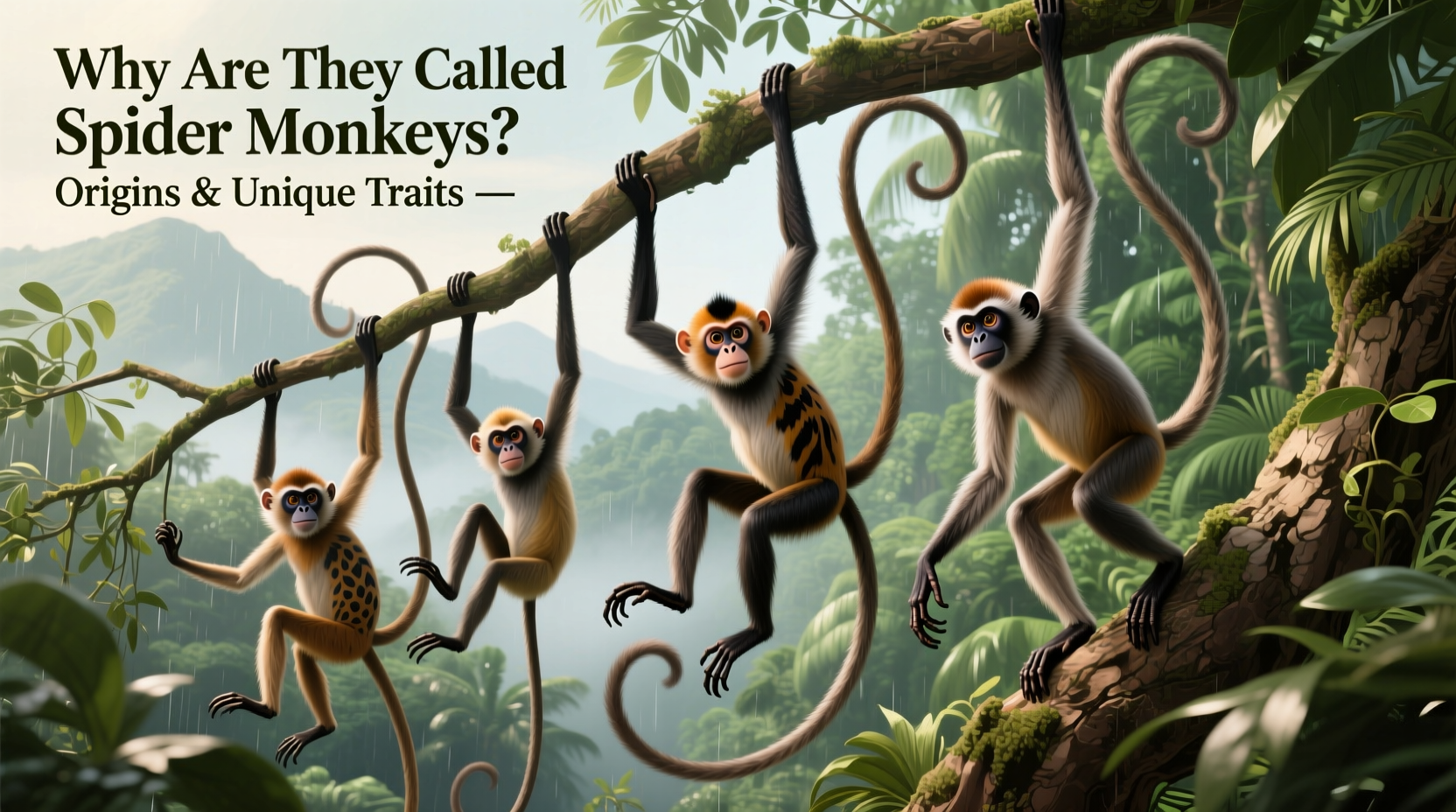
The term “spider monkey” does not stem from arachnid ancestry—there’s no genetic link to spiders—but rather from the way these primates move through the forest canopy. When observed from a distance, a spider monkey suspended by its limbs and prehensile tail resembles a large, eight-legged arachnid skittering across a web. Their long, slender arms and legs stretch outward, creating a silhouette reminiscent of a spider’s extended legs.
This visual analogy was first noted by early European naturalists who encountered the animals during explorations of the Neotropics. The French naturalist Georges-Louis Leclerc, Comte de Buffon, referenced their \"spider-like appearance\" in 18th-century writings, cementing the common name. In scientific taxonomy, they belong to the genus *Ateles*, derived from the Greek word *ateles*, meaning “imperfect” or “incomplete,” a reference to their reduced or absent thumbs—a trait we’ll explore later.
Evolutionary Origins and Geographic Range
Spider monkeys evolved in the tropical forests of Central and South America, with fossil and genetic evidence suggesting divergence from other atelines (such as howler and woolly monkeys) around 15 to 20 million years ago during the Miocene epoch. They are part of the family Atelidae, known for their advanced locomotor skills and complex social behaviors.
Today, seven recognized species of spider monkeys inhabit regions stretching from southern Mexico to Brazil, primarily within lowland rainforests, cloud forests, and mangroves. These include the black-headed spider monkey (*Ateles fusciceps*), red-faced spider monkey (*Ateles paniscus*), and Geoffroy’s spider monkey (*Ateles geoffroyi*), among others. Each species has adapted to slightly different microhabitats, but all depend on continuous forest canopies for survival.
Habitat fragmentation due to deforestation poses a significant threat. Because spider monkeys require large territories and mature trees for food and shelter, they are highly vulnerable to human encroachment. All species are listed as either endangered or critically endangered by the IUCN, underscoring the urgency of conservation efforts.
Unique Physical and Behavioral Traits
Spider monkeys stand out among primates for several extraordinary adaptations:
- Prehensile Tail: More than just an appendage, their tail functions as a fully operational fifth limb. It is hairless at the tip for enhanced grip, contains dermatoglyphs (similar to human fingerprints), and can support the monkey’s entire body weight. This allows them to feed while hanging upside down or reach distant branches without risking a fall.
- Reduced Thumbs: Unlike most primates, spider monkeys have vestigial thumbs or none at all. This adaptation enhances their ability to swing rapidly between trees using a hook-like grip with their long fingers. While it limits fine motor manipulation, it optimizes speed and agility in arboreal travel—a trade-off shaped by evolution.
- Brachiation Mastery: Spider monkeys are among the most accomplished brachiators in the primate world. They can swing up to 10 meters between branches at speeds exceeding 35 km/h, relying on momentum and precise coordination.
- Large Brain-to-Body Ratio: Among New World monkeys, spider monkeys possess one of the largest brains relative to body size. This correlates with advanced cognitive abilities, including problem-solving, memory for fruit tree locations, and complex social dynamics.
“Spider monkeys exemplify the pinnacle of arboreal adaptation. Their anatomy reflects millions of years of refinement for life in the high canopy.” — Dr. Elena Márquez, Primatologist, Universidad Nacional Autónoma de México
Social Structure and Communication
Spider monkeys live in fission-fusion societies, a rare trait shared with chimpanzees and humans. This means group size and composition change daily based on food availability, reproductive status, and social bonds. A community may consist of 20–40 individuals, but they typically forage in smaller subgroups of 2–6.
This fluid social system reduces competition for resources and allows efficient exploitation of scattered fruit trees. Females often disperse from their natal groups, while males remain and form strong kin-based alliances. Vocalizations, scent marking, and tactile communication play key roles in maintaining social cohesion.
They produce a range of calls—from barks and whinnies to screams—used to signal danger, locate group members, or assert dominance. Researchers have identified over a dozen distinct vocalizations, some of which appear to be context-specific and learned through social interaction.
Conservation Challenges and Real-World Impact
In Costa Rica’s Osa Peninsula, a long-term study tracked a troop of Geoffroy’s spider monkeys over a decade. As logging expanded nearby, their home range shrank by nearly 40%. The monkeys responded by altering their movement patterns, traveling longer distances each day and increasing intergroup conflict over dwindling fruit sources. Infant mortality rose, and genetic diversity declined due to isolation.
This case illustrates how habitat loss doesn’t just reduce space—it disrupts the delicate balance of feeding, reproduction, and social structure. Conservation initiatives now focus on reforestation corridors and protected reserves to reconnect fragmented populations.
| Trait | Function | Evolutionary Advantage |
|---|---|---|
| Prehensile Tail | Acts as fifth limb for gripping and balancing | Enables safe, efficient movement in high canopy |
| Vestigial Thumbs | Limited opposable thumb function | Enhances brachiation speed and grip efficiency |
| Fission-Fusion Society | Flexible group size and composition | Reduces resource competition and predation risk |
| Large Brain Size | Advanced cognition and memory | Improves foraging efficiency and social navigation |
Practical Tips for Supporting Spider Monkey Conservation
- Avoid products linked to deforestation, especially palm oil and non-sustainable timber.
- Support reputable wildlife organizations focused on Neotropical conservation, such as the Wildlife Conservation Society or Rainforest Trust.
- Travel responsibly: opt for eco-lodges and guided tours that contribute to local conservation efforts.
- Spread awareness about spider monkeys’ ecological role as seed dispersers—critical for forest regeneration.
- Advocate for stronger environmental policies protecting tropical habitats.
Frequently Asked Questions
Why don’t spider monkeys have thumbs?
Spider monkeys have evolved reduced or absent thumbs to improve their brachiating efficiency. Without thumbs, their hands form a more effective hook for swinging through trees, sacrificing precision grip for speed and mobility in the canopy.
Can spider monkeys swim?
While capable of swimming if necessary, spider monkeys avoid water. They are highly arboreal and rarely descend to the ground, making rivers and lakes natural barriers to their movement.
Are spider monkeys dangerous to humans?
No, spider monkeys are not aggressive toward humans unless threatened or habituated to people through feeding. In the wild, they tend to be shy and will retreat when approached.
Conclusion: A Call to Protect an Extraordinary Species
The name “spider monkey” captures a fleeting image—their spindly limbs outstretched against the sky—but it barely scratches the surface of their biological sophistication. From their intelligent social systems to their unparalleled mastery of the treetops, these primates represent a triumph of evolutionary design. Yet their future is uncertain. As forests fall and climate shifts, the very traits that made them successful—specialized diets, large territories, slow reproduction—now make them vulnerable.
Understanding why they’re called spider monkeys is more than a linguistic curiosity; it’s a doorway into appreciating their place in the natural world. By learning about their origins and unique traits, we gain not just knowledge, but responsibility. Protecting spider monkeys means protecting the integrity of tropical ecosystems—one branch, one forest, one choice at a time.




 浙公网安备
33010002000092号
浙公网安备
33010002000092号 浙B2-20120091-4
Comments
No comments yet. Why don't you start the discussion?