
Before the 19th century, every town set its own local time based on the position of the sun—noon was when the sun reached its highest point in the sky. While this worked for small communities, it became chaotic as transportation and communication advanced. Trains needed precise schedules, telegraphs demanded synchronization, and international coordination grew urgent. The solution? Time zones—a system that divides the world into standardized segments of time. But why are time zones a thing? And why can't we just use one universal clock?
The answer lies in the Earth’s rotation, human biology, and the practical demands of modern life. Time zones balance natural solar cycles with social and economic functionality, ensuring that \"daytime\" aligns roughly with daylight across different regions.
The Science Behind Earth's Rotation and Solar Time
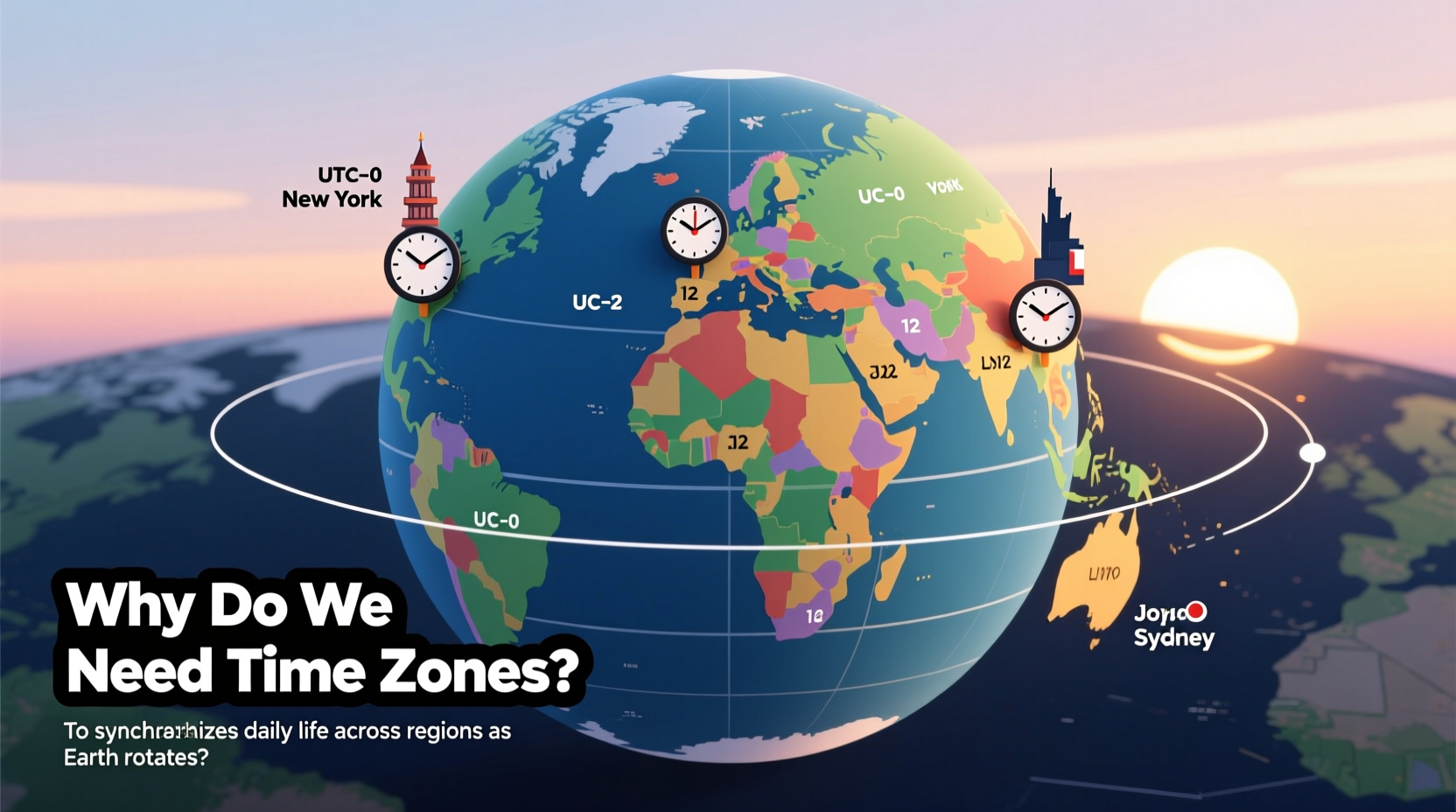
The Earth rotates 360 degrees every 24 hours, which means it turns 15 degrees per hour. As it spins, sunlight reaches different parts of the globe at different times. When it’s noon in New York, the sun is directly overhead there—but in London, it’s already late afternoon, and in Tokyo, it’s the middle of the night.
If everyone used the same clock—say, Greenwich Mean Time (GMT)—then noon would not correspond to midday in most places. In Los Angeles, “noon GMT” would occur around 4 AM local sunrise. This misalignment would make daily life confusing: clocks might say “lunchtime,” but it would still be dark outside.
To resolve this, the world adopted a system where each region sets its official time based on its longitudinal position relative to the Prime Meridian (0° longitude, passing through Greenwich, England). This ensures that noon occurs approximately when the sun is highest in the sky for that zone.
How Time Zones Were Invented and Standardized
The concept of standardized time zones emerged in the 1870s, largely due to the efforts of Sir Sandford Fleming, a Canadian railway engineer. Frustrated by inconsistent timetables and scheduling errors caused by hundreds of local times, he proposed a global system of 24 time zones, each spanning 15 degrees of longitude.
In 1884, the International Meridian Conference in Washington, D.C., formalized this idea. Delegates from 25 nations agreed to adopt the Greenwich Meridian as the prime reference line and established the foundation for today’s Coordinated Universal Time (UTC) system.
“Time zones were not invented for convenience alone—they were essential for safety, commerce, and communication in an increasingly connected world.” — Dr. Alan Thompson, Historian of Technology
Despite initial resistance, countries gradually adopted the system. Railroads led the way, followed by telegraph networks and later aviation and digital communications.
Modern Time Zone Structure and Exceptions
Today, the world is divided into 24 primary time zones, labeled from UTC−12 to UTC+14. Most zones differ by full hours from UTC, though some regions use half-hour or even 45-minute offsets:
- Nepal uses UTC+5:45
- India uses UTC+5:30
- Myanmar uses UTC+6:30
Political and economic considerations often override geographical logic. For example:
| Country/Region | Geographic Logic | Actual Time Zone | Reason for Deviation |
|---|---|---|---|
| China | Spans five time zones | UTC+8 nationwide | Political unity; single national time |
| Spain | Same longitude as UK | UTC+1 (Central European Time) | Aligned with Europe during WWII |
| Alaska | Western edge near Hawaii | Mostly UTC−9 | Economic ties to continental U.S. |
These exceptions show that while time zones are rooted in astronomy, they are ultimately shaped by human decisions.
The Role of Daylight Saving Time and Its Controversy
Daylight Saving Time (DST) adds another layer of complexity. Roughly 70 countries shift clocks forward in spring and back in fall to extend evening daylight during summer months. The rationale is energy conservation and increased outdoor activity.
However, DST disrupts time zone consistency. During DST, regions like New York operate on Eastern Daylight Time (UTC−4), shifting from standard UTC−5. This creates temporary mismatches in international coordination.
Recent studies question DST’s benefits. A 2020 study by the American Academy of Sleep Medicine found no significant energy savings and noted negative health impacts, including increased heart attack rates after the spring transition.
As a result, several regions—including the European Union and U.S. states like California and Florida—are considering ending seasonal clock changes altogether.
Global Coordination in the Digital Age
With remote work, global teams, and real-time communication, managing time zones has never been more critical. Miscommunication over meeting times costs businesses millions annually. Yet, tools like UTC-based scheduling, world clocks, and calendar apps have made cross-time-zone collaboration easier.
Many tech companies now default to UTC internally to avoid confusion. For example, software logs, server timestamps, and developer meetings often use UTC to ensure clarity regardless of location.
Still, challenges remain. A team member in Sydney might attend a 9 AM call that occurs at 10 PM their time. This raises concerns about work-life balance and long-term sustainability.
“We’re seeing a cultural shift toward asynchronous work—not because time zones are flawed, but because respecting them leads to better productivity and well-being.” — Lena Patel, Remote Work Strategist
Step-by-Step Guide to Managing Multiple Time Zones
- Identify all relevant time zones: Use tools like timeanddate.com to map team locations.
- Convert consistently to UTC: Use UTC as a neutral reference point for scheduling.
- Use time zone-friendly tools: Google Calendar, World Time Buddy, or Slack plugins automatically display times in recipients’ local zones.
- Rotate meeting times: Share the burden of odd-hour calls fairly across regions.
- Document deadlines clearly: Always specify time zones (e.g., “5 PM PST”) or convert to multiple zones.
Frequently Asked Questions
Why doesn’t the entire world use one time zone?
Using a single time zone would disconnect clock time from natural daylight. Noon could occur at midnight in some regions, disrupting sleep, work, and social routines. Human circadian rhythms rely on alignment between time and sunlight.
Which country has the most time zones?
France has the most time zones—12—due to its overseas territories spread across the globe, from French Guiana in South America to French Polynesia in the Pacific. Russia spans 11 time zones within its mainland.
What happens at the International Date Line?
The International Date Line, mostly along 180° longitude, marks where one calendar day ends and the next begins. Crossing it eastward subtracts a day; crossing westward adds a day. It zigzags to avoid splitting countries or islands.
- ✅ Always include time zone abbreviations (e.g., EST, IST, JST)
- ✅ Confirm meeting times using dual-time displays
- ✅ Avoid scheduling meetings during extreme off-hours (before 7 AM or after 10 PM local time)
- ✅ Record important meetings for those who can’t attend live
- ✅ Normalize asynchronous updates via shared documents or messaging platforms
Conclusion: Respecting Time Zones Is Respect for People
Time zones exist because the Earth is round and rotates steadily, but they endure because they serve human needs. They allow societies to synchronize daily life with natural light while enabling global cooperation. From train schedules in the 1800s to Zoom calls today, time zones remain a quiet but essential infrastructure of modern civilization.
Understanding them isn’t just about avoiding missed meetings—it’s about empathy. Recognizing that “9 AM” means something different in Mumbai, Mexico City, and Melbourne fosters better collaboration and mutual respect. As the world grows more interconnected, honoring time zones becomes not just practical, but ethical.




 浙公网安备
33010002000092号
浙公网安备
33010002000092号 浙B2-20120091-4
Comments
No comments yet. Why don't you start the discussion?