
At first glance, the tomato seems like a vegetable. It’s savory, often found in salads, sauces, and stews, and rarely appears in desserts. Yet, scientifically speaking, it's classified as a fruit. This contradiction has sparked curiosity, debate, and even a landmark U.S. Supreme Court case. To understand why tomatoes are fruits, we need to explore botany, history, law, and language. The answer lies not in taste or use, but in plant biology and reproductive function.
The Botanical Definition of Fruit
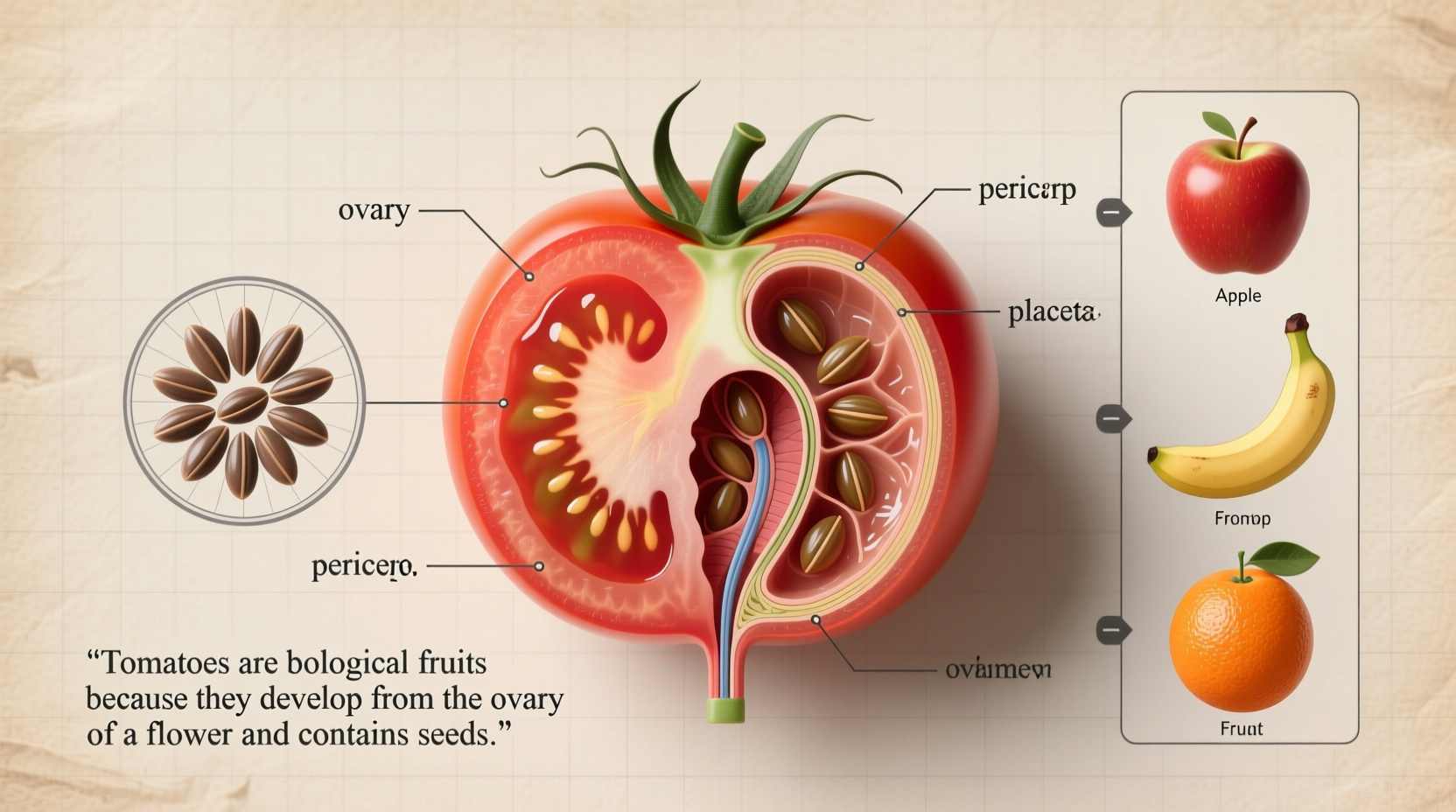
In botanical terms, a fruit is the mature ovary of a flowering plant, typically containing seeds. This definition is strictly biological and has nothing to do with sweetness or culinary application. When a flower is pollinated, the ovary swells and develops into what we recognize as fruit. Apples, oranges, and bananas fit this definition—and so does the tomato.
Tomatoes form after the yellow flowers on tomato plants are fertilized. The ovary at the base of the flower expands, ripens, and becomes the red (or yellow, purple, or green) fleshy structure we eat. Inside are numerous seeds capable of growing new plants. By this biological standard, the tomato is unambiguously a fruit.
“Botanically, there’s no debate: if it develops from the flower and contains seeds, it’s a fruit. Tomatoes meet both criteria.” — Dr. Lila Chen, Plant Biologist, University of California
Culinary vs. Scientific Classification
While science defines fruits by origin and structure, cooking categorizes ingredients by flavor and use. In the kitchen, fruits are generally sweet and used in desserts, while vegetables are savory and used in main dishes. Tomatoes fall into the latter category in practice, despite their botanical status.
This divergence leads to widespread confusion. People expect fruits to be sweet, so calling a tomato a fruit feels counterintuitive. But many other \"vegetables\" are also fruits by definition: cucumbers, peppers, eggplants, zucchini, and pumpkins all develop from flowers and contain seeds.
The disconnect isn’t just cultural—it’s practical. Culinary taxonomy prioritizes taste, texture, and tradition over biological accuracy. As a result, tomatoes are treated as vegetables in recipes, grocery stores, and nutritional guidelines.
A Historical Turning Point: Nix v. Hedden
The tension between science and everyday usage reached a legal peak in 1893 with the U.S. Supreme Court case Nix v. Hedden. At issue was whether imported tomatoes should be taxed as vegetables under the Tariff Act of 1883. Botanists testified that tomatoes were fruits, but the court ruled otherwise.
Justice Horace Gray delivered the opinion: “Botanically speaking, tomatoes are the fruit of a vine… But in the common language of the people… they are vegetables.” The decision hinged on how tomatoes are used in meals—not their biological makeup.
This ruling didn’t change the science, but it cemented the tomato’s place in the culinary vegetable category. It also highlighted a broader truth: classification depends on context. In a lab, a tomato is a fruit. In a salad, it’s a vegetable.
Common Misconceptions About Fruits and Vegetables
Many people believe that sugar content determines whether something is a fruit. While fruits tend to be sweeter, this isn’t a defining trait. Lemons and limes are sour but clearly fruits. Conversely, carrots and beets are sweet but remain vegetables because they come from roots, not flowers.
Another misconception is that only tree-grown items qualify as fruits. But botany makes no distinction based on plant type. Whether from vines (tomatoes), bushes (blueberries), or trees (apples), the key factor is the plant’s reproductive anatomy.
| Item | Botanical Classification | Culinary Use |
|---|---|---|
| Tomato | Fruit (berry) | Vegetable |
| Cucumber | Fruit (pepo) | Vegetable |
| Pepper | Fruit (berry) | Vegetable |
| Zucchini | Fruit (pepo) | Vegetable |
| Strawberry | Fruit (aggregate accessory) | Fruit |
| Potato | Vegetable (tuber) | Vegetable |
Tomatoes Are Berries? Yes, Technically
Even more surprising: tomatoes are berries. In botanical terms, a berry is a fleshy fruit produced from a single ovary and typically containing multiple seeds. True berries include grapes, kiwis, and bananas. Tomatoes meet all these criteria.
The confusion arises because common language uses “berry” differently. Blueberries and raspberries seem like obvious candidates, but strawberries aren’t true berries (their seeds are on the outside), and raspberries are aggregate fruits. Meanwhile, tomatoes, avocados, and even bananas are botanically berries.
This illustrates how scientific terminology can diverge sharply from everyday speech. Understanding this helps clarify why experts insist tomatoes are fruits—even when our taste buds disagree.
Practical Implications: Does the Classification Matter?
For most people, whether a tomato is a fruit or vegetable doesn’t affect daily life. However, accurate classification matters in agriculture, nutrition labeling, and food regulation. For example, school lunch programs follow USDA guidelines that classify tomatoes as vegetables for meal planning.
In gardening, knowing that tomatoes are fruits influences how they’re grown. Fruit-bearing plants often require different care than root or leaf vegetables—more support, consistent watering, and attention to pollination.
Step-by-Step: How a Tomato Develops from Flower to Fruit
- Flowering: The tomato plant produces small yellow blossoms.
- Pollination: Pollen transfers from anther to stigma, either by wind, insects, or self-pollination.
- Fertilization: The ovules inside the ovary are fertilized and begin developing into seeds.
- Ovary Expansion: The ovary wall thickens and swells, forming the fleshy part of the tomato.
- Ripening: Chlorophyll breaks down, revealing red (or other color) pigments; sugars and acids develop.
- Maturity: The fully formed fruit contains viable seeds, ready for dispersal.
This process mirrors that of apples, melons, and peppers—confirming the tomato’s place among fruits.
FAQ
Is a tomato a fruit or a vegetable?
Scientifically, it’s a fruit because it develops from the flower of the plant and contains seeds. Culturally and culinarily, it’s treated as a vegetable due to its savory flavor and common uses in meals.
Are all fruits sweet?
No. While many fruits are sweet, others like lemons, cranberries, and tomatoes are tart or savory. Sweetness is not a botanical requirement for fruit classification.
Why do some people say tomatoes are vegetables?
Because of their taste and typical use in savory dishes, tomatoes are grouped with vegetables in cooking, nutrition, and commerce—even though botanically they are fruits.
Checklist: How to Explain Why Tomatoes Are Fruits
- Confirm that fruits develop from the flower’s ovary.
- Point out that tomatoes contain seeds and grow from pollinated flowers.
- Clarify that culinary use doesn’t override biological classification.
- Mention other savory fruits like cucumbers and peppers for comparison.
- Reference the Supreme Court case to show the difference between legal and scientific definitions.
Conclusion
The tomato’s identity crisis reveals a deeper truth about how humans categorize nature. Science relies on precise definitions based on structure and function. Culture relies on habit, taste, and utility. Both perspectives are valid in their context. Recognizing that tomatoes are fruits doesn’t mean you have to put them in a fruit salad—it simply means appreciating the complexity behind a simple garden staple.
Understanding this distinction empowers better gardening, smarter cooking, and more informed conversations about food. Whether you slice it for a sandwich or study it in a biology lab, the tomato remains one of nature’s most fascinating contradictions.




 浙公网安备
33010002000092号
浙公网安备
33010002000092号 浙B2-20120091-4
Comments
No comments yet. Why don't you start the discussion?