
The sight of a U.S. flag patch on a military or law enforcement uniform might raise a question for the observant: Why does the star field appear on the right side, making it look “backwards”? This is not an error or oversight—it’s intentional. The design follows a precise standard rooted in tradition, symbolism, and the movement of the wearer. Understanding this practice reveals deeper respect for national symbols and their proper use in motion.
The Historical Roots of Flag Orientation
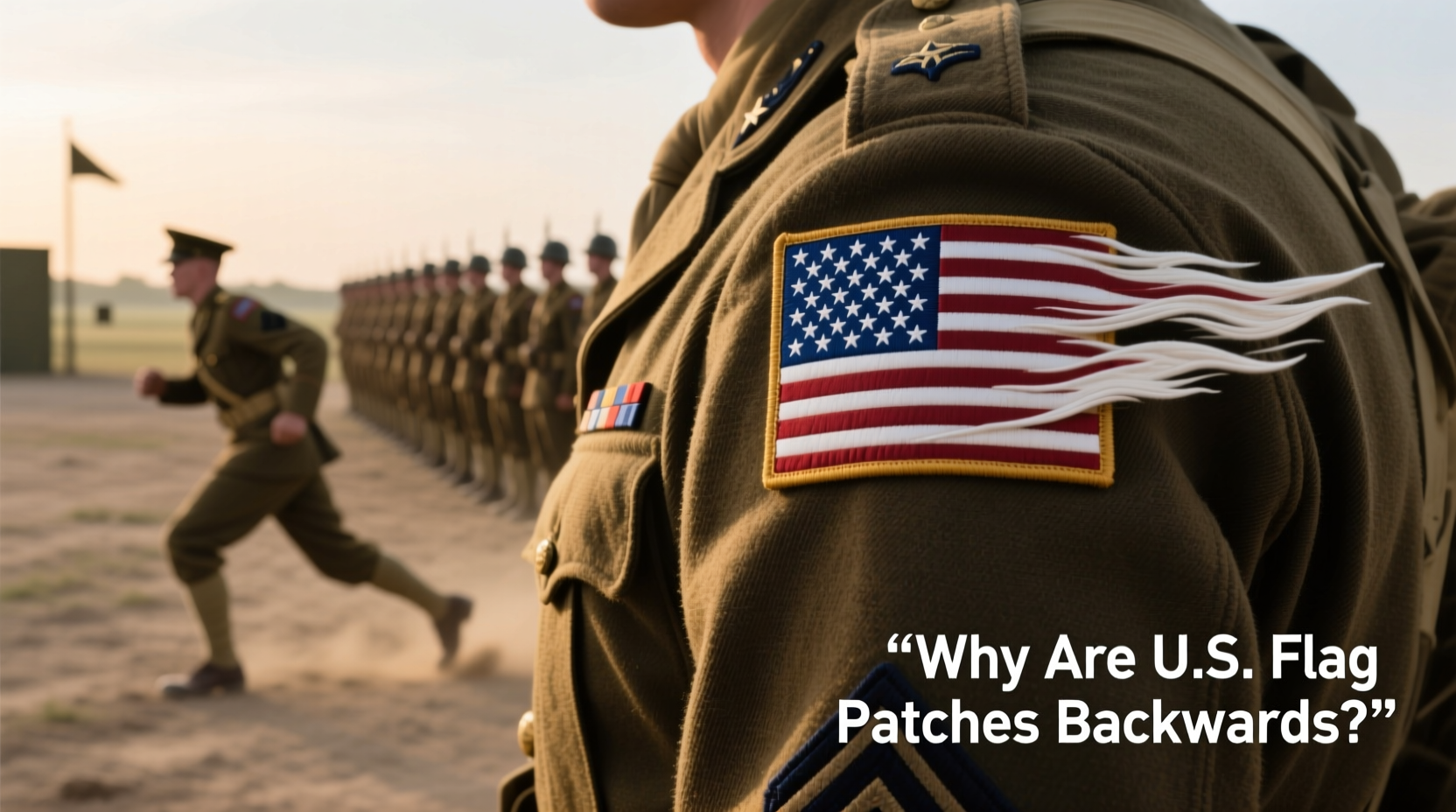
The American flag has always carried symbolic weight in its design and display. According to the U.S. Flag Code, the union—the blue field with white stars—should be positioned at the highest point of honor: the top left corner when the flag is displayed vertically or horizontally on a wall or pole. This placement ensures that the flag appears to be moving forward, as if carried into battle by the bearer.
When the flag is affixed to a uniform sleeve, however, the rules adapt. The key principle is that the flag should appear as though it is flying in the breeze as the wearer moves forward. In real-world terms, this means the union (blue field) must face forward, toward the front of the individual. To achieve this effect on the right arm, the flag must be reversed so that the stars lead the stripes as the person advances.
“Soldiers don’t retreat; they go forward. The flag on their shoulder must reflect that momentum.” — Brigadier General John R. Allen (Ret.), U.S. Marine Corps
Why \"Backwards\" Is Actually Correct
The term “backwards” is a common misnomer. In reality, the flag is not reversed but rather oriented to simulate forward motion. When worn on the right shoulder, a properly mounted flag patch shows the union on the observer’s left—mirroring the natural position on a pole. But because the patch is sewn onto a moving body, the orientation shifts to maintain visual accuracy during movement.
Imagine a soldier charging ahead: the flag on their right arm would stream backward behind them. To ensure the union leads the way—never trailing—the patch is flipped so that the stars are closest to the direction of travel. This gives the impression that the flag is fluttering in the wind as the service member advances.
Proper Display Standards Across Uniformed Services
All branches of the U.S. Armed Forces—including Army, Navy, Air Force, Marine Corps, Coast Guard, and Space Force—follow the same standard for flag patch orientation. Federal law enforcement agencies like the FBI, DEA, and Border Patrol also adopt similar guidelines. The Department of Defense Instruction 1005.8 governs these standards, ensuring consistency across uniforms.
The regulation applies only to wearable flag patches—not printed graphics, decals, or static displays. For example, a flag painted on a vehicle or displayed on a T-shirt does not require reversal. Only when the flag is worn on a garment and meant to represent a flying banner in motion does the reversal rule apply.
| Wear Location | Union Position | Reason |
|---|---|---|
| Left Sleeve | Top Left (Normal) | Flag flows backward from front to back as wearer moves |
| Right Sleeve | Top Right (Reversed) | Simulates flag flying forward, stars leading movement |
| Wall Display | Top Left | Standard honor position per U.S. Flag Code |
| Vehicle Decal | Top Left | No motion simulation required; standard orientation used |
Common Misconceptions About Reversed Flags
One widespread myth is that a reversed flag symbolizes mourning or defeat. This is false. A fully inverted flag (upside down) is recognized under the Flag Code as a distress signal, but a reversed field of stars is not. Another misconception is that the practice began after 9/11 as a tribute to fallen heroes. While flag visibility increased post-9/11, the reversed patch standard predates that event by decades, originating in military uniform regulations from the mid-20th century.
Step-by-Step Guide to Proper Flag Patch Placement
Whether you're tailoring a uniform, designing apparel, or simply curious about correct usage, follow these steps to ensure accurate flag display:
- Determine the wearing position: Identify whether the patch will go on the left or right sleeve.
- Select the correct patch type: Use a standard flag patch for the left arm; use a “reverse” or “combat” flag patch for the right arm.
- Orient the patch correctly: On the left sleeve, the union (blue field) goes toward the center of the body (top-left). On the right sleeve, the union faces outward, toward the front (top-right).
- Sew or attach securely: Ensure the patch is flat, aligned with the shoulder seam, and firmly attached.
- Inspect for accuracy: From the front, both patches should appear as if the flag is streaming backward from a pole held in the wearer’s right hand.
Real-World Example: The Soldier’s Perspective
Consider Sergeant Maria Lopez, deployed in Afghanistan. Her combat uniform bears a U.S. flag patch on both sleeves. On her left arm, the stars sit in the upper-left corner—standard orientation. On her right arm, the patch shows stars on the upper-right. As she jogs from one outpost to another, the flag on her right sleeve appears to fly behind her, with the union leading the way. To someone unfamiliar with military protocol, it may seem incorrect. But in motion, the symbolism is clear: she is advancing, not retreating. The flag honors that forward momentum.
This small detail reflects a broader ethos: precision, pride, and adherence to tradition even in the smallest elements of service.
Checklist for Correct Flag Patch Usage
- ✅ Confirm which arm the patch will be worn on
- ✅ Use a reverse-oriented patch only on the right sleeve
- ✅ Ensure the union (blue field) faces forward on the right arm
- ✅ Avoid using reversed patches on non-uniform items unless simulating motion
- ✅ Never display the flag upside down unless signaling extreme distress
- ✅ Educate others to prevent misunderstanding of the reversed design
Frequently Asked Questions
Is a reversed flag patch disrespectful?
No. When used correctly on the right sleeve of a uniform, a reversed flag patch is not disrespectful. It adheres to official military standards and symbolizes forward movement. Disrespect would involve improper handling, such as allowing the flag to touch the ground or displaying it upside down without cause.
Can civilians wear reversed flag patches?
Civilians may wear flag patches on clothing, especially those honoring military service or patriotism. If worn on the right sleeve of a jacket or shirt, using a reversed patch is acceptable and often encouraged to maintain authenticity. However, it's important to do so respectfully and not trivialize the symbol through inappropriate contexts (e.g., torn jeans or party costumes).
Does the same rule apply to other countries’ flags?
While some nations incorporate similar motion-based flag displays, the U.S. standard is unique in its codified application. Other militaries may use national emblems on uniforms, but few have such a detailed regulation about directional orientation based on movement. Always consult specific national guidelines when representing foreign flags.
Honor in Every Detail
The reversed U.S. flag patch is more than a uniform detail—it’s a silent statement of progress, courage, and unwavering commitment. Far from being an error, it is a carefully considered emblem of how Americans serve and advance. Whether on a battlefield, patrol route, or parade ground, the flag moves with purpose, just as those who wear it do.




 浙公网安备
33010002000092号
浙公网安备
33010002000092号 浙B2-20120091-4
Comments
No comments yet. Why don't you start the discussion?