
On a warm summer day, the hum of flying insects is common—but not all buzzing visitors are created equal. While bees are often seen as gentle pollinators flitting from flower to flower, wasps have earned a reputation for sudden stings, uninvited appearances at picnics, and aggressive behavior around humans. This contrast raises an important question: why are wasps more aggressive than bees? The answer lies in fundamental differences in their biology, social structure, diet, and survival strategies.
Understanding these distinctions not only satisfies curiosity but also helps people coexist more safely with both species. Despite their bad press, wasps play crucial ecological roles, just like bees. However, knowing what drives their behavior can prevent unnecessary conflicts and reduce the risk of painful encounters.
Biology and Defense Mechanisms
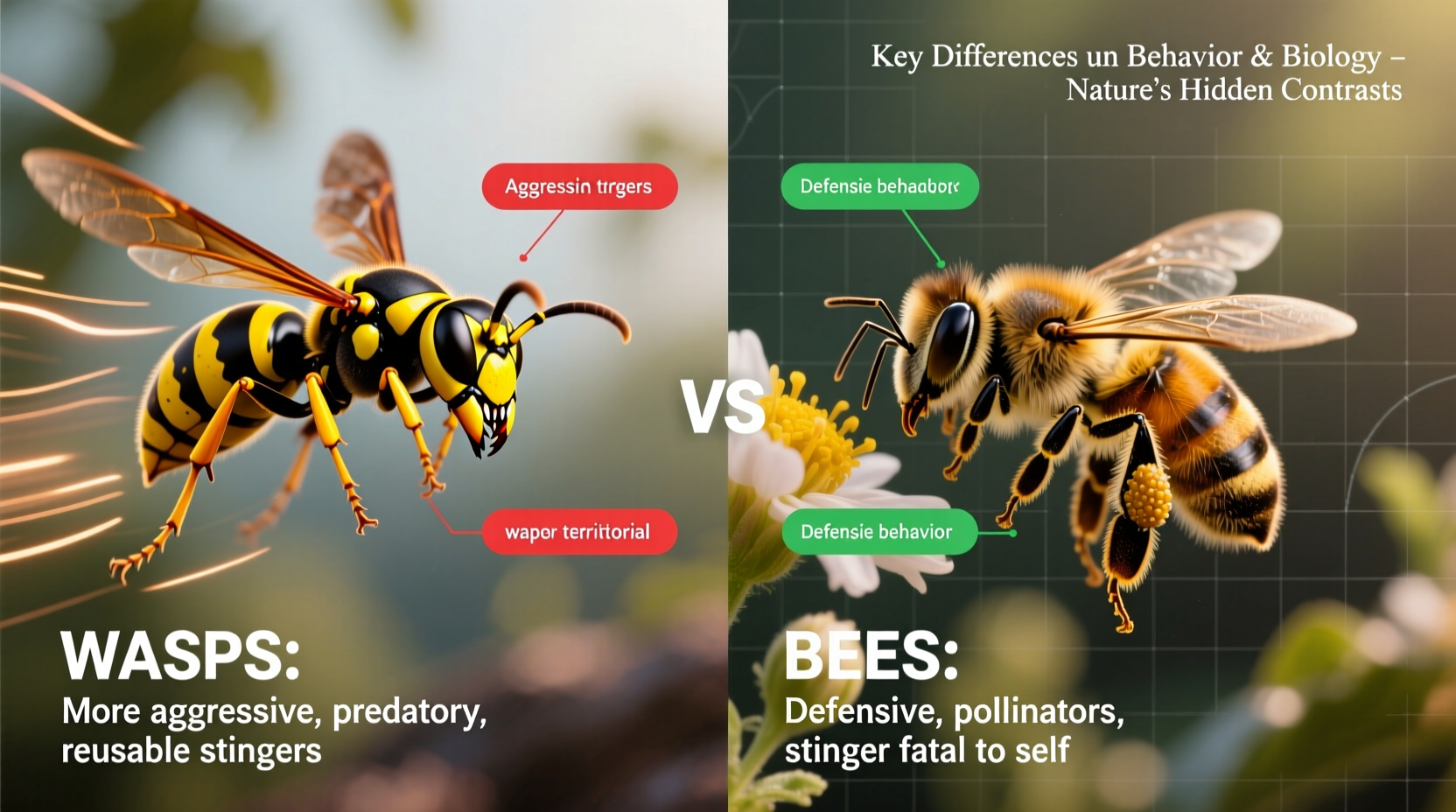
The physical and physiological makeup of wasps and bees explains much of their differing temperaments. Both belong to the order Hymenoptera, but they diverge significantly in anatomy and venom composition.
Wasps possess smooth stingers that allow them to sting repeatedly without dying—a stark contrast to honeybees, which lose their barbed stinger after attacking and die shortly afterward. This biological difference means wasps face no fatal consequence when defending themselves or their nests, making them more willing to attack perceived threats.
Additionally, wasp venom contains higher concentrations of acetylcholine and kinins, compounds that amplify pain signals in humans. This potent cocktail makes their stings feel sharper and more inflammatory than those of bees. As entomologist Dr. Laura Mitchell notes:
“Wasp venom is designed not just to deter predators but to deliver immediate, memorable pain—this is part of their evolutionary strategy for colony protection.” — Dr. Laura Mitchell, Entomology Researcher, University of Vermont
In contrast, bees rely on scent-based communication and coordinated group defense. A honeybee will sting only as a last resort, typically sacrificing its life to protect the hive. Their approach is less about aggression and more about calculated survival.
Social Behavior and Nesting Habits
The way wasps and bees organize their colonies influences how they interact with their environment—and with humans.
Most social wasps, such as yellow jackets and paper wasps, build small, exposed nests under eaves, inside wall cavities, or in the ground. These nests are vulnerable to disturbance, so wasps have evolved high alertness and rapid response behaviors. Any vibration or shadow near the nest can trigger defensive swarming.
Bees, particularly honeybees, construct large, enclosed hives often located in hollow trees or managed apiaries. These structures offer greater insulation and protection, reducing the frequency of external threats. Honeybees use pheromones to coordinate responses and generally avoid confrontation unless the hive itself is breached.
Dietary Differences and Foraging Behavior
One of the most overlooked reasons for wasp aggression is their diet. Adult wasps are primarily carnivorous, feeding on other insects like flies, caterpillars, and spiders. They hunt to feed their larvae, which secrete a sugary substance in return—an intricate mutualism within the colony.
However, in late summer and early fall, larval production declines, and adult wasps begin seeking carbohydrates directly. This shift leads them to scavenge at outdoor meals, garbage bins, and sugary drinks—areas densely populated by humans. Their presence at picnics isn’t hostility; it’s hunger.
Bees, on the other hand, are almost exclusively nectar and pollen feeders. Their foraging is focused on flowers, and they rarely show interest in human food unless it's extremely sweet (like spilled soda). Because they aren't scavengers, bees are less likely to come into close contact with people in ways that provoke defensive reactions.
Key Differences Between Wasps and Bees: A Comparison Table
| Feature | Wasps | Bees |
|---|---|---|
| Stinger Type | Smooth, retractable – can sting multiple times | Barbed – dies after stinging mammals |
| Diet | Carnivorous adults; feed larvae insects | Nectar and pollen; herbivorous |
| Nest Location | Underground, eaves, wall voids – often hidden | Tree cavities, hives, managed boxes |
| Body Appearance | Slender, shiny, narrow waist | Furry, robust, wider abdomen |
| Aggression Level | High when nest is threatened or during food scarcity | Low; defensive only when hive is disturbed |
Real-World Scenario: A Backyard Encounter
Consider a family hosting a barbecue in mid-August. Plates of grilled meat, fruit salad, and soda attract several yellow jackets circling the table. One lands on a child’s arm, provoking a swat. Instantly, two more wasps dive toward the movement. Within seconds, someone gets stung.
This scenario illustrates how seasonal behavior and human activity intersect. The wasps weren’t attacking—they were foraging. But sudden movements near their flight path triggered a defensive reflex. In contrast, if bees had been present, they would likely ignore the food and focus on nearby flowering plants unless someone stepped directly on a hidden hive.
Understanding this context helps prevent overreaction. Remaining calm, slowly moving away, and covering food can reduce conflict without harming beneficial insects.
How to Minimize Risk: A Practical Checklist
- Keep outdoor food covered during meals, especially meats and sugary drinks
- Use closed-top trash cans with tight-fitting lids
- Avoid wearing bright floral patterns or strong perfumes outdoors
- Inspect your property for potential nesting sites (e.g., attic vents, deck crevices)
- Install wasp traps in early spring before populations grow
- Never swat at a wasp—slow, deliberate movements are safer
- Seal cracks and openings in homes to prevent indoor nesting
Frequently Asked Questions
Can all wasps sting?
Only female wasps have stingers, which evolved from egg-laying organs. Male wasps cannot sting, though they may mimic defensive postures. All worker wasps are female and capable of multiple stings.
Are bees ever aggressive?
Yes, certain species like Africanized “killer” bees are highly defensive and may attack in large numbers with minimal provocation. However, most European honeybees are docile unless protecting their hive. Even then, they typically send out guard bees as warnings before escalating.
Do wasps serve any benefit to ecosystems?
Absolutely. Wasps are natural pest controllers, preying on garden-damaging insects like aphids, grubs, and caterpillars. Some species also contribute to pollination, though less efficiently than bees. Eliminating wasps entirely can disrupt local ecological balance.
Conclusion: Coexistence Through Understanding
The perception that wasps are inherently more aggressive than bees holds some truth—but it’s rooted in biology and behavior, not malice. Wasps sting repeatedly because they can. They approach human spaces because they’re searching for food. And they defend fiercely because their nests are fragile and exposed.
Rather than viewing them as pests to be eradicated, recognizing their role in nature allows for smarter, safer interactions. Simple precautions—like managing waste, avoiding sudden movements, and respecting their space—can prevent most conflicts.




 浙公网安备
33010002000092号
浙公网安备
33010002000092号 浙B2-20120091-4
Comments
No comments yet. Why don't you start the discussion?