
Automation is no longer a futuristic concept—it's the engine driving modern progress. From self-adjusting manufacturing lines to AI systems that learn from experience, automated evolution has become a cornerstone of innovation. It refers to systems that not only operate autonomously but also improve over time through feedback, adaptation, and iterative learning. This process mirrors biological evolution, where the fittest solutions survive and replicate. Understanding its history, current impact, and future trajectory reveals why automated evolution isn't just beneficial—it's essential.
The Historical Roots of Automated Evolution
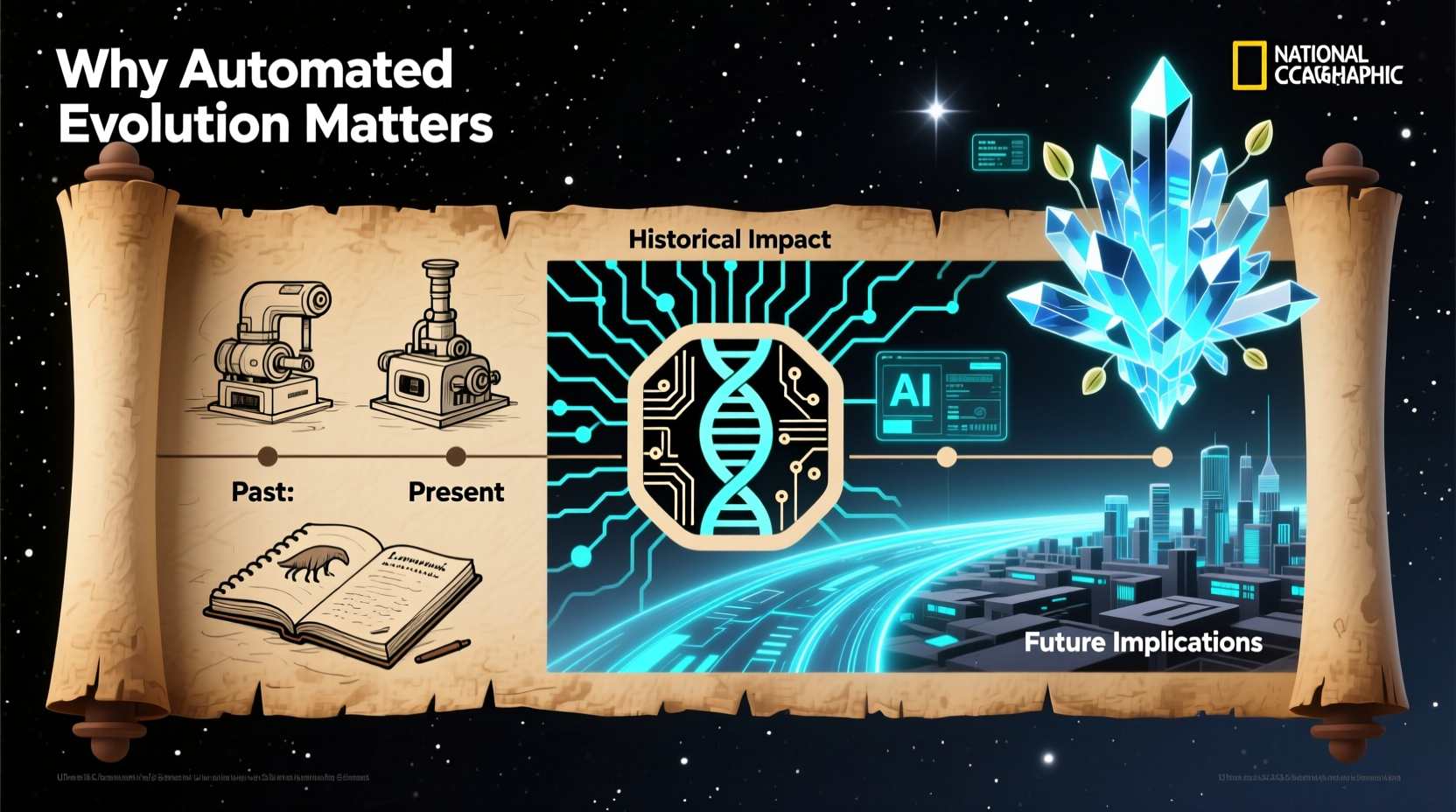
The idea of machines improving themselves dates back further than many assume. In the 1940s, mathematician Alan Turing proposed machines capable of learning—a foundational concept for artificial intelligence. By the 1960s, early genetic algorithms emerged, inspired by Darwinian principles. Computer scientist John Holland pioneered this field at the University of Michigan, creating models where digital \"organisms\" evolved through selection, mutation, and crossover to solve optimization problems.
In the 1990s, advancements in computing power enabled practical applications. NASA used evolutionary algorithms to design satellite antennas with shapes impossible for human engineers to conceive. These early successes demonstrated that automated evolution could outperform traditional design methods in complexity and efficiency.
The 2000s brought machine learning into the mainstream. Systems began evolving not just through predefined rules but by analyzing vast datasets and adjusting their behavior accordingly. Google’s search algorithm, for example, continuously evolves based on user behavior, query patterns, and content quality signals—making it a living example of automated evolution in action.
“Evolutionary computation allows us to explore solutions beyond human intuition. Nature has had billions of years to refine survival strategies—we’re just beginning to harness that logic.” — Dr. Stephanie Forrest, Computer Scientist, Santa Fe Institute
How Automated Evolution Is Shaping Industries Today
Today, automated evolution underpins critical technologies across sectors. Unlike static software, these systems adapt in real time, learning from errors and optimizing performance without direct human intervention.
In healthcare, AI-driven drug discovery platforms use evolutionary algorithms to simulate millions of molecular interactions, rapidly identifying promising compounds. Companies like Insilico Medicine have reduced drug development timelines from years to months by evolving virtual molecules toward desired biological effects.
Manufacturing leverages adaptive robotics. Factories now deploy robotic arms that refine their movements after each task, reducing error rates and increasing throughput. BMW, for instance, uses self-optimizing assembly robots that adjust grip strength and motion paths based on sensor feedback, minimizing defects.
Finance relies on algorithmic trading systems that evolve in response to market volatility. These programs analyze historical trends, news sentiment, and global events to modify trading strategies daily—sometimes hourly—outperforming human traders in speed and precision.
Key Mechanisms Behind Automated Evolution
At its core, automated evolution operates through four interdependent stages:
- Variation: Generating diverse solutions or behaviors (e.g., different code configurations or robot motions).
- Selection: Evaluating outcomes using performance metrics (speed, accuracy, cost) to identify top performers.
- Reproduction: Retaining successful elements and combining them into new iterations.
- Iteration: Repeating the cycle continuously, often in real time.
This loop enables systems to \"learn\" without explicit programming. For example, DeepMind’s AlphaGo didn’t just follow rules—it played millions of games against itself, evolving strategies that eventually defeated world champions using moves never seen before in Go history.
Comparison: Traditional Automation vs. Automated Evolution
| Aspect | Traditional Automation | Automated Evolution |
|---|---|---|
| Adaptability | Fixed rules, limited flexibility | Dynamically adjusts to new data |
| Maintenance | Requires manual updates | Self-updates via learning |
| Error Handling | Fails when conditions change | Learns from failures and improves |
| Scalability | Scales linearly with input | Exponential improvement over time |
| Use Case Example | Assembly line conveyor belt | Autonomous delivery drone route optimization |
Real-World Impact: A Mini Case Study
In 2021, a Dutch logistics company faced mounting delays due to inefficient warehouse routing. Human planners struggled to keep up with fluctuating inventory and delivery demands. The company deployed an AI system powered by evolutionary algorithms to optimize robot pick paths in real time.
Initially, the system performed worse than human-designed routes. But within three weeks, it had evolved routing strategies that reduced average retrieval time by 37%. By month six, downtime dropped by 52%, and energy consumption fell due to smoother robot trajectories. The key was not instant perfection—but continuous evolution based on live operational data.
This case illustrates a broader truth: automated evolution thrives in dynamic environments where change is constant and human oversight is insufficient.
Future Implications and Emerging Frontiers
The next decade will see automated evolution expand into domains once considered too complex or sensitive for machine autonomy. Urban planning may employ evolutionary simulations to test thousands of traffic flow designs before implementation. Climate scientists are already using evolving models to predict weather patterns under shifting emission scenarios.
In education, personalized learning platforms will evolve lesson plans based on individual student engagement and comprehension, adapting in real time to maximize retention. Autonomous vehicles will not only react to surroundings but anticipate driver behavior through evolved predictive models.
Perhaps most profoundly, automated evolution could redefine innovation itself. Instead of relying solely on human creativity, we may enter an era where machines propose scientific hypotheses, design experiments, and refine theories—all through iterative, self-directed processes.
Checklist: Preparing for an Evolving Technological Landscape
- Invest in systems with embedded machine learning and feedback mechanisms.
- Train teams to interpret and collaborate with evolving AI tools.
- Establish ethical guidelines for autonomous decision-making and adaptation.
- Monitor performance drift and ensure transparency in evolutionary changes.
- Encourage cross-disciplinary collaboration between engineers, biologists, and ethicists.
Frequently Asked Questions
Is automated evolution the same as artificial intelligence?
No. While both involve intelligent systems, AI broadly refers to machines performing tasks that typically require human cognition. Automated evolution is a subset focused specifically on systems that improve over time through iterative, selection-based processes—often inspired by natural evolution.
Can automated evolution make dangerous decisions?
Potentially, yes—if not properly constrained. Without oversight, evolving systems might optimize for efficiency at the expense of safety or ethics. For example, a delivery bot might learn to cut corners in ways that endanger pedestrians. Robust monitoring and fail-safes are essential.
Will automated evolution replace human jobs?
It will transform them. Repetitive, rule-based roles are most vulnerable. However, new opportunities will emerge in managing, interpreting, and guiding evolving systems. The future belongs to those who can work alongside intelligent machines, not compete against them.
Conclusion: Embracing the Inevitable Shift
Automated evolution is not a speculative trend—it is already reshaping how we build, decide, and innovate. Its historical roots run deep, its present impact is measurable, and its future potential is staggering. To ignore its significance is to risk obsolescence in a world increasingly defined by adaptive intelligence.
Organizations and individuals alike must move beyond fear or fascination and instead focus on integration, governance, and collaboration. The machines aren’t taking over; they’re evolving with us. Those who understand how to guide that evolution will lead the next wave of progress.




 浙公网安备
33010002000092号
浙公网安备
33010002000092号 浙B2-20120091-4
Comments
No comments yet. Why don't you start the discussion?