
It’s a common sight: birds perched casually on high-voltage power lines, completely unharmed despite the immense electrical currents flowing just beneath their feet. At first glance, it seems almost miraculous. After all, humans are repeatedly warned about the dangers of electricity, yet these small creatures sit on live wires with no apparent consequence. The answer lies not in magic, but in the fundamental principles of electricity—specifically, how current flows and what conditions are necessary for electrocution to occur.
Understanding this phenomenon requires a basic grasp of electrical circuits, voltage potential, and conductivity. It also reveals important insights into how electricity behaves in the real world and why safety measures for humans differ so drastically from the natural advantages birds possess.
How Electricity Travels: The Basics of Circuit Flow
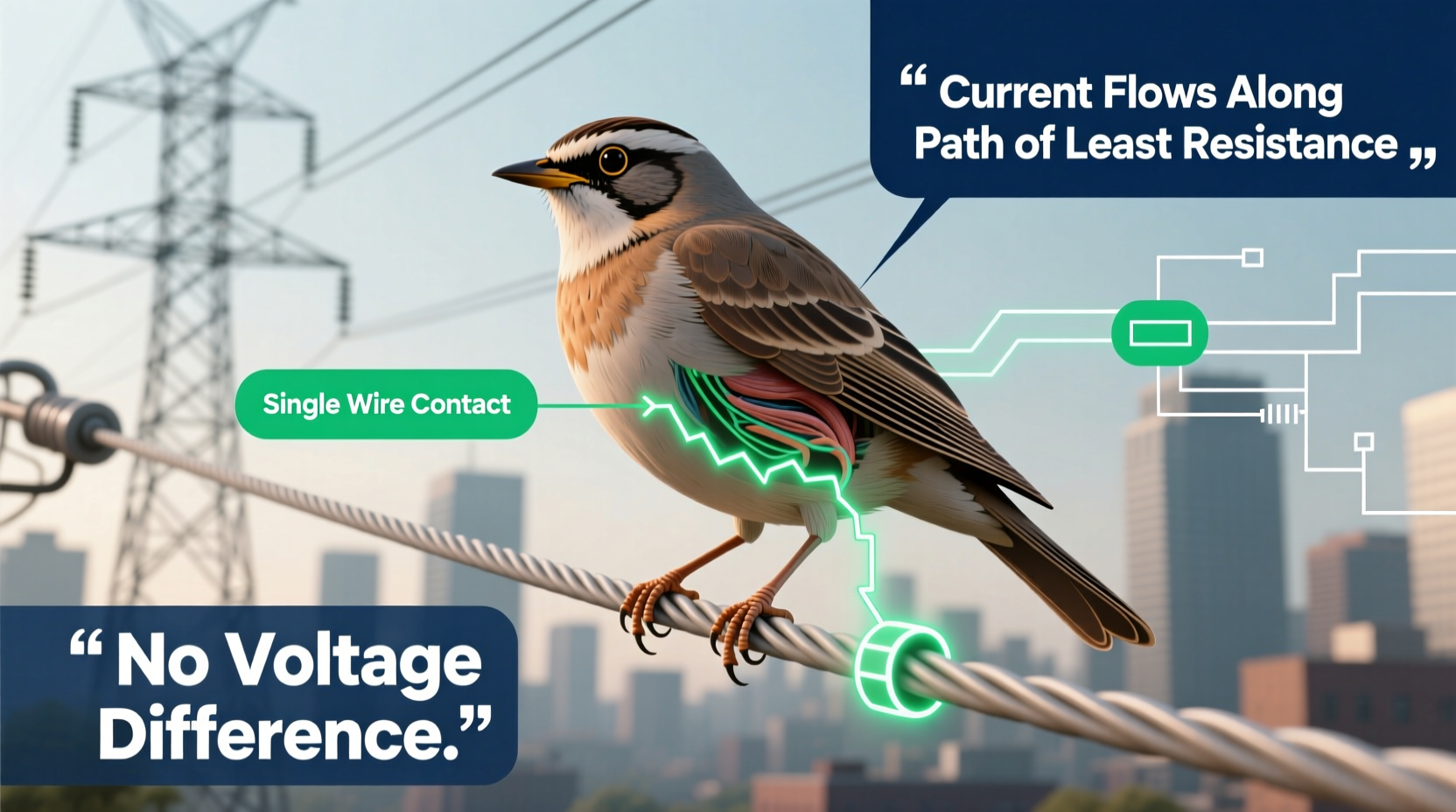
Electricity always seeks the path of least resistance back to the ground or to another point of lower voltage. For current to flow—and for electrocution to happen—there must be a complete circuit. This means electrons need a continuous conductive pathway from a source of high voltage to a point of lower voltage, typically the ground.
When a bird lands on a single power line, its body becomes part of the electrical system—but only minimally. Because both of the bird’s feet are on the same wire, they are at nearly the same electrical potential. There is no significant voltage difference across the bird’s body, so very little current flows through it. Without a voltage differential, there is no driving force for electricity to travel through the bird.
This principle is similar to how linemen can work on live power lines using helicopters or insulated platforms. As long as they don’t create a path to a lower voltage (like the ground or another wire), they remain safe—even while touching energized lines.
The Role of Insulation and Conductivity
Power lines are typically made of aluminum or copper, excellent conductors of electricity. The wires are bare—no insulation—because air acts as a natural insulator at standard voltages used in distribution systems. Birds, too, are relatively poor conductors compared to metal. Their bodies offer much higher resistance than the wire itself, so electricity prefers to stay in the path of least resistance: the wire.
Even if some tiny amount of current passes through the bird, it’s negligible—like a small detour on a highway. The vast majority of the current continues along the wire uninterrupted. This is known as parallel conduction, where current divides based on resistance. Since the wire has far less resistance than the bird, virtually all the electricity bypasses the animal.
However, this safety only holds when the bird remains isolated to one wire. If it touches another wire with a different voltage—or simultaneously contacts a grounded structure like a pole or transformer—it completes a circuit. In that case, electricity will surge through its body, resulting in electrocution.
Real Example: When Safety Fails
In urban areas, larger birds such as eagles, hawks, or owls are occasionally electrocuted on utility poles. These incidents usually occur when a bird spreads its wings and bridges two wires, or contacts a live wire while one foot is on a grounded crossarm. Wildlife conservation groups report that thousands of raptors die annually in the U.S. due to such accidents, especially in regions with outdated infrastructure.
One documented case involved a red-tailed hawk in Colorado that landed on a distribution pole. As it took off, its wingtip brushed a second phase wire while its talon remained on the first. The resulting short circuit caused immediate fatality and triggered a local power outage. This tragic event underscores how critical isolation is—even for creatures naturally immune under normal circumstances.
“Birds aren’t insulated from electricity—they’re protected by physics. It’s not what they’re made of, but how they interact with the circuit.” — Dr. Alan Pierce, Electrical Safety Researcher, National Institute of Standards and Technology
Why Humans Can’t Replicate This Safety
While birds can safely land on a single wire, humans cannot without special equipment. The reason isn’t biological superiority, but behavioral and structural differences. People are usually grounded—standing on the earth, a ladder, or a pole—all of which provide a direct path to lower voltage. If a person touches a live wire while grounded, current flows through their body to the ground, causing severe injury or death.
Utility workers avoid this risk by using insulated buckets, gloves, and hot sticks, or by working from helicopters that do not contact the ground. They follow strict protocols to ensure they never create a path between high voltage and ground. In essence, trained professionals mimic the bird’s condition—maintaining equal potential and avoiding contact with alternate voltage points.
Checklist: Conditions That Prevent Electrocution on Power Lines
- ✅ Contact with only one wire (same voltage potential)
- ✅ No contact with the ground or grounded structures
- ✅ No simultaneous contact with another wire or conductor
- ✅ High resistance of the body compared to the wire
- ✅ Dry conditions (wet feathers or skin increase conductivity)
Do’s and Don’ts: Understanding Risk Around Power Lines
| Do’s | Don’ts |
|---|---|
| Stay clear of downed power lines | Never touch a fallen wire, even if it looks dead |
| Assume all overhead lines are live | Don’t fly kites or drones near power lines |
| Use non-conductive tools near electrical sources | Don’t lean ladders against poles with wires |
| Respect utility warning signs | Don’t attempt DIY repairs on service drops |
| Report damaged infrastructure to authorities | Don’t approach transformers or substations |
Frequently Asked Questions
Can a bird get shocked if the wire is wet?
Rain alone doesn’t change the physics significantly. As long as the bird is only touching one wire and isn’t bridging a gap to another conductor, it remains safe. However, if water creates a conductive path between the wire and a grounded pole—or if multiple wires are close together—the risk increases. Wet conditions lower resistance, making accidental shorts more likely.
What happens if a bird touches two wires at once?
If a bird connects two wires with different voltages (called phases), it completes a circuit. Electricity will flow through its body from the higher-voltage wire to the lower one, causing electrocution. This is why larger birds with wide wingspans are more vulnerable, particularly on older utility poles where wires are spaced closely.
Are power lines insulated to protect birds?
No, most overhead power lines are bare metal. They rely on air as insulation and physical spacing between conductors. Some utilities install protective covers on specific sections where bird collisions or electrocutions are common, especially in ecologically sensitive areas. These are called avian guards or flight diverters, designed to prevent contact rather than provide insulation.
Conclusion: Nature Meets Physics
The reason birds don’t get electrocuted on power lines is a perfect example of physics in action. It’s not immunity, luck, or insulation—it’s the absence of a voltage difference across their bodies. As long as they remain on a single conductor and avoid grounding or bridging connections, they face no danger from the current flowing beneath them.
This understanding isn’t just fascinating—it’s practical. It informs electrical safety standards, wildlife protection efforts, and the design of modern power infrastructure. By respecting the same laws of physics that keep birds safe, humans can also work around electricity without harm—provided we take the right precautions.




 浙公网安备
33010002000092号
浙公网安备
33010002000092号 浙B2-20120091-4
Comments
No comments yet. Why don't you start the discussion?