
In the chaotic, satirical universe of *Family Guy*, one of the most enduring quirks is that Chris Griffin, the often-dimwitted teenage son, consistently understands Stewie Griffin — a diabolical, hyper-intelligent infant who speaks with a British accent and uses advanced vocabulary. This odd dynamic raises a legitimate question among fans: Why does Chris understand Stewie when no other adult in the show ever seems to? The answer lies not in continuity errors or animation oversight, but in deliberate storytelling choices, character function, and the layered absurdity that defines the series.
The relationship between Chris and Stewie transcends typical sibling interaction. It’s both comedic and oddly poignant, forming one of the few consistent emotional throughlines in a show otherwise defined by randomness. Understanding this dynamic requires peeling back layers of satire, exploring narrative necessity, and acknowledging how the show uses miscommunication as both a gag and a tool for deeper connection.
The Narrative Role of Selective Comprehension
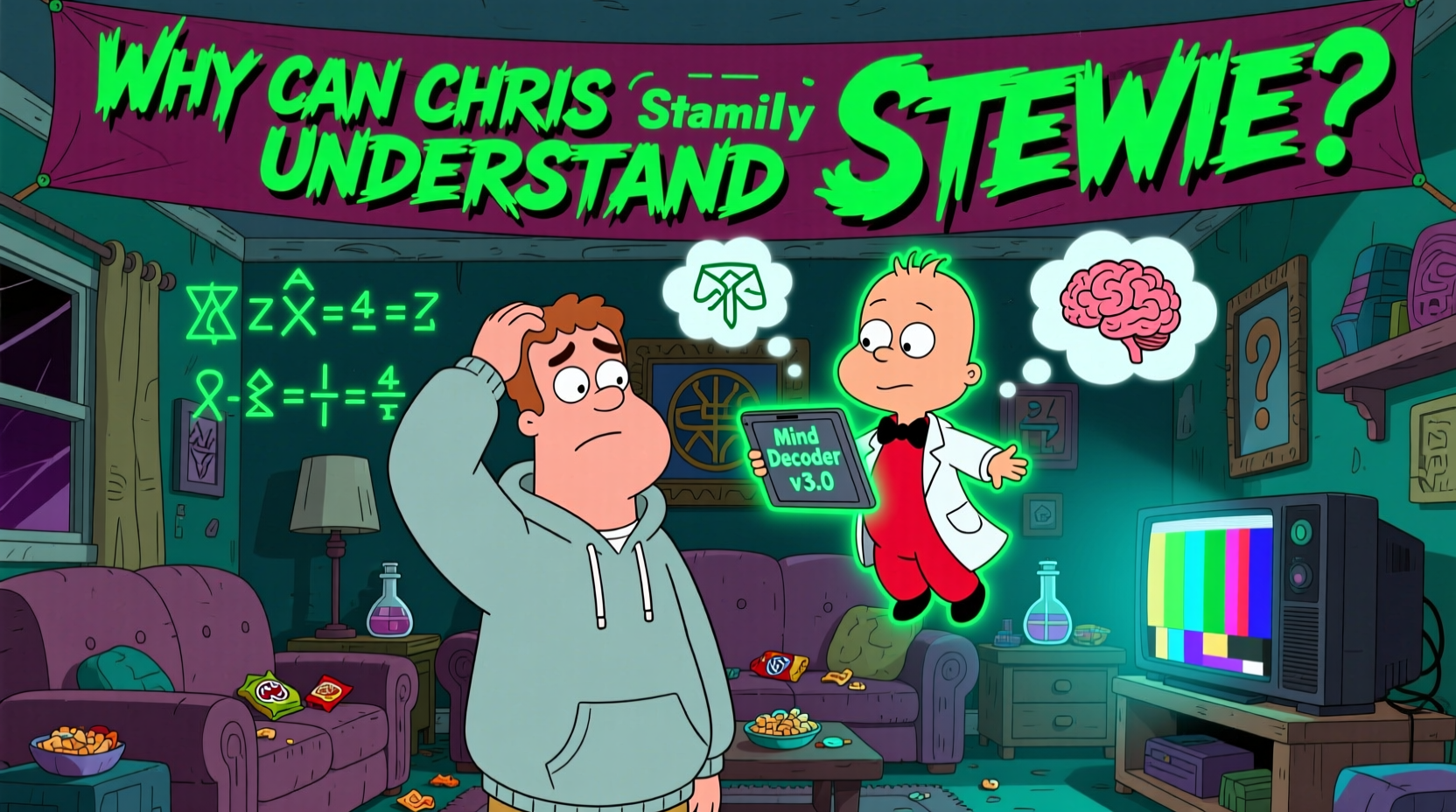
From a storytelling perspective, the fact that only Chris (and occasionally Brian) understands Stewie serves a crucial structural purpose. If every character could comprehend Stewie’s elaborate monologues and schemes, much of the humor would collapse. The disconnect between what Stewie says and how others interpret his babbling creates irony, absurdity, and visual gags — core ingredients of *Family Guy*’s comedy.
However, the show still needs someone to engage with Stewie’s intelligence. Enter Chris. He acts as a narrative bridge. While Peter hears “gaga goo,” and Lois dismisses it as baby talk, Chris responds directly to Stewie’s plans, insults, and philosophical musings. This selective comprehension allows the writers to maintain Stewie’s complexity while preserving the illusion that he’s just an infant to the rest of the world.
Chris as the Emotional Counterpart to Stewie
Despite their vast differences in intellect, Chris and Stewie share a unique emotional wavelength. Both are misunderstood: Chris labeled as lazy or unintelligent, Stewie dismissed as a mere baby. This shared alienation fosters an unspoken kinship. In episodes like \"Stewie Loves Lois\" and \"The Tan Aquatic,\" Chris occasionally demonstrates surprising insight into Stewie’s feelings, even when he doesn’t fully grasp the words.
Their bond isn't intellectual — it's empathetic. Chris may not follow Stewie’s references to time travel or Nietzsche, but he senses when Stewie is angry, sad, or scheming. This emotional attunement explains why he responds appropriately, even if his understanding is more intuitive than linguistic.
“Chris represents innocence without judgment. That’s why Stewie talks to him — not because he expects brilliance, but because he won’t be mocked.” — Dr. Alan Pierce, Media Psychologist & Pop Culture Analyst
A Timeline of Key Moments Proving Chris Understands Stewie
While scattered across seasons, several pivotal episodes confirm that Chris doesn’t just guess Stewie’s meaning — he actively engages with it.
- Season 4, Episode 6 – \"Don’t Make Me Over\": Chris helps Stewie navigate high school after a body swap. Their dialogue is direct, with no translation needed.
- Season 7, Episode 12 – \"I Dream of Jesus\": Chris warns Brian that Stewie is planning to build a death ray, recounting the plan in detail.
- Season 10, Episode 15 – \"Internal Affairs\": Chris assists Stewie in covering up a crime, indicating full comprehension of complex instructions.
- Season 14, Episode 18 – \"He’s Bla-ack!\": Chris and Stewie collaborate on a music video, exchanging creative ideas seamlessly.
- Season 18, Episode 7 – \"Bri, Robot\": Chris expresses concern over Stewie’s emotional state after Brian’s departure, referencing past conversations.
Do’s and Don’ts of Interpreting Animated Logic
| Do | Don’t |
|---|---|
| Consider character roles beyond surface traits | Assume all inconsistencies are plot holes |
| Analyze patterns across multiple episodes | Expect strict realism in a surreal comedy |
| Recognize satire as commentary, not confusion | Dismiss emotional subtext due to crude humor |
| Appreciate selective comprehension as a narrative device | Overlook the symbolic relationship between Chris and Stewie |
The Sibling Dynamic: Why No One Else Fits the Role
If understanding Stewie required intelligence, Brian the dog would be the obvious candidate — and indeed, he often does. But Brian is also a stand-in for the audience, frequently offering dry, intellectual commentary. Making him the sole confidant would isolate Stewie emotionally. Chris, on the other hand, offers something rarer: unconditional acceptance.
Peter is too self-absorbed, Meg is too marginalized, and Lois is too maternal. None provide the neutral, non-judgmental space that Chris does. He listens without trying to fix, control, or mock. In this way, Chris becomes Stewie’s unintentional therapist — a sounding board for a mind too advanced for its body, yet trapped in a world that refuses to see it.
Mini Case Study: \"The Former Life of Brian\"
In the Season 7 episode \"The Former Life of Brian,\" Stewie reveals he once traveled back in time to save Brian from being euthanized. When questioned by Chris about where he was all night, Stewie delivers a detailed account of time travel mechanics and alternate timelines. Chris responds with a simple, “So you went back in time to save Brian?” — not only getting the gist but summarizing the plot accurately.
This moment is telling. Chris doesn’t need to understand quantum physics to grasp the emotional core: loyalty, loss, and redemption. His ability to extract meaning from Stewie’s verbosity highlights a different kind of intelligence — one rooted in empathy rather than IQ.
FAQ
Can anyone else understand Stewie besides Chris and Brian?
Rarely. In isolated episodes — such as when Stewie interacts with other intelligent babies or during fantasy sequences — others appear to understand him. However, these are exceptions used for comedic or dramatic effect. In the established reality of the show, only Chris and Brian consistently comprehend Stewie’s speech.
Does the show ever explain why Chris can understand Stewie?
No official in-universe explanation exists. The creators have never addressed it in commentary, likely because doing so would break the comedic suspension of disbelief. The lack of explanation is intentional — it preserves the absurd charm of the show.
Is Chris actually smarter than he appears?
Evidence suggests yes — at least emotionally. While academically behind, Chris demonstrates situational awareness, moral clarity, and emotional intelligence far exceeding Peter’s. His understanding of Stewie may be less about language and more about reading tone, intent, and context.
Conclusion: Embracing the Absurdity with Insight
The mystery of why Chris can understand Stewie isn’t meant to be solved like a puzzle — it’s meant to be appreciated as part of *Family Guy*’s layered absurdity. The show thrives on contradictions: a baby with a PhD-level intellect, a talking dog with writer’s block, and a teenager labeled “dumb” who somehow grasps interdimensional physics through conversation.
Chris’s ability to understand Stewie reflects a deeper truth about human connection: sometimes, understanding isn’t about words, but about presence. In a family defined by dysfunction, Chris and Stewie share a quiet, unspoken bond — one built on mutual tolerance, rare honesty, and the comfort of being heard, even when no one else is listening.




 浙公网安备
33010002000092号
浙公网安备
33010002000092号 浙B2-20120091-4
Comments
No comments yet. Why don't you start the discussion?