
The Nasdaq Composite Index is one of the most widely followed stock market benchmarks in the world, especially among investors interested in technology and growth-oriented companies. It includes over 3,000 stocks listed on the Nasdaq exchange, with heavy representation from tech giants like Apple, Microsoft, Amazon, and NVIDIA. Many investors ask: why can’t I just buy the Nasdaq Composite Index directly? The short answer is that an index is not a tradable asset—it’s a measurement tool, like a ruler or a thermometer for the market. You can’t purchase a ruler, but you can use it to measure what you own. Similarly, you can’t buy the index itself, but you can gain exposure to its performance through other financial instruments.
What Is the Nasdaq Composite Index?
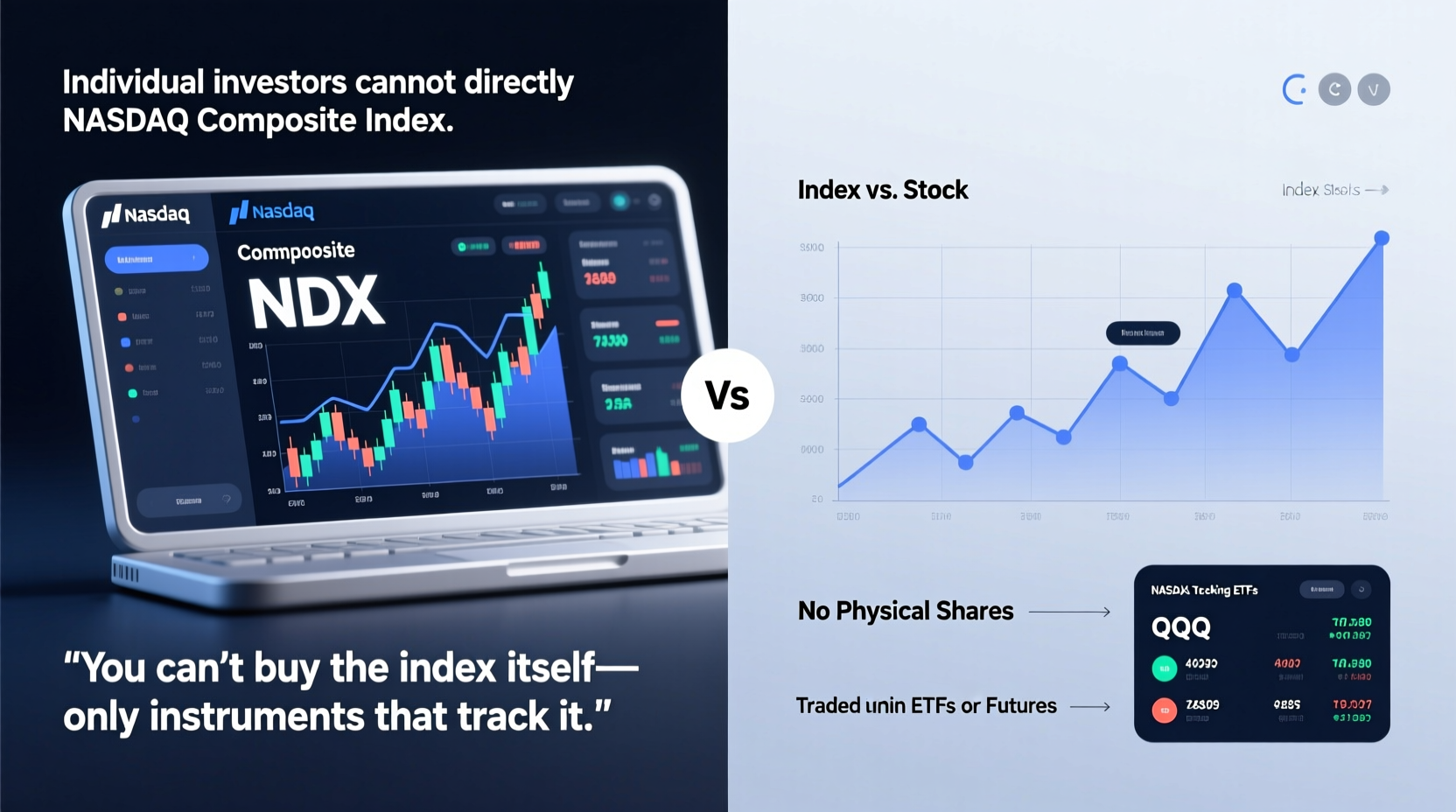
The Nasdaq Composite Index tracks the performance of all common stocks listed on the Nasdaq Stock Market. Launched in 1971, it began at a base value of 100 and has since grown dramatically, particularly during periods of technological innovation. Unlike the Dow Jones Industrial Average, which includes only 30 large-cap U.S. companies, the Nasdaq Composite is broad and diversified across sectors—though technology dominates, making up roughly half of its total weight.
Because it's market-capitalization-weighted, larger companies have a disproportionate impact on the index’s movement. For example, if Apple’s stock rises 5% in a day, it will influence the index far more than a smaller company with a similar percentage gain.
“Indexes are statistical composites designed to reflect market trends, not investment products. They serve as benchmarks, not portfolios.” — John Bogle, Founder of Vanguard Group
Why Can’t You Buy an Index Directly?
An index is not an asset; it’s a calculated number derived from the prices of its underlying securities. Think of it like a sports team’s overall ranking. You can’t buy the ranking—you can only support the team by buying merchandise or tickets. In investing, the “merchandise” equivalent would be an exchange-traded fund (ETF) or mutual fund that mirrors the index.
To replicate the Nasdaq Composite Index manually, you’d need to purchase all 3,000+ component stocks in their exact market-cap proportions—a logistical and financial impossibility for most individual investors. Even institutional investors avoid this due to high transaction costs, ongoing rebalancing needs, and dividend reinvestment complexity.
How to Gain Exposure to the Nasdaq Composite
While you can’t buy the index itself, several investment vehicles offer nearly identical exposure:
- Index Funds: Mutual funds designed to replicate the index’s performance. These are typically offered by major asset managers like Fidelity or Vanguard.
- Exchange-Traded Funds (ETFs): Trade like stocks but hold a basket of securities matching the index. Popular options include the Invesco QQQ Trust (which tracks the Nasdaq-100, a close cousin).
- Robo-Advisors: Platforms like Betterment or Wealthfront automatically allocate your money into diversified portfolios that may include Nasdaq-heavy funds.
- Index-Based Mutual Funds: Some funds explicitly aim to mirror the Nasdaq Composite, though they are less common than Nasdaq-100 alternatives.
Popular Funds That Track Nasdaq Benchmarks
| Fund Name | Ticker | Benchmark Tracked | Expense Ratio | Minimum Investment |
|---|---|---|---|---|
| Invesco QQQ Trust | QQQ | Nasdaq-100 | 0.20% | $0 (one share) |
| Fidelity Nasdaq Composite Index Fund | FNDFX | Nasdaq Composite | 0.25% | $0 (via Fidelity) |
| Schwab Index Fund – Nasdaq 100 Index | SNPNX | Nasdaq-100 | 0.18% | $0 |
| Vanguard Growth Index Fund | VGSLX | CRSP US Large Cap Growth | 0.05% | $3,000 |
Note: While QQQ is often mistaken for tracking the Nasdaq Composite, it actually follows the Nasdaq-100, which excludes financial and biotech firms and contains only the 100 largest non-financial companies. Still, due to overlapping tech giants, its performance closely correlates with the broader index.
Step-by-Step Guide to Investing in the Nasdaq Composite
If your goal is to invest in the Nasdaq Composite or a very close proxy, follow this practical sequence:
- Open a brokerage account with a provider like Fidelity, Charles Schwab, or E*TRADE.
- Research funds that track either the Nasdaq Composite or Nasdaq-100.
- Compare expense ratios, minimum investments, and historical tracking accuracy.
- Purchase shares of the chosen ETF or mutual fund through your brokerage platform.
- Set up automatic contributions to build long-term exposure without timing the market.
- Monitor periodically to ensure the fund continues to align with your goals.
Mini Case Study: Sarah’s Smart Entry into Tech Investing
Sarah, a 32-year-old software engineer, wanted exposure to tech growth but didn’t know where to start. She initially searched for “how to buy the Nasdaq Composite” and was confused when she couldn’t find a direct option. After researching, she discovered the Invesco QQQ Trust (QQQ), which tracks the Nasdaq-100. Though not identical to the Composite, she learned that QQQ holds many of the same dominant tech stocks and has a proven track record.
She opened a Roth IRA with Fidelity, invested $300 monthly into QQQ, and set up automatic reinvestment of dividends. Over five years, her portfolio grew significantly, driven largely by strong performance in cloud computing and AI-related holdings within the index. By focusing on a simple, rules-based approach, Sarah avoided stock-picking stress and benefited from broad market gains.
Common Misconceptions About Index Investing
Many investors assume that because they can’t buy an index directly, they’re missing out on pure exposure. This isn’t true. Index funds and ETFs are engineered to deliver returns that match—or come extremely close to—the index after fees. Here are some myths debunked:
- Myth: Buying individual stocks gives better returns than index funds.
Reality: Over 80% of active fund managers underperform their benchmarks over 10 years (S&P Global). - Myth: ETFs don’t fully replicate the index.
Reality: Most large ETFs use full replication or sophisticated sampling to minimize tracking error. - Myth: You need large capital to invest in indexes.
Reality: ETFs like QQQ trade per share, allowing entry with as little as $50.
FAQ
Can I buy the Nasdaq Composite Index through a mutual fund?
Yes. Some mutual funds, like the Fidelity Nasdaq Composite Index Fund (FNDFX), are specifically designed to mirror the index. However, they are less common than Nasdaq-100 funds like QQQ.
Is QQQ the same as the Nasdaq Composite?
No. QQQ tracks the Nasdaq-100, which includes only the 100 largest non-financial companies listed on Nasdaq. The Nasdaq Composite includes over 3,000 stocks across all sectors, including smaller companies and financials.
Why doesn’t an ETF exist for the full Nasdaq Composite?
Creating an ETF for such a broad index is complex and costly due to the sheer number of holdings, many of which are illiquid small-caps. It’s more efficient to track a focused subset like the Nasdaq-100.
Conclusion: Invest Smarter, Not Harder
You can’t buy the Nasdaq Composite Index directly—and you don’t need to. The financial system offers accessible, low-cost, and highly effective alternatives that deliver the exposure you’re seeking. Whether through ETFs like QQQ or dedicated index funds, you can participate in the growth of one of the world’s most dynamic markets with minimal effort and maximum efficiency.
Understanding the difference between an index and an investable product is a crucial step toward becoming a more informed investor. Focus on simplicity, diversification, and consistency. Let the market work for you, not against you.




 浙公网安备
33010002000092号
浙公网安备
33010002000092号 浙B2-20120091-4
Comments
No comments yet. Why don't you start the discussion?