
Tickling is one of the most curious human experiences—simultaneously playful, awkward, and revealing of deep neurological processes. Most people have tried to tickle themselves at some point, only to find it impossible. No matter how hard you try, the sensation never matches the surprise and intensity of being tickled by someone else. The reason lies not in your sense of touch, but in how your brain anticipates and filters sensory input. Understanding this phenomenon offers a window into how the brain distinguishes between self-generated actions and external stimuli—a critical function for perception, movement, and even sanity.
The Two Types of Tickling
Not all tickles are created equal. Scientists categorize ticklishness into two distinct types:
- Knutzie (or knismesis): A light, feather-like sensation that can be mildly irritating or pleasant but doesn’t provoke laughter. This type can sometimes be self-induced, such as when brushing dust off your arm.
- Gargalesis: The intense, laughter-inducing tickling that occurs with repeated pressure on sensitive areas like the ribs, feet, or underarms. This is the kind that requires another person and cannot be self-produced.
It’s gargalesis that puzzles researchers and laypeople alike. Why does the same physical motion produce wildly different reactions depending on who performs it?
How the Brain Predicts Sensations
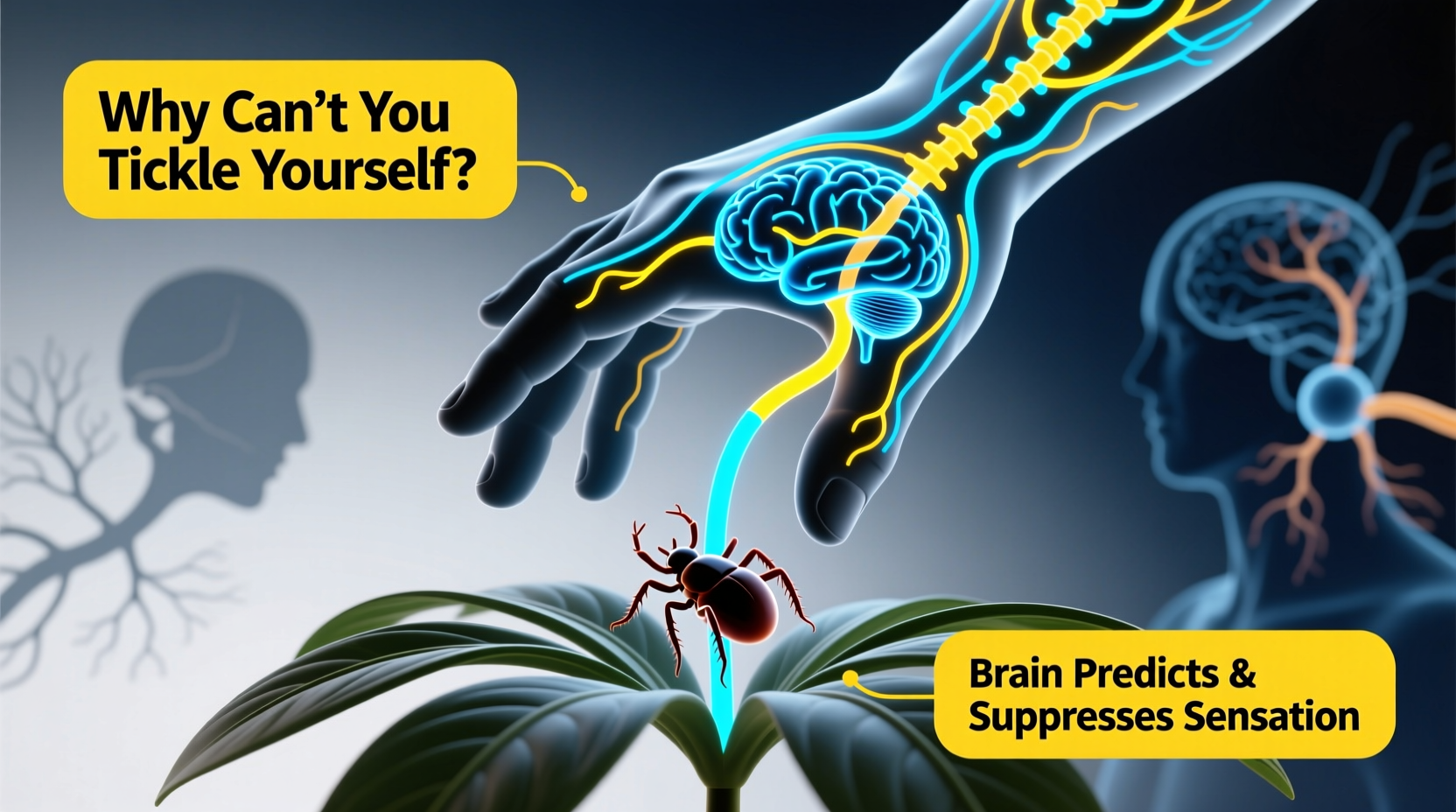
The answer begins in the cerebellum and the somatosensory cortex—two regions responsible for coordinating movement and processing touch. When you decide to move your hand toward your side to \"tickler,\" your brain sends a motor command. Simultaneously, it generates an internal prediction of what that movement will feel like.
This predictive mechanism is called an efference copy. It's essentially a duplicate of the outgoing motor signal that allows the brain to anticipate the sensory consequences of self-made actions. Because the sensation matches the prediction, the brain downregulates—or suppresses—the response. The result? No real tickle.
In contrast, when someone else tickles you, their movements are unpredictable. There's no efference copy to prepare the brain, so the sensory input registers as novel and surprising. That unpredictability amplifies the sensation, triggering laughter, withdrawal, and sometimes panic.
“Your brain is constantly filtering out expected sensations so you can focus on the unexpected ones—those could be threats.” — Dr. Sarah Blakemore, Cognitive Neuroscientist, University College London
Neurological Evidence from Experiments
Studies using functional MRI scans have confirmed this theory. In one landmark experiment, participants were asked to tickle themselves while lying in a brain scanner. In another condition, a machine delivered identical touches, but with a slight delay, making the stimulus unpredictable.
The results showed significantly less activity in the somatosensory cortex during self-tickling. However, when the robotic device introduced a time lag—even as little as 200 milliseconds—the brain treated the sensation as foreign, and participants reported feeling ticklish.
This demonstrates that timing and predictability are key. The brain doesn’t reject self-touch entirely—it simply dampens sensations it has foreseen.
| Condition | Brain Activity (Somatosensory Cortex) | Reported Ticklishness |
|---|---|---|
| Self-tickling (no delay) | Low | Minimal or none |
| Machine tickling (no delay) | Moderate | Mild |
| Machine tickling (200ms delay) | High | Strong |
| Other person tickling | Very High | Very Strong |
Implications for Mental Health
The ability to distinguish self from other isn’t just about avoiding awkward solo tickling attempts. It’s fundamental to our sense of identity and reality.
Interestingly, people with schizophrenia sometimes report being able to tickle themselves. This may stem from a disruption in the efference copy system, where the brain fails to properly predict the sensory outcomes of self-generated actions. As a result, self-touch feels alien, contributing to delusions such as believing thoughts are being inserted by an outside force.
This connection underscores how finely tuned our neural machinery must be. The same system that prevents self-tickling also helps maintain a coherent sense of self.
Can You Trick Your Brain Into Feeling Self-Tickling?
While true self-tickling remains elusive, certain techniques can blur the line between predicted and unexpected sensation. These work by disrupting the brain’s ability to accurately forecast touch.
- Use a robot or mechanical device: As demonstrated in lab settings, if you control a lever that moves a tickling tool with a slight delay, the sensation becomes unpredictable—and thus ticklish.
- Close your eyes and rely on touch alone: Removing visual feedback reduces precision, making movements less predictable.
- Have someone mirror your movements: If another person mimics your hand motion on your skin in real time, the combined input can create a false sense of external touch.
Mini Case Study: The Delayed Feedback Experiment
In a classroom demonstration at MIT, students built a simple tickling robot connected to a joystick. When users moved the joystick, a foam pad touched their palm after a half-second delay. Despite knowing they controlled the device, nearly all participants reported a ticklish sensation.
One student remarked, “It felt like someone else was doing it. My brain knew it was me, but my skin didn’t get the memo.”
This illustrates how temporal discrepancies disrupt the brain’s predictive model, temporarily breaking the illusion of self-control and allowing ticklishness to emerge.
Frequently Asked Questions
Why do some people not like being tickled at all?
Tickling activates both the somatosensory cortex and emotional centers like the hypothalamus. For some, especially those with sensory sensitivities or past trauma, the loss of control and involuntary laughter can feel distressing rather than fun. What feels playful to one person may feel violating to another.
Are animals ticklish?
Yes—particularly social mammals. Rats emit ultrasonic chirps when tickled, similar to laughter, and seek out tickling sessions. Primates like chimpanzees also exhibit tickle-induced vocalizations. This suggests tickling may play a role in bonding and social development across species.
Can babies tickle themselves?
No—but not because their brains work differently. Infants lack the motor coordination to target ticklish zones effectively. However, they laugh when tickled by others, indicating the sensory-motor prediction system develops early, even before full self-awareness emerges.
Practical Checklist: Exploring Self-Tickling Safely
- Choose a quiet environment to minimize distractions.
- Focus on typically ticklish areas: feet, armpits, sides of torso.
- Try varying pressure and speed—sometimes unpredictability comes from inconsistency.
- Use tools (feather, brush) to increase sensory separation from your hand.
- Experiment with delayed mechanisms (robotic arms, mirrors).
- Always respect personal boundaries—even in self-experimentation, discomfort should be heeded.
Conclusion: More Than Just a Quirk
The inability to tickle oneself is more than a party trick gone wrong. It reflects a sophisticated neural system that continuously predicts, monitors, and adjusts to bodily sensations. This predictive filtering allows us to ignore routine inputs—like the feel of clothing or the sound of our own voice—while remaining alert to new or threatening stimuli.
By studying why we can’t tickle ourselves, scientists gain insight into consciousness, motor control, and disorders of self-perception. It’s a small phenomenon with vast implications.




 浙公网安备
33010002000092号
浙公网安备
33010002000092号 浙B2-20120091-4
Comments
No comments yet. Why don't you start the discussion?