
The PlayStation 4 brought a new era of gaming with enhanced graphics, faster load times, and a more connected online experience. However, one common frustration among gamers has been the inability to play their favorite PlayStation 3 titles directly on the PS4. Despite both being consoles from Sony, backward compatibility between the PS3 and PS4 is extremely limited. Understanding why this limitation exists requires a look into hardware architecture, software design, and the evolution of console technology.
The Core Technical Barrier: Different Hardware Architectures
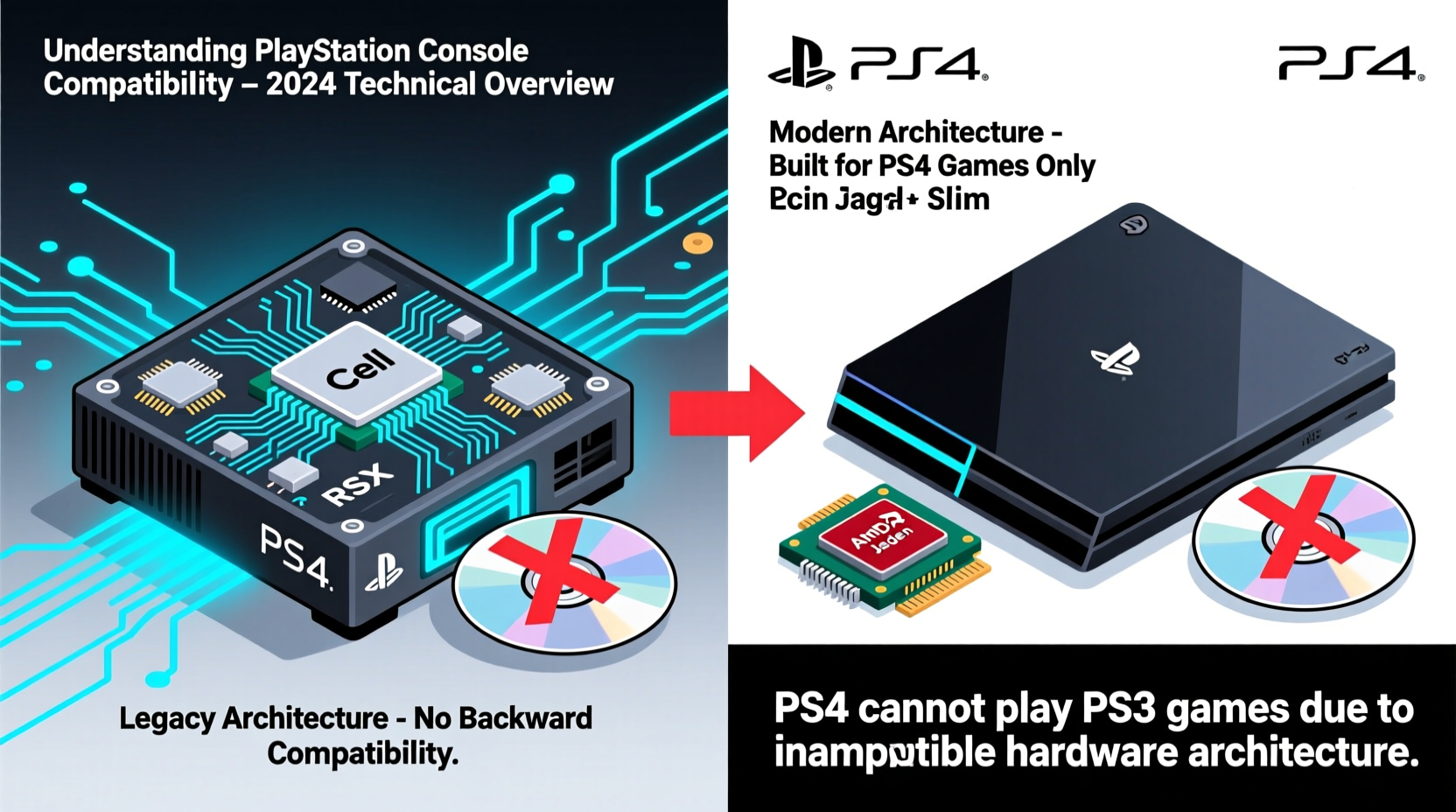
The most fundamental reason the PS4 cannot natively play PS3 games lies in the difference between their internal hardware designs. The PS3 was built around a unique processor called the Cell Broadband Engine, co-developed by Sony, Toshiba, and IBM. This chip featured a powerful main processor (PPE) and multiple synergistic processing elements (SPEs), designed for parallel computing tasks. While innovative, the Cell processor was notoriously difficult to program for and diverged significantly from standard computing architectures.
In contrast, the PS4 adopted a more conventional x86-64 AMD-based architecture—similar to modern PCs. This shift made game development easier and allowed for better optimization across platforms. However, it also meant that PS3 games, which were compiled specifically to run on the Cell processor, could not execute directly on the PS4’s CPU.
“Backward compatibility isn’t just about fitting discs—it’s about replicating an entirely different computing environment.” — Mark Cerny, Lead System Architect, PlayStation 4
Without identical or emulated hardware, the PS4 lacks the ability to interpret and run PS3 game code as it was originally intended.
Why Emulation Isn’t a Simple Fix
One might assume that emulation—running software that mimics the original hardware—could bridge the gap. After all, many PC users emulate older consoles successfully. However, full PS3 emulation is exceptionally complex due to the system’s intricate architecture and proprietary components.
Emulating the Cell processor alone requires significant computational overhead. Each SPE must be simulated individually, and timing between them must remain precise to prevent crashes or graphical glitches. Additionally, the PS3 used a custom graphics processor (RSX) and a unique operating system based on FreeBSD, further complicating accurate emulation.
Sony would need to develop and maintain a robust emulator capable of handling hundreds of PS3 titles, each with different performance demands and quirks. Even minor inaccuracies in emulation can lead to gameplay issues such as audio desynchronization, broken physics, or failure to boot.
Official Solutions: PlayStation Now and Classics Catalog
Recognizing the demand for backward compatibility, Sony introduced PlayStation Now, a cloud-based streaming service that allows access to select PS3 (and PS2, PS1) games. Instead of running games locally on the PS4, they are streamed from remote servers where actual PS3 hardware or server-grade emulators process the gameplay.
This approach bypasses the hardware mismatch issue but introduces new limitations:
- Requires a stable, high-speed internet connection (minimum 5 Mbps, recommended 15+ Mbps)
- Input lag may affect responsiveness, especially in fast-paced games
- Game library is curated and does not include all PS3 titles
- Service availability varies by region
In recent years, Sony has also expanded its “Classics” catalog on the PS4 and PS5, offering digitally remastered versions of select PS2 and PS1 games. However, PS3 titles remain largely absent from this initiative due to the technical complexity involved in porting them to newer systems.
Comparison of Backward Compatibility Options
| Solution | How It Works | Pros | Cons |
|---|---|---|---|
| PS3 Console | Native playback of physical discs | Full compatibility, no latency | Requires extra hardware and space |
| PlayStation Now | Cloud streaming of PS3 games | No extra hardware needed, access to select titles | Internet-dependent, input lag, limited library |
| PS5 Backward Compatibility | Direct support for PS4 and some PS2/PS1 games | Enhanced performance, quick resume | Still no native PS3 disc support |
| Third-party Emulators (PC) | Software like RPCS3 | Free, growing compatibility list | Legally gray, requires technical setup |
Real Example: A Gamer’s Dilemma
Consider Alex, a long-time PlayStation fan who upgraded to a PS4 in 2015. He owns over 30 PS3 games, including classics like *The Last of Us*, *Uncharted 2*, and *Heavy Rain*. When he tried inserting his copy of *The Last of Us* into the PS4, nothing happened—the disc wasn’t recognized. Disappointed, he researched options and discovered that only through PlayStation Now could he legally stream a version of the game. Even then, he noticed slight delays during cutscenes and had to pause gameplay whenever his internet fluctuated. Eventually, Alex decided to keep his PS3 connected alongside his PS4, using HDMI switching to toggle between systems—a workaround, but one that preserved his full gaming library.
What You Can Do: Practical Checklist
If you want to continue playing PS3 games without relying on uncertain future updates, here’s what you can do now:
- Keep your PS3 console – Maintain it properly and use it alongside your PS4.
- Check PlayStation Plus Premium – If available in your region, subscribe to access select PS3 titles via cloud streaming.
- Digital purchases matter – Some remastered PS3-era games (e.g., *The Last of Us Remastered*) are available as standalone PS4 titles.
- Explore RPCS3 emulator – For technically inclined users, this open-source emulator runs many PS3 games on PC (requires owning original game files).
- Upgrade to PS5 when possible – While still not compatible with PS3 discs, the PS5 offers superior backward compatibility with PS4 games and improved streaming performance.
Frequently Asked Questions
Can any PS3 games be played on PS4?
No physical PS3 discs can be played on the PS4. However, select titles are available through PlayStation Now (included in PlayStation Plus Premium) via cloud streaming. Additionally, some popular PS3 games have been remastered and re-released as native PS4 downloads.
Why can the PS5 play PS4 games but not PS3 games?
The PS5 uses a similar x86-64 architecture to the PS4, making backward compatibility achievable through software patches and performance scaling. The PS3’s fundamentally different hardware makes direct compatibility impossible without emulation or streaming, which Sony has chosen to implement selectively rather than universally.
Is there any chance Sony will add full PS3 backward compatibility in the future?
While not impossible, it's unlikely. Sony has focused on remastering key titles and offering streaming access instead of investing in broad emulation. Given the declining user base of PS3 owners and the technical hurdles, widespread backward compatibility is not a priority.
Final Thoughts: Preserving Gaming History
The inability of the PS4 to play PS3 games highlights a broader challenge in the gaming industry: balancing innovation with legacy support. While technological progress demands new architectures, fans lose access to beloved titles when backward compatibility is sacrificed. For now, the best solution remains preserving original hardware or utilizing official streaming services.
As gaming continues to evolve, the conversation around digital ownership and long-term accessibility grows more urgent. Whether through emulation, remasters, or cloud infrastructure, ensuring that classic games remain playable should be a shared goal for developers and players alike.




 浙公网安备
33010002000092号
浙公网安备
33010002000092号 浙B2-20120091-4
Comments
No comments yet. Why don't you start the discussion?