
In recent decades, a simple seasonal greeting—“Merry Christmas”—has sparked debate, controversy, and even policy changes across workplaces, schools, and retail environments. What was once an unremarkable holiday salutation now carries cultural weight, often replaced with more inclusive phrases like “Happy Holidays” or “Season’s Greetings.” This shift isn’t just linguistic—it reflects deeper societal changes around religion, diversity, and public expression. Understanding why saying “Merry Christmas” has become complicated requires examining historical context, legal rulings, demographic trends, and evolving social norms.
The Historical Context of Holiday Greetings
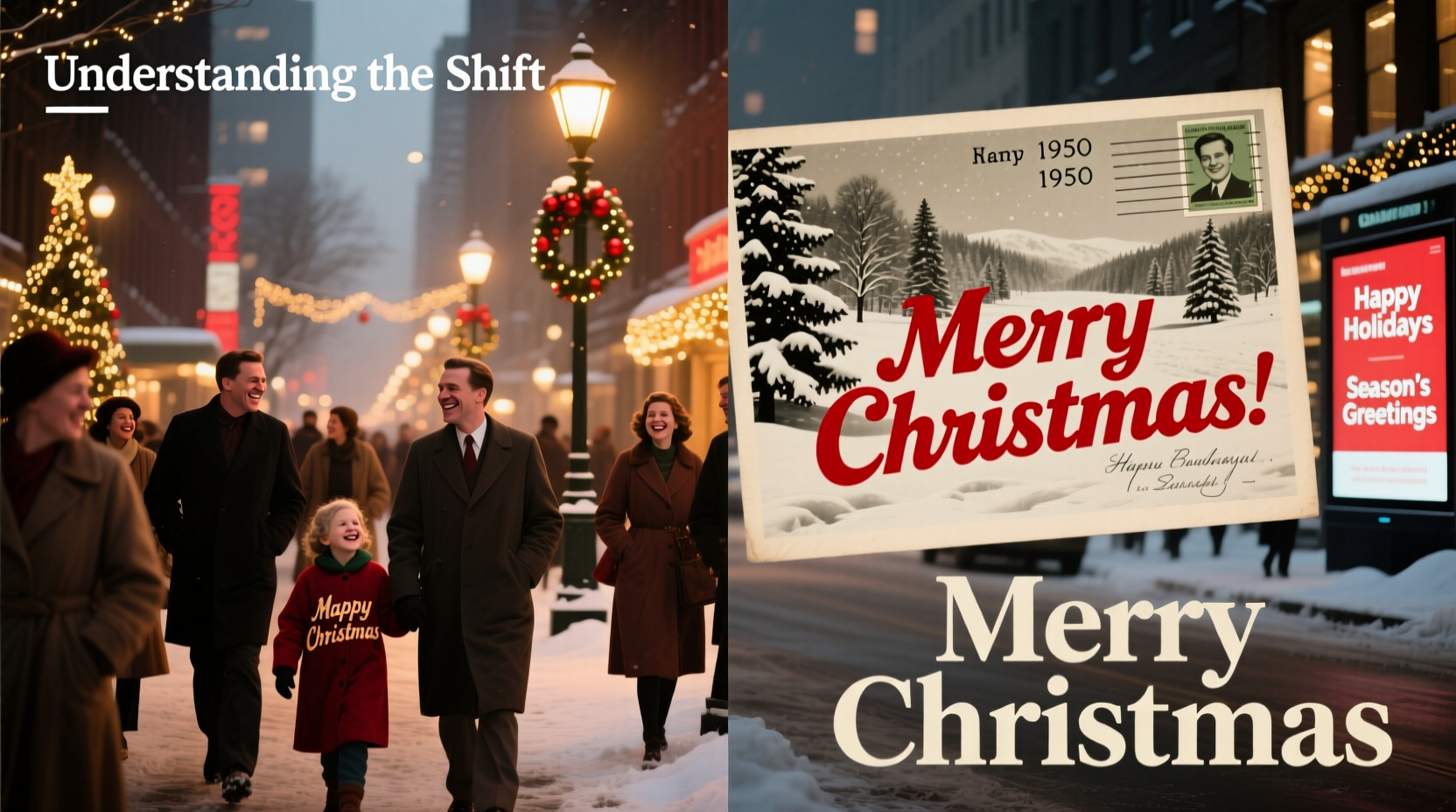
For much of American history, Christmas was treated as both a religious and national celebration. Public decorations, school nativity plays, and government-sponsored events often centered on Christian traditions. The phrase “Merry Christmas” appeared on postage stamps, advertisements, and storefronts without controversy. In the mid-20th century, it was common for businesses and institutions to close during the holiday season, assuming employees celebrated Christmas.
However, starting in the 1960s and accelerating through the 1980s and 1990s, increasing religious diversity began to challenge the assumption that everyone observed Christmas. Immigration patterns brought larger populations of Muslims, Hindus, Buddhists, Jews, and non-religious individuals into mainstream American life. As awareness of inclusivity grew, so did scrutiny over language perceived as exclusionary.
“Language in public spaces should reflect the pluralism of our society. When one tradition dominates the narrative, others feel invisible.” — Dr. Lena Patel, Cultural Anthropologist at Georgetown University
Legal and Institutional Influences
Court decisions have played a significant role in reshaping how holidays are acknowledged in public institutions. A series of rulings under the First Amendment’s Establishment Clause limited overtly religious expressions by government entities. For example:
- Lynch v. Donnelly (1984): Allowed a city-sponsored nativity scene as part of a broader holiday display, but set precedent requiring balance.
- American Civil Liberties Union (ACLU) lawsuits: Challenged school-led Christmas pageants and municipal displays featuring only Christian symbols.
As a result, many public schools and local governments adopted neutral language policies. Teachers were advised not to say “Merry Christmas” in class, and official communications shifted toward “Winter Break” instead of “Christmas Vacation.” These changes weren’t always driven by hostility toward Christianity but by a desire to avoid legal challenges and ensure all students felt included.
Societal Shifts and the Rise of Inclusivity
Beyond legal factors, broader cultural movements emphasizing equity and inclusion have influenced holiday language. Corporate America, in particular, responded to consumer demographics by adopting neutral messaging. Retailers like Target, Walmart, and Starbucks faced public attention when their holiday campaigns avoided explicit references to Christmas.
This wasn’t merely political correctness—it was also business strategy. With growing recognition of Hanukkah, Kwanzaa, Diwali, and secular winter celebrations, companies sought to appeal to a wider audience. A 2022 Pew Research study found that only 65% of Americans identify as Christian, down from 77% in 2007. Among younger adults, the decline is even steeper.
| Year | % of U.S. Adults Identifying as Christian | Major Non-Christian Religions (Combined %) |
|---|---|---|
| 2007 | 77% | 5% |
| 2014 | 71% | 7% |
| 2022 | 65% | 11% |
The data illustrates a clear trend: the American religious landscape is diversifying. Saying “Merry Christmas” in a homogenous community may go unnoticed, but in a multicultural workplace or urban center, it can unintentionally signal that only one tradition matters.
Mini Case Study: The Office Holiday Party Dilemma
At a regional insurance firm in Denver, a manager traditionally ended each December team meeting with “Merry Christmas, everyone!” In 2020, a new employee—a practicing Muslim—quietly expressed discomfort. He didn’t object to the sentiment but felt excluded by the assumption that everyone celebrated Christmas. HR facilitated a brief discussion, after which the team agreed to use “Happy Holidays” in group settings while allowing personal greetings in private conversations. Productivity improved, and team cohesion strengthened. The change wasn’t about censorship—it was about awareness.
Public Perception and Media Narratives
The idea that “we can’t say Merry Christmas anymore” gained traction through media coverage and political commentary, particularly in the early 2000s. Phrases like “War on Christmas” entered public discourse, often citing isolated incidents where schools or stores avoided the term. While some cases involved genuine overreach, many were misreported or taken out of context.
For instance, a widely shared story claimed a school banned Christmas carols. In reality, the school allowed traditional songs but required them to be balanced with non-religious winter music. The nuance was lost in viral outrage.
Still, the perception persists. A 2023 Gallup poll showed that 43% of white evangelical Protestants believe Christians face discrimination in holiday celebrations, compared to just 14% of the general population. This gap highlights how cultural shifts can be interpreted differently depending on one’s background.
Expert Insight on Communication Balance
“You don’t have to erase your faith to respect someone else’s absence of it. The goal isn’t to silence ‘Merry Christmas,’ but to create space where all traditions can coexist.” — Rev. Michael Tran, Interfaith Dialogue Coordinator, Chicago Theological Seminary
Practical Guidance: Navigating Holiday Greetings Today
Nobody should feel pressured to hide their beliefs, nor should anyone feel alienated during a season meant for goodwill. The key lies in situational awareness and intentionality. Below is a checklist to help navigate holiday interactions respectfully.
📋 Holiday Greeting Checklist
- Assess your audience: Is this a personal, religious, or diverse setting?
- In mixed groups, start with neutral phrases like “Happy Holidays” or “Enjoy the season.”
- If you know someone celebrates Christmas, “Merry Christmas” remains perfectly appropriate.
- Be open to receiving different greetings without defensiveness.
- Encourage inclusive practices at work without shaming personal expressions.
Frequently Asked Questions
Is saying “Merry Christmas” now considered offensive?
Not inherently. In personal, religious, or culturally Christian contexts, it remains a warm and welcome greeting. However, in diverse public or professional environments, it may be seen as excluding those who don’t celebrate Christmas. Sensitivity doesn’t require abandoning tradition—it invites thoughtful communication.
Why do companies avoid “Merry Christmas” in ads?
Many brands aim to appeal to the broadest possible customer base. Using inclusive language like “Happy Holidays” acknowledges that consumers observe various traditions—or none at all. It’s less about political correctness and more about market inclusivity and brand neutrality.
Has there been a real ban on “Merry Christmas” in schools or government?
There is no federal or state law banning the phrase. Some institutions have internal guidelines encouraging inclusive language to comply with anti-discrimination policies or avoid legal disputes. These are typically administrative choices, not constitutional prohibitions.
Conclusion: Reclaiming Kindness Over Conflict
The question of whether we can say “Merry Christmas” anymore isn’t really about words—it’s about values. Do we prioritize uniformity, or do we embrace diversity with grace? The ability to say “Merry Christmas” freely hasn’t disappeared; it has simply been joined by other expressions that honor different beliefs.
This season, consider the power of choice. Say “Merry Christmas” proudly if it reflects your tradition. Offer “Happy Hanukkah,” “Joyous Kwanzaa,” or “Happy New Year” when appropriate. And in shared spaces, let kindness guide your words more than controversy.




 浙公网安备
33010002000092号
浙公网安备
33010002000092号 浙B2-20120091-4
Comments
No comments yet. Why don't you start the discussion?