
Capitalization is more than a stylistic choice—it’s a foundational element of clear, professional writing. When used correctly, capital letters guide readers through text, signal importance, and uphold grammatical standards. Misused or inconsistent capitalization, on the other hand, can confuse readers, undermine credibility, and distort meaning. Whether you're drafting an email, writing a report, or posting online, understanding when and why to capitalize is essential.
This article explores the reasoning behind capitalization rules, breaks down their practical applications, and provides real-world examples to help you write with precision and confidence.
The Purpose of Capitalization in English
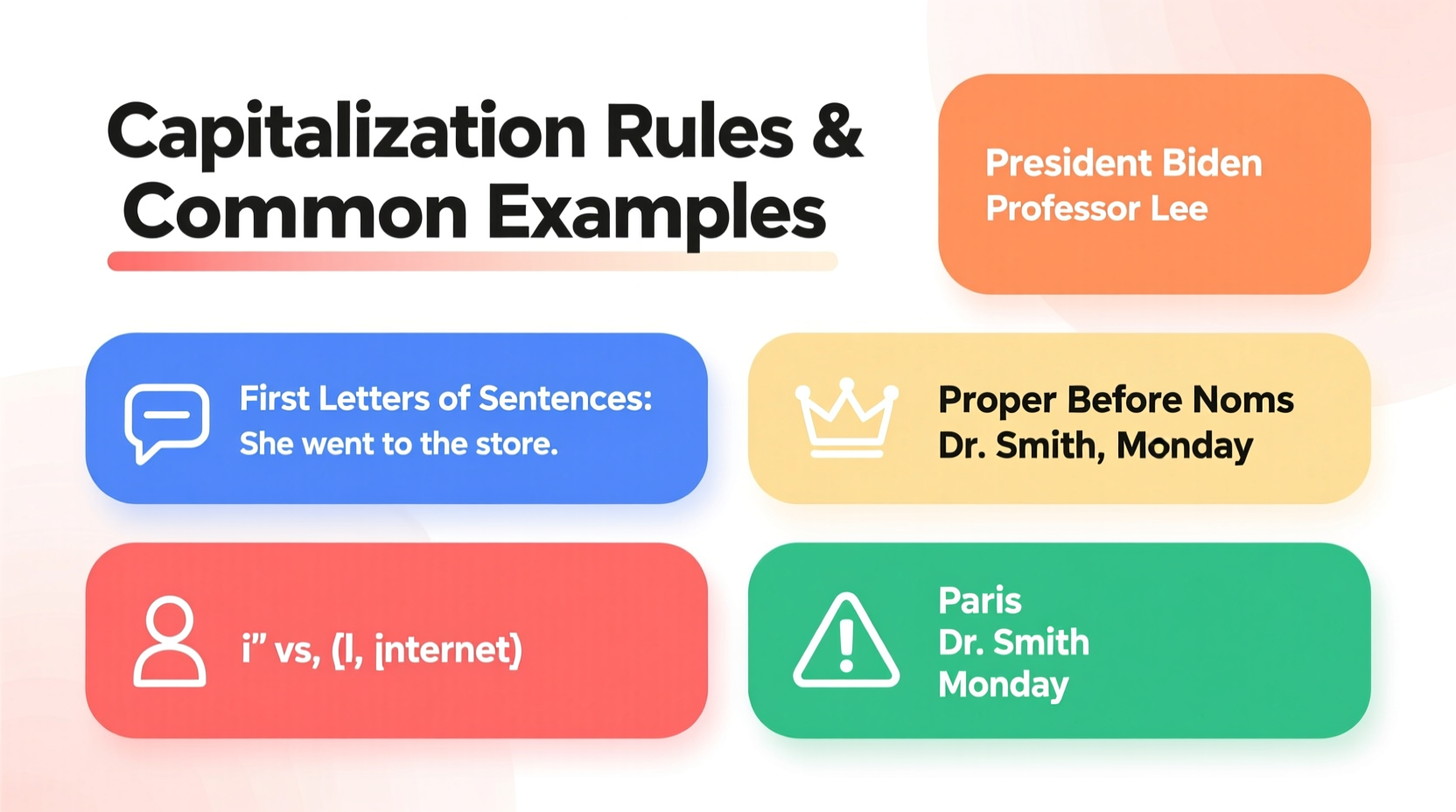
At its core, capitalization serves as a visual cue. It helps distinguish between different types of words and structures, making written language easier to navigate. The first letter of a sentence, proper nouns, titles, and key terms are typically capitalized not by accident but by design—each rule exists to enhance readability and convey meaning accurately.
Consider the difference between “i visited paris last summer” and “I visited Paris last summer.” The second version is instantly clearer: the pronoun “I” stands out, and “Paris” is properly marked as a proper noun. Without correct capitalization, even simple sentences can appear sloppy or ambiguous.
“Capitalization isn’t about tradition alone—it’s about clarity. It tells readers where sentences begin, which names are specific, and what titles are formal.” — Dr. Lydia Chen, Linguistics Professor at Boston University
Core Rules of Capitalization and Their Importance
English capitalization follows a set of well-established rules. While some variations exist between style guides (e.g., AP vs. Chicago), the fundamentals remain consistent across most contexts.
- Capitalize the first word of every sentence. This signals the start of a new thought and improves reading flow.
- Capitalize proper nouns: names of people (Maria Garcia), places (Tokyo), organizations (World Health Organization), and brands (Nike).
- Capitalize days, months, and holidays, but not seasons (e.g., Monday, December, Thanksgiving, but not autumn).
- Capitalize titles when they precede a name (President Biden) but not when used generically (the president gave a speech).
- Capitalize the first word and all major words in titles of books, articles, and films (The Art of Digital Marketing).
- Always capitalize the pronoun “I”, regardless of context.
These rules aren’t arbitrary. They reflect linguistic logic and reader expectations. For example, distinguishing between “university” (common noun) and “Harvard University” (proper noun) prevents confusion. Similarly, capitalizing job titles only when attached to a name avoids implying that every manager is *the* Manager.
Common Examples in Practice
Understanding rules is one thing; applying them correctly is another. Below are everyday scenarios where capitalization plays a critical role.
Email Communication
In professional emails, correct capitalization maintains tone and authority. Compare:
- Incorrect: \"hi john, can you send me the report from last week?\"
- Correct: \"Hi John, can you send me the report from last week?\"
The second version respects basic grammar, starting with a capital “Hi” and using the proper noun “John” correctly.
Social Media Posts
While informal platforms often see relaxed grammar, overuse of lowercase—even at the start of sentences—can make content seem careless. A post like “just landed in miami! so excited to present at the summit” benefits from correction: “Just landed in Miami! So excited to present at the summit.” Proper capitalization reinforces professionalism, even in casual updates.
Resume and Cover Letters
Job applications demand meticulous attention to detail. Capitalizing job titles (Marketing Director, Senior Analyst), company names (Google, United Nations), and certifications (Certified Public Accountant) ensures accuracy and respect for formal titles.
| Context | Correct Capitalization | Incorrect Usage |
|---|---|---|
| Sentence Start | She attended Columbia University. | she attended Columbia University. |
| Proper Noun | We flew to Tokyo via Air France. | We flew to tokyo via air france. |
| Title Before Name | Director Lee approved the budget. | director Lee approved the budget. |
| Generic Title | The director approved the budget. | The Director approved the budget. |
| Pronoun \"I\" | I believe I can contribute significantly. | i believe i can contribute significantly. |
When Capitalization Affects Meaning
In some cases, incorrect capitalization doesn’t just look wrong—it changes meaning. Consider:
- “I saw a republican candidate” vs. “I saw a Republican candidate.” The lowercase version suggests a generic description; the uppercase refers to a member of the Republican Party.
- “We visited a church in spring” vs. “We visited Church in Spring.” The second implies a specific place named “Church” located in a town called “Spring.”
Such distinctions matter in journalism, legal writing, and academic work, where precision is non-negotiable.
Mini Case Study: Brand Messaging Gone Awry
A small tech startup once launched a campaign with the tagline “innovating for the future.” Despite strong product design, engagement was low. Upon review, a branding consultant noted that the lack of capitalization weakened perceived professionalism. After revising the tagline to “Innovating for the Future,” website bounce rates dropped by 18% over six weeks. While multiple factors were at play, the change in presentation contributed to a perception of credibility and intentionality.
Step-by-Step Guide to Applying Capitalization Correctly
To ensure consistency in your writing, follow this five-step process:
- Review sentence beginnings: Scan your document and confirm every sentence starts with a capital letter.
- Identify proper nouns: Highlight names of people, places, companies, and institutions. Ensure each is capitalized.
- Check titles and roles: Determine whether titles are used before names (capitalize) or generically (lowercase).
- Verify days, months, and holidays: Make sure these are capitalized, while seasons are not.
- Edit for consistency: Use a spellchecker or style guide (like APA or MLA) to align formatting across documents.
Frequently Asked Questions
Do I capitalize job titles in a list?
Yes, if the title is part of a formal heading or directly associated with a name (e.g., “Senior Developer – Ana Lopez”). In descriptive lists without names, lowercase is acceptable: “Roles include project manager, designer, and analyst.”
Should internet, email, or web be capitalized?
Modern usage favors lowercase: “email,” “internet,” “website.” Major dictionaries and style guides, including AP and Chicago, now treat these as common nouns unless they begin a sentence.
Are course titles capitalized?
Yes, when referring to a specific class: “I’m enrolled in Introduction to Data Science.” General subjects are lowercase: “She enjoys biology and history.”
Final Checklist for Confident Capitalization
- ✅ First word of every sentence is capitalized
- ✅ All proper nouns (names, cities, brands) are capitalized
- ✅ Days, months, and holidays use uppercase
- ✅ Titles before names are capitalized (e.g., Professor Kim)
- ✅ Generic references to roles are lowercase (e.g., the professor)
- ✅ The pronoun “I” is always capitalized
- ✅ Titles of works follow standard capitalization rules
Conclusion
Capitalization is not merely a grammatical formality—it’s a tool for clarity, professionalism, and effective communication. By understanding the reasons behind the rules and practicing them consistently, you elevate the quality of your writing across emails, reports, social media, and formal documents. These small details accumulate into a strong impression of competence and care.




 浙公网安备
33010002000092号
浙公网安备
33010002000092号 浙B2-20120091-4
Comments
No comments yet. Why don't you start the discussion?