
Applying to competitive college programs in computer science means more than strong grades and test scores. Admissions officers look for students who not only excel academically but also demonstrate genuine passion, intellectual curiosity, and the potential to contribute meaningfully to their campus communities. The personal essay is one of the few places where applicants can go beyond transcripts and test results to tell their story. For aspiring computer scientists, this space offers a powerful opportunity to explain how coding, algorithms, or problem-solving became more than just a class — they became a calling.
A well-crafted computer science essay doesn’t just list achievements; it reveals motivation, resilience, and vision. Yet many students struggle to translate their technical interests into compelling narratives. That’s where targeted tips and real-world examples become invaluable. They provide structure, inspiration, and clarity — helping students avoid common pitfalls while highlighting what makes their journey unique.
What Makes a Strong Computer Science Essay?
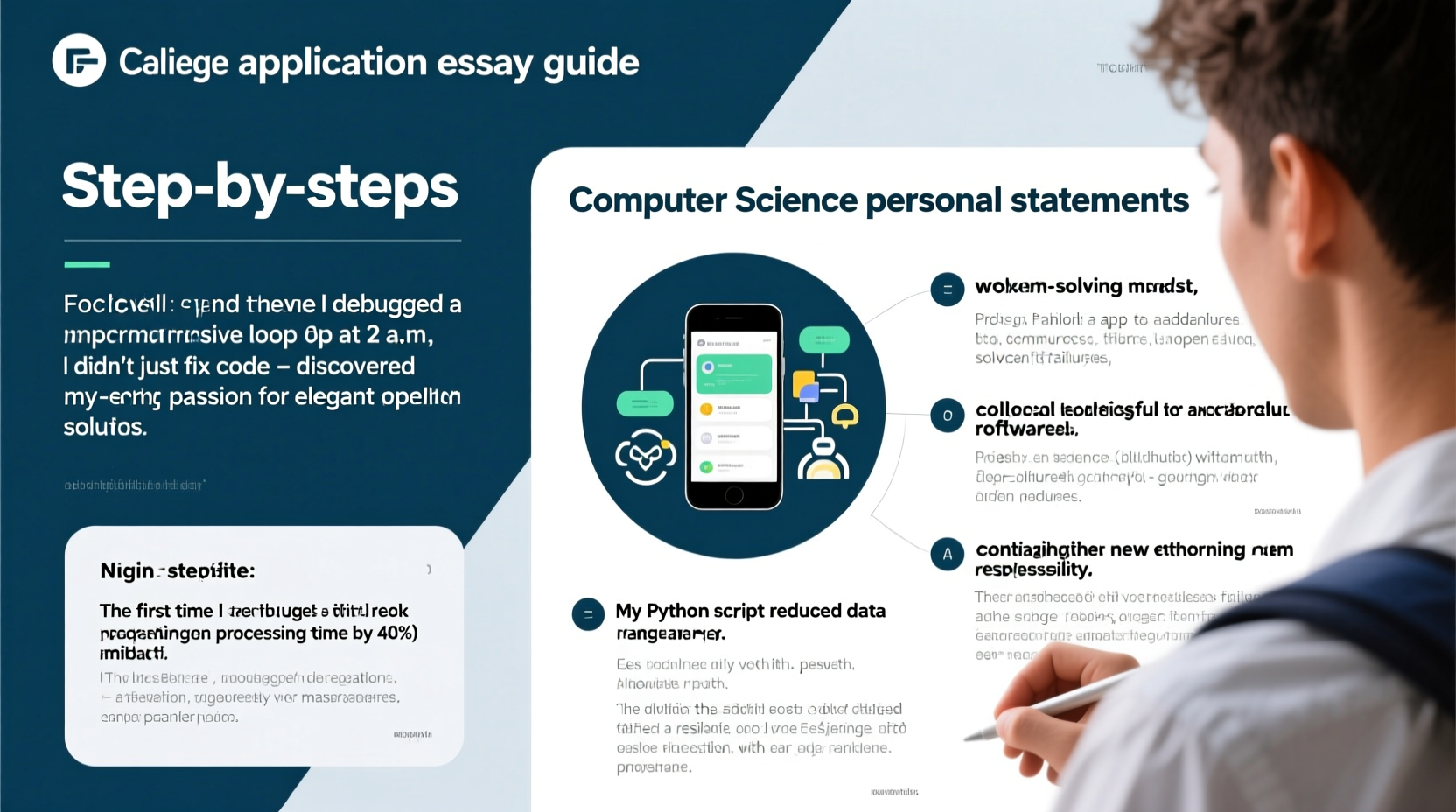
The best computer science essays do more than state interest — they show it. They illustrate a student’s relationship with technology through specific experiences: debugging a stubborn program late at night, building a tool to help a local nonprofit, or discovering the elegance of a mathematical proof behind encryption. These moments, when framed thoughtfully, reveal depth far beyond GPA or AP exam scores.
Admissions committees at top institutions like MIT, Stanford, and Carnegie Mellon often emphasize authenticity over polish. A raw but honest reflection on failure — such as a robotics team losing a competition due to a flawed sensor algorithm — can be more impactful than a perfectly written summary of awards. What matters is insight: what the student learned, how they grew, and how that experience shaped their desire to study computer science at the collegiate level.
Key Tips for Writing Your Computer Science Essay
Writing about technical subjects in a way that resonates emotionally requires balance. Here are essential strategies to keep your essay engaging and authentic:
- Show, don’t just tell. Instead of saying “I love programming,” describe the first time you made a webpage respond to user input — the thrill when the button actually worked.
- Focus on growth, not just achievement. Did you struggle with recursion? Explain how you overcame it through practice, mentorship, or teaching yourself from online resources.
- Connect your past to your future. How will studying computer science in college allow you to solve problems that matter to you? Link your goals to real-world impact.
- Be specific about what excites you. Don’t say “AI is cool.” Say, “I want to explore ethical AI because my cousin with a speech disability struggled with voice assistants that didn’t understand her accent.”
- Avoid jargon unless you explain it. Remember, your reader may not be a coder. Use metaphors or simple language to make complex ideas accessible.
Common Pitfalls to Avoid
| Do’s | Don’ts |
|---|---|
| Talk about a project that failed and what you learned | Claim you’ve “always wanted to be a programmer” without evidence |
| Mention a professor’s research you admire at the school | Name-drop technologies (e.g., “I used React, Node, MongoDB”) without context |
| Explain how CS intersects with other interests (art, music, social justice) | Write a resume in paragraph form — focus on narrative, not listing |
| Use dialogue or sensory details (“My fingers froze over the keyboard as the deadline ticked down”) | Start with clichés like “In today’s digital age…” |
Real Example: From Idea to Essay
Consider Maya, a high school senior applying to computer science programs. She had strong grades and built a mobile app to help classmates track homework. But her first draft read like a project report: “I created an app using Flutter and Firebase to improve productivity.” It was factual but flat.
After revising with feedback, she reframed the story around a moment of empathy. She noticed a friend with ADHD falling behind despite working hard. That observation sparked the idea for the app. Her new opening described watching her friend panic before a quiz, realizing no existing planner adapted to unpredictable focus levels.
The revised essay focused less on tools and more on purpose. She wrote about staying up to fix a bug that caused data loss, learning about user-centered design, and testing early versions with peers. She concluded by linking her goal to study human-computer interaction in college — not just to build apps, but to build ones that truly serve diverse minds.
“Students who connect their technical skills to human needs stand out. It shows they’re thinking like future innovators, not just coders.” — Dr. Lena Torres, Director of Undergraduate Admissions, UC Berkeley School of Engineering
Step-by-Step Guide to Crafting Your Essay
Follow this timeline to develop a thoughtful, polished essay without last-minute stress:
- Week 1: Brainstorm Experiences
List projects, challenges, or moments when you felt deeply engaged with CS. Include failures, curiosities, and inspirations. - Week 2: Identify a Core Theme
Is it problem-solving? Creativity? Equity in tech? Choose one lens to unify your story. - Week 3: Draft Freely
Write without editing. Focus on storytelling — what happened, how you felt, what changed. - Week 4: Refine for Clarity and Voice
Trim jargon. Add sensory details. Ensure the “why” of your CS interest shines through. - Week 5: Get Feedback
Share with a teacher, counselor, or mentor — especially someone unfamiliar with coding, to test accessibility. - Week 6: Finalize and Proofread
Check tone, grammar, and alignment with each college’s values. Tailor supplemental essays accordingly.
FAQ: Common Questions About CS Essays
Do I need research or internship experience to write a strong essay?
No. While research or internships can provide material, many powerful essays come from self-driven learning, classroom projects, or personal experiments. What matters is reflection — showing how any experience deepened your understanding of computer science.
Can I write about non-technical interests in a CS application?
Absolutely. In fact, it’s encouraged. Colleges value interdisciplinary thinkers. An essay about using data visualization to analyze poetry trends or building a music-generating algorithm shows breadth and creativity — traits highly valued in modern CS programs.
How technical should my essay be?
Not very. Assume your reader is intelligent but not a programmer. Explain concepts briefly if needed, but prioritize emotional and intellectual journey over technical detail. Save specifics for interviews or portfolios.
Why Examples Matter: Learning from Others’ Success
Reading sample essays isn’t about copying — it’s about understanding structure, tone, and narrative flow. For instance, one successful applicant opened with a childhood memory of disassembling a broken calculator to see how it worked. Another described teaching coding to younger students and realizing how much joy came from sharing knowledge.
These examples illustrate a key principle: the most memorable essays often begin outside the lab. They root technical passion in human experience. By studying these models, students learn how to frame their own stories with clarity and heart.
“The best essays don’t prove intelligence — they reveal character. We’re looking for students who will collaborate, innovate, and grow.” — James Reed, Former Admissions Officer, Harvard College
Conclusion
Your computer science essay is more than a requirement — it’s a chance to define yourself beyond numbers. Whether you’ve contributed to open-source software or just started learning Python, your perspective has value. Use proven tips and thoughtful examples not to mimic others, but to uncover your authentic voice. Focus on moments that challenged or inspired you, and let your curiosity shine through.




 浙公网安备
33010002000092号
浙公网安备
33010002000092号 浙B2-20120091-4
Comments
No comments yet. Why don't you start the discussion?