
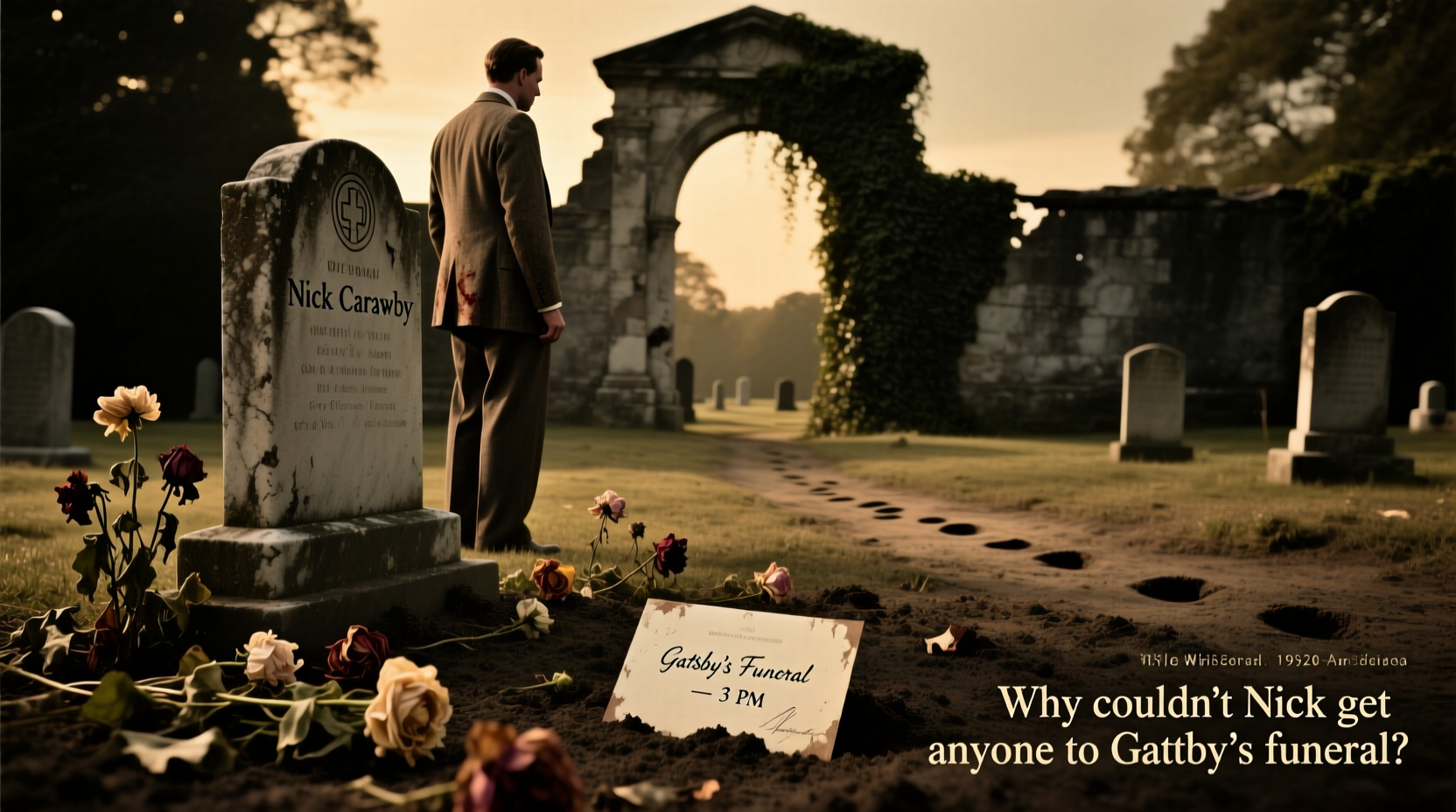
In F. Scott Fitzgerald’s *The Great Gatsby*, Jay Gatsby dies alone—shot in his pool by George Wilson, a man misled by tragic circumstances. What follows is one of the most haunting scenes in American literature: Gatsby’s funeral, attended only by Nick Carraway, the minister, a few servants, and Owl Eyes, the eccentric bibliophile from one of Gatsby’s parties. Despite hosting lavish weekly gatherings that drew hundreds, no close friends, lovers, or business associates appear. Nick, as both narrator and moral center, is left to grapple with this stark absence. Why couldn’t he get anyone to come? The answer lies not in logistical failure but in the deeper truths about identity, illusion, and the hollowness of the American Dream.
The Illusion of Popularity
Gatsby’s parties were spectacles—orchestras playing, champagne flowing, strangers arriving uninvited in borrowed cars. Yet these crowds weren’t drawn by friendship or loyalty. They came for the spectacle, the music, the alcohol, and the chance to say they’d been to Gatsby’s mansion. As Nick observes, “They were people whom curiosity brought… into Gatsby’s blue gardens.” Once the music stopped and the lights went out, so did their interest.
The guests at Gatsby’s parties were consumers of experience, not participants in relationship. When Gatsby died, there was nothing left to consume. His wealth, mystery, and extravagance had served their purpose. Now, with the show over, no one felt obligated—or even moved—to attend his funeral.
The Absence of True Friendship
Despite his charisma and generosity, Gatsby had no real friends. Meyer Wolfsheim, the man who helped him rise through bootlegging, sends a letter excusing himself, citing business. Jordan Baker shows mild disapproval when Nick calls her, more concerned with tennis scores than mourning. Daisy, the woman Gatsby loved and idealized above all else, doesn’t send so much as a telegram.
Nick tries to reach out—calling people listed in Gatsby’s schedule, writing letters, making personal appeals. But each attempt fails. This isn’t oversight; it’s revelation. Gatsby built his life around a fantasy: that if he accumulated enough wealth and recreated the past, Daisy would return to him. He didn’t build authentic connections along the way. His friendships were transactions, his love was obsession, and his identity was performance.
“Nobody’s coming to the funeral,” I said. “I can’t get anybody.” — Nick Carraway, *The Great Gatsby*
Daisy’s Silence and Moral Cowardice
Daisy Buchanan represents the ultimate betrayal—not through malice, but through indifference. After Gatsby takes the blame for Myrtle’s death, shielding her from consequences, she retreats into the safety of her marriage with Tom. She and Tom leave town without notice, abandoning Gatsby in death as they did in life.
Nick expected something—anything—from her. A flower, a note, a sign of regret. But there is none. Her absence underscores a central theme: the moral emptiness of the upper class. Daisy is beautiful, charming, and utterly incapable of responsibility. She uses people and moves on, protected by her wealth and social position. Gatsby’s devotion meant nothing against the inertia of her privilege.
Social Superficiality in the Jazz Age
Fitzgerald critiques the 1920s as an era of glittering surfaces and hollow cores. The Roaring Twenties celebrated excess, pleasure, and reinvention—but lacked depth, empathy, or accountability. Gatsby embodies this paradox: self-made, ambitious, endlessly hopeful, yet fundamentally isolated.
Consider the guest list at one of his parties versus his funeral. Hundreds danced under his roof; one man mourns his death. This contrast isn’t accidental—it’s structural. The society Gatsby sought to join valued appearances over authenticity. Loyalty wasn’t currency; utility was. Once Gatsby was no longer useful or entertaining, he was forgotten.
| Aspect | During Life | After Death |
|---|---|---|
| Public Presence | Hosted weekly galas with 100+ guests | No visitors at wake or funeral |
| Relationships | Superficial connections, transactional ties | No emotional obligations fulfilled |
| Social Status | Seen as mysterious, wealthy, influential | Dismissed as irrelevant after death |
| Nick’s Efforts | Tried contacting associates, friends, family | Only Owl Eyes and servants responded |
The Role of Nick Carraway: Lone Mourner and Moral Witness
Nick stands apart because he sees clearly. Unlike others, he doesn’t just observe Gatsby—he understands him. He recognizes the tragedy not just in Gatsby’s death, but in his life: a man who believed in the green light, in the possibility of recapturing the past, in love as redemption.
His struggle to organize the funeral becomes symbolic. It’s not merely logistical; it’s existential. He’s trying to give dignity to a man the world has discarded. When he fails to gather mourners, it reflects not his inadequacy, but society’s. As he says near the novel’s end: “They’re a rotten crowd… You’re worth the whole damn bunch put together.”
Nick’s grief is compounded by futility. He buries Gatsby knowing the truth will be buried with him—replaced by gossip, rumors, and newspaper headlines.
Mini Case Study: Owl Eyes at the Funeral
One of the few attendees is Owl Eyes, the man who once marveled at Gatsby’s library, impressed that the books were real. At the funeral, he appears uninvited, stunned that so few have come. “Why, my God! People were coming by the hundreds,” he exclaims, unaware of the irony.
Owl Eyes symbolizes the rare observer who glimpses authenticity beneath the surface. He didn’t know Gatsby well, but he respected the effort—the real books, the curated image, the dream behind the façade. His presence, though brief, validates Nick’s belief that Gatsby mattered. He’s proof that someone noticed, even if too late.
Checklist: Signs of Superficial Relationships (Inspired by Gatsby’s World)
- People only engage when there’s entertainment or benefit
- Friends disappear during hardship or crisis
- Relationships are based on status, not shared values
- There’s admiration for lifestyle, not character
- Communication ends when the “show” is over
Expert Insight on Loneliness and Identity
“The tragedy of Gatsby is not that he died, but that he lived alone. He created a persona so convincing that even he forgot who he was. And when he died, no one knew the real man to mourn him.” — Dr. Laura Simmons, Literary Critic and Professor of American Fiction
This observation cuts to the heart of the novel. Gatsby wasn’t just isolated in death—he was isolated in life. James Gatz transformed himself into Jay Gatsby to win Daisy, but in doing so, he erased his origins, his family, his past. No one knew his true story. How could they mourn a man they never met?
Frequently Asked Questions
Did Gatsby have any family?
Yes—his father, Henry C. Gatz, arrives from Minnesota after hearing of the death through the newspaper. He brings a childhood book with Gatsby’s schedule written inside, revealing the roots of his ambition. His appearance contrasts sharply with the East Coast elite, emphasizing Gatsby’s humble beginnings and the sincerity of his dreams.
Why didn’t Meyer Wolfsheim attend?
Wolfsheim cites “business” as his reason, but it’s clear he fears association with a scandal. As a criminal figure involved in fixing the 1919 World Series, he avoids any public connection to Gatsby’s murder. His refusal highlights the transactional nature of their bond—no loyalty beyond mutual gain.
Could Nick have done more?
Nick did everything a single person reasonably could: made calls, sent messages, arranged the service. The failure wasn’t his—it was societal. The lack of attendance wasn’t due to negligence, but to the moral vacuum surrounding Gatsby’s world. Nick’s effort underscores his integrity, not his failure.
Conclusion: The Last Kind Word
Nick couldn’t get anyone to Gatsby’s funeral because Gatsby, for all his wealth and charm, was alone. Not because he was unlovable, but because he built his life on illusions that attracted crowds but repelled intimacy. The people who danced in his garden never saw the man behind the myth. When he died, the myth died with him—and no one stayed for the truth.
Gatsby’s funeral is more than a plot point—it’s a judgment. On wealth without wisdom, love without courage, dreams without grounding. Nick’s solitary grief becomes a quiet act of resistance against a world that discards people when they’re no longer useful.




 浙公网安备
33010002000092号
浙公网安备
33010002000092号 浙B2-20120091-4
Comments
No comments yet. Why don't you start the discussion?