
Arthur Pendragon, introduced as a cheerful and idealistic boy from modern-day Britain who stumbles into the magical world of Liones, begins as one of the most morally grounded characters in The Seven Deadly Sins. His innocence, sense of justice, and unwavering belief in doing good stand in stark contrast to the hardened warriors around him. Yet, over time, his transformation into a figure associated with chaos and destruction raises a compelling question: Why did Arthur turn evil? While “evil” may be too simplistic a label, his actions grow increasingly questionable, culminating in decisions that align more with tyranny than heroism. Understanding this shift requires examining narrative arcs, psychological development, and thematic intent.
The Idealist’s Collision with Reality
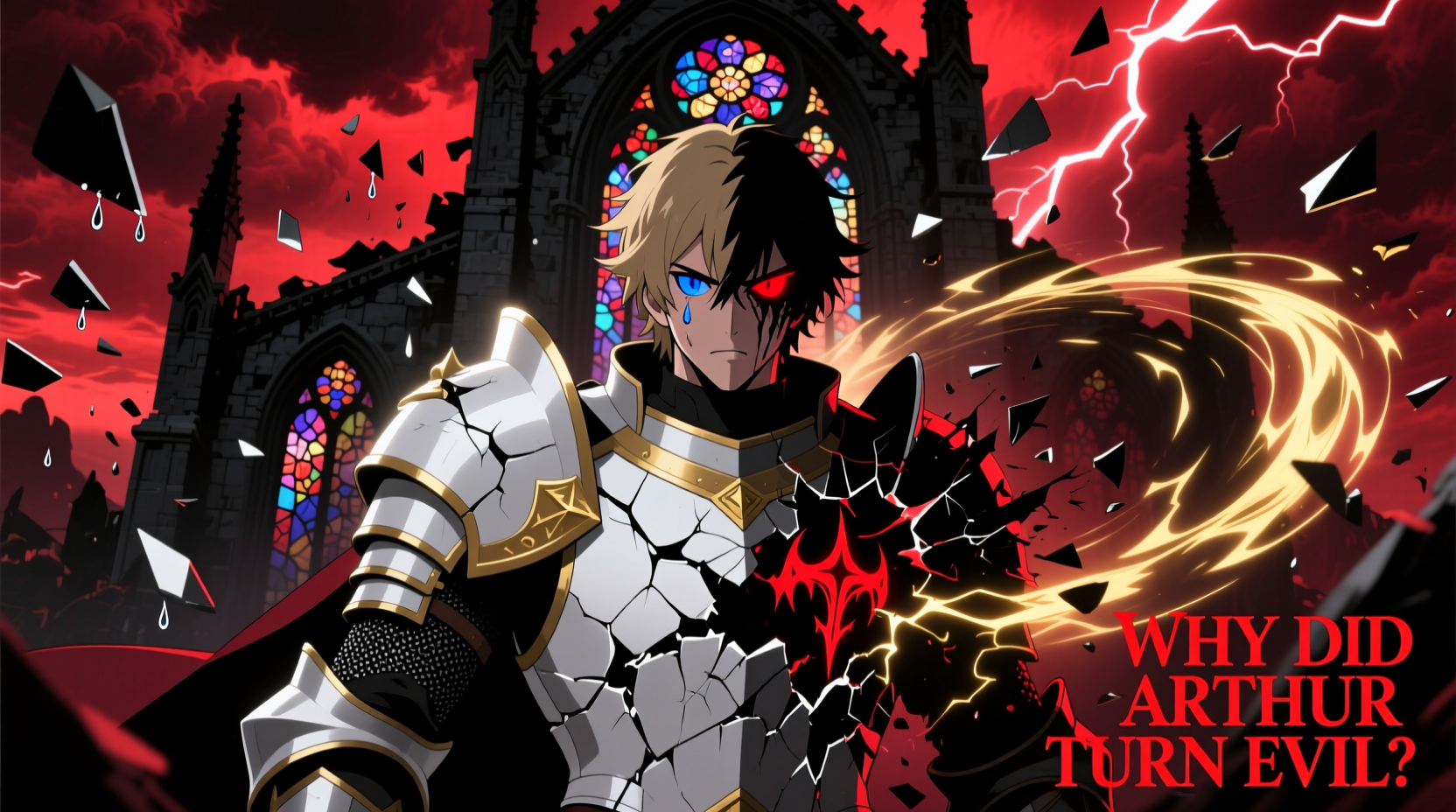
Arthur starts as a symbol of pure idealism. Raised in 21st-century England, he embodies democratic values, empathy, and a belief in peaceful resolution. When he arrives in the medieval kingdom of Liones—a land ruled by divine mandates, war, and rigid hierarchies—his worldview is immediately challenged. He sees injustice everywhere: the oppression of weaker beings, the abuse of power by Holy Knights, and the suffering caused by endless conflict.
His initial response is noble—he joins Meliodas and the Seven Deadly Sins to fight corruption and protect the innocent. But as the series progresses, Arthur becomes disillusioned. He realizes that defeating corrupt individuals doesn’t dismantle systemic injustice. No matter how many villains they defeat, new ones rise. Peace remains fragile. This growing frustration plants the first seed of his eventual transformation.
Exposure to the Demon King’s Influence
A critical turning point occurs when Arthur gains access to ancient knowledge—specifically, the truth about the Great War between the Humans, Goddesses, and Demons. As the reincarnation of King Arthur, he inherits memories and insights from the past. Through these revelations, he learns that peace has always been enforced through domination: the Supreme Deity controls the goddess clan, who subjugate the demon clan, who in turn oppress humans.
This cycle of control disgusts him. He concludes that true peace cannot exist under any form of rule, no matter how benevolent it appears. It is here that the Demon King’s philosophy begins to resonate with him. The Demon King advocates for a world without gods, laws, or rulers—a chaotic utopia where freedom reigns absolutely. To Arthur, this isn’t evil; it’s liberation.
“Order built on oppression is not peace—it’s slavery with better branding.” — Nanatsu no Taizai supplementary material, Vol. 32
The Corruption of Noble Intentions
Arthur never sets out to become a tyrant or a destroyer. His motivation remains rooted in compassion. He wants to end suffering. But his solution evolves from reform to revolution—and eventually, annihilation of the existing order. He believes that only by wiping the slate clean can true freedom emerge.
This mindset mirrors real-world revolutionary ideologies, where the desire to eradicate injustice leads to extreme measures. Arthur’s flaw isn’t malice—it’s absolutism. He stops seeing compromise as viable. Anyone who resists his vision, including former allies like Meliodas and Elizabeth, becomes an obstacle to salvation.
His possession of Excalibur, the sacred sword tied to his soul, amplifies both his power and his conviction. The blade responds to his will, reinforcing his belief that he is destined to reshape the world. With each use, the line between justice and fanaticism blurs.
Key Factors in Arthur’s Transformation
Several interconnected elements contribute to Arthur’s fall from grace:
- Philosophical radicalization: Exposure to cyclical history makes him reject all forms of authority.
- Isolation: As his views diverge from the Sins, he becomes emotionally detached, relying only on his own judgment.
- Power inflation: Wielding Excalibur and ancient knowledge gives him a god complex.
- Moral absolutism: Believing he alone sees the truth, he deems opposition as ignorance or corruption.
- Lack of mentorship: Unlike Meliodas, who had mentors and consequences, Arthur lacks guidance to temper his ideals.
Timeline of Arthur’s Descent
- Arrival in Liones: Begins as a kind-hearted outsider advocating for justice.
- Alliance with the Sins: Fights against corruption, believing reform is possible.
- Discovery of the Great War: Learns the truth about divine hierarchy and eternal conflict.
- Rejection of divine rule: Starts questioning whether any ruler, even well-intentioned ones, can bring peace.
- Embrace of chaos: Concludes that only total destruction of the system can lead to true freedom.
- Confrontation with Meliodas: Views his former leader as part of the oppressive cycle.
- Attempted world reset: Seeks to erase the current order, regardless of cost.
Was Arthur Truly Evil?
Labeling Arthur as “evil” oversimplifies his arc. He doesn’t seek power for personal gain, nor does he enjoy suffering. His actions stem from a warped sense of altruism. In many ways, he becomes a tragic figure—a boy who wanted peace so badly that he was willing to destroy the world to achieve it.
The series uses Arthur to explore a central theme: the danger of purity. Absolute ideals, when unchecked, can justify horrific means. Meliodas, by contrast, chooses love, compromise, and incremental change. He accepts that peace must be imperfect to be sustainable. Arthur cannot accept that. His inability to tolerate imperfection leads him down a dark path.
| Aspect | Arthur’s Belief | Meliodas’ Belief |
|---|---|---|
| Source of Conflict | Systemic rule by gods/demons | Human greed and hatred |
| Solution to War | Destroy all rulers and systems | Break the cycle through understanding |
| View of Compromise | Weakness; enables oppression | Necessary for lasting peace |
| Role of Power | Tool to enforce liberation | Responsibility to protect others |
| Moral Flexibility | Rigid idealism | Pragmatic compassion |
Frequently Asked Questions
Did Arthur become a villain in the end?
Not in the traditional sense. While his goals oppose the protagonists, he never embraces malice. He remains convinced he’s saving the world. His role is more of a philosophical antagonist than a pure villain.
Can Arthur be redeemed?
In the current canon, Arthur is not fully redeemed, but there are hints of internal conflict. His bond with the Sins, especially Hawk and Meliodas, suggests remnants of his old self. Redemption would require him to accept imperfection in peace—a hurdle he hasn’t yet overcome.
Is Arthur stronger than Meliodas?
In raw power, especially when wielding Excalibur and ancient magic, Arthur can rival Meliodas. However, Meliodas has centuries of combat experience, emotional resilience, and the support of allies. Power alone doesn’t determine victory.
Actionable Checklist: Understanding Character Falls from Grace
To analyze similar character arcs in storytelling, follow this checklist:
- Identify the character’s original values and motivations.
- Track key events that challenge their worldview.
- Note moments of isolation or loss of support systems.
- Look for ideological shifts masked as moral progress.
- Assess whether their methods begin to contradict their goals.
- Determine if they view dissent as betrayal rather than dialogue.
- Evaluate whether redemption is possible based on self-awareness.
Conclusion: A Warning Against Ideological Purity
Arthur’s journey is not one of simple corruption. It’s a cautionary tale about how noble intentions, when divorced from empathy and humility, can lead to destruction. His evolution challenges readers to reflect: How much are we willing to sacrifice for our ideals? Where do we draw the line between justice and extremism?
The brilliance of The Seven Deadly Sins lies in its refusal to paint morality in black and white. Arthur isn’t evil because he wants to hurt people—he’s dangerous because he believes hurting them is the only way to save them. That nuance is what makes his arc unforgettable.




 浙公网安备
33010002000092号
浙公网安备
33010002000092号 浙B2-20120091-4
Comments
No comments yet. Why don't you start the discussion?