
The story of Thomas Edison and the light bulb is often reduced to a single moment: a man in a lab, flipping a switch, illuminating a room for the first time. But the real narrative is far more complex. Edison didn’t “invent” the light bulb out of thin air—he refined it, commercialized it, and made it practical for everyday use. Understanding why he pursued this innovation reveals not just scientific ambition, but also economic vision, competitive drive, and a deep understanding of human need.
Long before Edison, dozens of inventors experimented with electric lighting. Some created early prototypes that glowed briefly before burning out. What set Edison apart wasn’t genius in isolation—it was persistence, strategic investment, and a clear goal: to create an affordable, long-lasting, scalable electric lighting system for homes and cities.
The Myth of the Lone Inventor
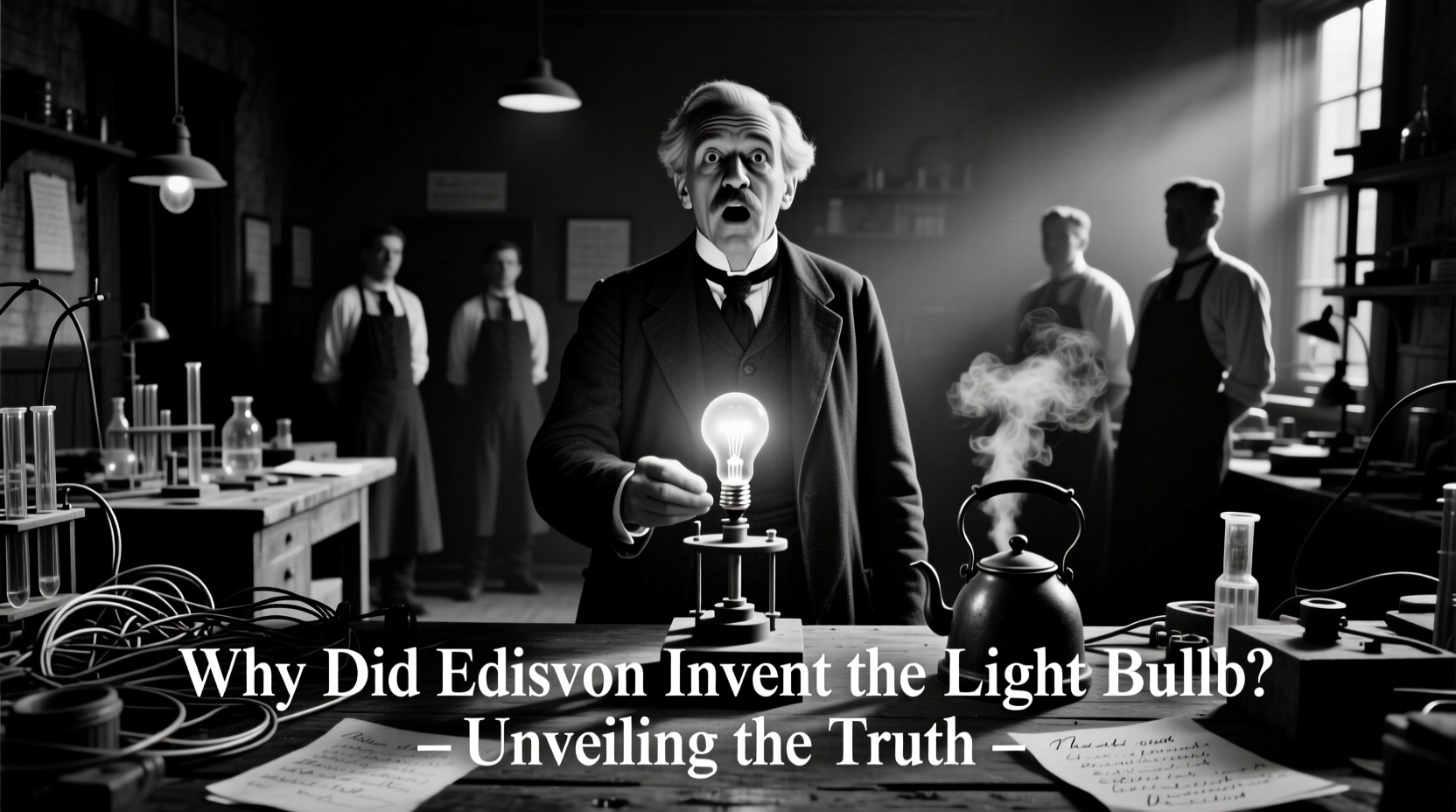
A common misconception is that Edison single-handedly invented the light bulb. In reality, he built upon decades of prior work. As early as 1802, Humphry Davy demonstrated the first electric arc lamp. By the 1840s, Warren de la Rue enclosed a platinum filament in a vacuum tube and achieved limited success. Later, inventors like Joseph Swan in England developed carbon-filament lamps that worked—but only for short durations.
Edison’s breakthrough wasn’t the concept, but the execution. He asked a different question: How can we make electric light last hundreds of hours, be mass-produced, and powered by a reliable distribution system?
“Genius is one percent inspiration and ninety-nine percent perspiration.” — Thomas Edison
This famous quote underscores his method. Edison didn’t rely on sudden insight; he tested over 6,000 materials for the filament—bamboo, cork, even human hair—before settling on carbonized bamboo, which lasted over 1,200 hours.
Commercial Motivation: Lighting as a Business
Edison wasn’t driven solely by curiosity. He saw electric lighting as a business opportunity. At the time, gas lamps dominated urban illumination. They were dim, smoky, and posed fire risks. A safer, brighter alternative could revolutionize home and city life—and generate enormous profits.
In 1878, Edison founded the Edison Electric Light Company, backed by investors including J.P. Morgan. This wasn’t a hobbyist’s workshop; it was a research and development enterprise with a mission: to beat competitors and dominate the emerging market.
The Full System: More Than Just a Bulb
One of Edison’s most overlooked achievements was designing the entire electrical ecosystem. A light bulb alone is useless without power generation, wiring, sockets, switches, and safety mechanisms. In 1882, he launched the Pearl Street Station in Manhattan—the first commercial power plant in the U.S.—supplying electricity to 400 lamps in 85 buildings.
This holistic approach gave him a critical edge. While others focused on the bulb, Edison engineered a complete solution. His Menlo Park laboratory functioned like a modern tech startup, employing engineers, chemists, and machinists working in parallel on generators, meters, fuses, and underground conduits.
Key Components of Edison’s Lighting System
| Component | Purpose | Impact |
|---|---|---|
| Carbon Filament Bulb | Long-lasting, safe illumination | Replaced gas lamps in homes |
| Direct Current (DC) Generator | Stable power source | Enabled centralized power plants |
| Underground Wiring | Reduced fire risk and visual clutter | Improved urban infrastructure |
| Electric Meter | Billed customers based on usage | Created a sustainable utility model |
| Fuses & Switches | Enhanced safety and control | Increased consumer trust |
Competition and the War of Currents
Edison faced fierce rivals. In Britain, Joseph Swan had already demonstrated a working incandescent lamp and later sued Edison for patent infringement. The two eventually merged their interests to form Ediswan.
But the bigger battle came from within the U.S. electrical industry. George Westinghouse and Nikola Tesla championed alternating current (AC), which could transmit power over longer distances more efficiently than Edison’s direct current (DC). This sparked the infamous “War of Currents.”
Edison launched a public relations campaign to discredit AC, even promoting its use in the first electric chair to associate it with danger. Despite these efforts, AC prevailed due to its scalability. Edison’s company eventually adapted, merging into what would become General Electric.
“He has all the English types of vacillation and indecision… I am perfectly sure my system will ultimately beat his.” — Thomas Edison on Joseph Swan
Timeline: The Path to Practical Electric Light
Edison’s journey from idea to implementation followed a disciplined, iterative process. Here’s a step-by-step breakdown of key milestones:
- 1878: Announces intention to create a practical electric lighting system after visiting laboratories in Paris.
- 1879: Develops a carbonized cotton thread filament that lasts 14.5 hours—first major breakthrough.
- 1880: Discovers carbonized bamboo filament extends lifespan to over 1,200 hours.
- 1881: Opens the Holborn Viaduct power station in London as a test site.
- 1882: Launches Pearl Street Station in New York City, powering the first grid.
- 1883: Faces patent challenges from Swan; begins negotiations for collaboration.
- 1884: Begins transition toward AC technology despite personal preference for DC.
Mini Case Study: Illuminating Lower Manhattan
On September 4, 1882, at 3:00 PM, Edison flipped the switch at Pearl Street Station. Instantly, 400 lamps lit up offices in the financial district. One newspaper reported: “The light was soft, steady, and agreeable.”
Within months, demand surged. Businesses stayed open later. Streets felt safer. Homes began requesting installations. Within five years, over 50,000 bulbs were in use across New York.
This wasn’t just technological progress—it was social transformation. Families gained extra hours for reading, sewing, or conversation. Productivity rose. The rhythm of daily life shifted.
FAQ
Did Thomas Edison really invent the light bulb?
No single person “invented” the light bulb. Many contributed over decades. Edison’s role was perfecting a durable, commercially viable version and creating the infrastructure to support it.
Why did Edison choose carbon filaments?
After testing thousands of materials, carbonized organic fibers—especially bamboo—proved most effective at glowing brightly without rapid burnout in a vacuum-sealed bulb.
Was Edison’s light bulb immediately successful?
Yes, but only because he paired it with a full electrical system. Without power plants and wiring, the bulb would have remained a laboratory curiosity.
Action Checklist: Lessons from Edison’s Approach
- Identify a real-world problem people face daily (e.g., unsafe, dim lighting).
- Don’t just improve a product—design the entire user experience.
- Test relentlessly. Failure is data, not defeat.
- Secure funding and build a team with diverse expertise.
- Anticipate competition and plan for long-term scalability.
- Communicate your vision clearly to investors, the public, and regulators.
Conclusion: Beyond the Glow
The light bulb was never just about illumination. For Edison, it was about reimagining society. He didn’t invent in a vacuum—he responded to urbanization, industrial growth, and the rising demand for convenience and safety.
His legacy isn’t merely the bulb on a shelf, but the network behind it: the systems, standards, and services that turned electricity into a utility. That same mindset—holistic, customer-focused, resilient—is what drives innovation today, from smart grids to renewable energy.




 浙公网安备
33010002000092号
浙公网安备
33010002000092号 浙B2-20120091-4
Comments
No comments yet. Why don't you start the discussion?