
F. Scott Fitzgerald’s *The Great Gatsby* stands as one of the most enduring novels in American literature, not only for its lyrical prose and tragic romance but for the depth of purpose behind its creation. While it may appear at first glance to be a story about wealth, parties, and unrequited love, the novel is deeply rooted in Fitzgerald’s personal struggles, social observations, and artistic aspirations. Understanding why he wrote *The Great Gatsby* requires peeling back layers of biography, historical context, and literary intent.
Personal Experience and Emotional Resonance
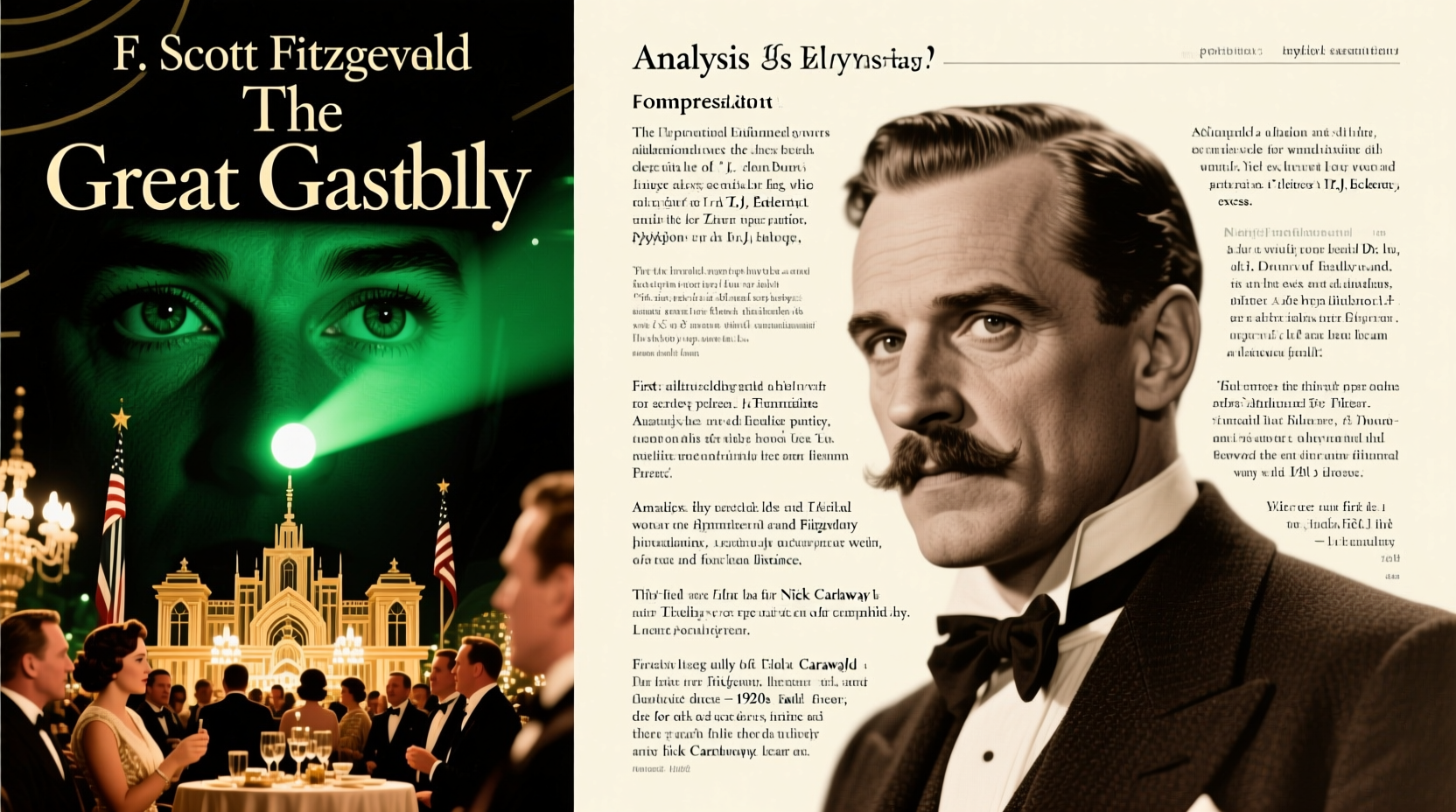
Fitzgerald drew heavily from his own life when crafting the world of West Egg and East Egg. His courtship with Zelda Sayre mirrored Gatsby’s pursuit of Daisy Buchanan—both were marked by longing, class barriers, and romantic idealism. When Fitzgerald first met Zelda in 1918, she hesitated to marry him until he could prove his financial success. This experience left a lasting imprint: the idea that love could be conditional on wealth became central to *Gatsby*.
Like Gatsby, Fitzgerald reinvented himself. Born into a middle-class family in St. Paul, Minnesota, he was acutely aware of his outsider status among the elite at Princeton and later within high society circles. His time in Long Island during the early 1920s exposed him to the opulence and moral emptiness of the Jazz Age—a world both alluring and repellant.
“Let me tell you about the very rich. They are different from you and me.” — F. Scott Fitzgerald
This famous line captures Fitzgerald’s ambivalence toward wealth. He was fascinated by the glamour of the wealthy but disillusioned by their carelessness and emotional detachment. In *Gatsby*, this duality manifests in characters like Tom and Daisy Buchanan, whom Nick Carraway describes as “careless people” who “smashed up things and creatures and then retreated back into their money.”
Literary Ambition and Artistic Redemption
By 1923, Fitzgerald had published two successful novels—*This Side of Paradise* and *The Beautiful and Damned*—but critics often dismissed him as a chronicler of flappers and frivolity. He longed to be taken seriously as a literary artist. Writing *The Great Gatsby* was, in part, an attempt to transcend his reputation and craft a work of lasting aesthetic value.
In letters to friends and editors, Fitzgerald expressed hopes that this novel would be “a consciously artistic achievement” and “something new—something extraordinary and beautiful.” He revised meticulously, reshaping early drafts under the guidance of editor Maxwell Perkins. The result was a tightly structured narrative with symbolic depth, poetic language, and a controlled point of view rare in his earlier works.
The use of Nick Carraway as a narrator allowed Fitzgerald to maintain critical distance while still immersing readers in Gatsby’s dream. Unlike a purely omniscient voice, Nick is both participant and observer—sympathetic yet capable of judgment. This narrative choice elevated the novel beyond mere melodrama into the realm of modernist literature.
Social Critique of the American Dream
At its core, *The Great Gatsby* is a critique of the American Dream—the belief that anyone, regardless of origin, can achieve success through hard work and determination. Gatsby embodies this ideal: born James Gatz to poor farmers, he transforms himself into a millionaire through sheer will and imagination. Yet his dream is ultimately hollow. Despite his wealth, he cannot win Daisy, nor gain acceptance from old-money elites.
Fitzgerald uses Gatsby’s rise and fall to expose the corruption beneath the surface of prosperity. The green light at the end of Daisy’s dock symbolizes not just romantic desire but the elusive promise of upward mobility. It glows with hope, yet remains forever out of reach.
| Element | Symbolic Meaning | Critique of American Dream |
|---|---|---|
| Gatsby's Mansion | Self-made wealth and aspiration | Impressive but empty; no real belonging |
| The Valley of Ashes | Industrial decay and inequality | Cost of progress borne by the powerless |
| The Eyes of Dr. T.J. Eckleburg | Moral decay and lost values | No divine justice in a materialistic world |
| Daisy Buchanan | The object of desire | Represents how dreams become corrupted by materialism |
The tragedy lies not in Gatsby’s death, but in the realization that the dream itself was flawed. Success, in this world, is measured not by character or effort, but by birth and connections. Fitzgerald suggests that the American Dream has been reduced to a pursuit of wealth devoid of moral foundation.
A Response to Cultural Excess
The 1920s were a decade of dramatic social change: Prohibition, jazz, women’s suffrage, and economic boom created a culture of rebellion and indulgence. Fitzgerald coined the term “Jazz Age” and became one of its most visible figures. But he was also one of its sharpest critics.
*The Great Gatsby* reflects his concern about what he saw as a nation losing its moral compass. The endless parties at Gatsby’s estate—lavish, anonymous, and ultimately meaningless—are not celebrations of joy but symptoms of spiritual emptiness. Guests flock to his mansion without knowing him, drink his liquor, and vanish when he needs them most.
This theme is illustrated in a mini case study from Chapter IV, when Nick attends lunch with Meyer Wolfsheim and hears stories of fixed baseball games and underworld dealings. Wolfsheim represents the dark side of ambition—one where success is achieved through corruption rather than merit. Gatsby’s association with him undermines the purity of his dream, revealing that even noble aspirations can be tainted by the means used to achieve them.
Writing Process and Creative Evolution
Fitzgerald began writing *The Great Gatsby* in 1923, initially titling it *Trimalchio in West Egg*, a reference to a vulgar Roman freedman known for extravagant banquets. Over the next year, he moved between France and America, revising multiple drafts. His process was disciplined and introspective, far removed from the spontaneous image he projected in public life.
A timeline of key developments reveals the depth of his commitment:
- 1923: Begins drafting under working title *Trimalchio*
- Early 1924: Relocates to the French Riviera to focus on writing
- Summer 1924: Completes first full draft
- Fall 1924: Works closely with Maxwell Perkins on revisions—tightening plot, enhancing symbolism
- April 1925: Published by Scribner’s as *The Great Gatsby*
Despite his efforts, the novel sold poorly upon release—fewer than 20,000 copies in its first year. Critics were mixed; some praised its craftsmanship, others found it shallow. Fitzgerald died in 1940 believing himself a failure. It wasn’t until World War II, when the Armed Services Editions distributed free copies to soldiers, that the book gained widespread acclaim and entered the canon of American literature.
- ✅ Process personal heartbreak and class insecurity through fiction
- ✅ Elevate his status from popular writer to serious literary artist
- ✅ Critique the moral decay hidden beneath 1920s prosperity
- ✅ Explore the illusion and collapse of the American Dream
- ✅ Capture the spirit—and danger—of cultural excess
Frequently Asked Questions
Did Fitzgerald identify with Jay Gatsby?
Yes, profoundly. Like Gatsby, Fitzgerald came from modest roots and reinvented himself to win the love of a woman tied to higher social standing. He shared Gatsby’s romantic idealism and belief in self-transformation, though he was more aware of its dangers.
Was *The Great Gatsby* successful when it was first published?
No. Despite critical praise from some quarters, it sold poorly and did not recoup Fitzgerald’s advance. He died thinking of it as a commercial and literary disappointment. Its reputation grew significantly posthumously.
Why did Fitzgerald choose Nick Carraway as the narrator?
Nick provides a balanced perspective—close enough to the action to understand it, but distant enough to offer judgment. As a Midwesterner, he represents traditional values contrasted against Eastern decadence. His moral growth frames the novel’s deeper message about integrity in a corrupt world.
Conclusion: A Legacy Forged in Reflection
Fitzgerald wrote *The Great Gatsby* not merely to tell a story, but to make sense of his era, his failures, and his deepest hopes. It was an act of artistic courage—to look honestly at the cost of ambition, the fragility of dreams, and the contradictions of American identity. Though unrecognized in his lifetime, the novel now stands as a timeless reflection on who we are and what we chase.
If you’ve ever worked toward a goal fueled by memory, love, or the desire to belong, you’ve touched the same current that drove Gatsby—and Fitzgerald. Recognizing the motives behind the novel deepens our appreciation not just of literature, but of the human condition it mirrors.




 浙公网安备
33010002000092号
浙公网安备
33010002000092号 浙B2-20120091-4
Comments
No comments yet. Why don't you start the discussion?