
In the beloved musical Wicked, based on Gregory Maguire’s novel of the same name, the transformation of Prince Fiyero into the Scarecrow is one of the most emotionally resonant and symbolically rich moments in the story. Unlike the original Wizard of Oz where the Scarecrow is simply a character made of straw, in Wicked, his origin carries deep emotional weight and narrative significance. Understanding why Fiyero becomes the Scarecrow requires exploring themes of love, sacrifice, identity, and resistance—all woven through both theatrical storytelling and subtextual commentary.
The Narrative Context: From Lover to Legend
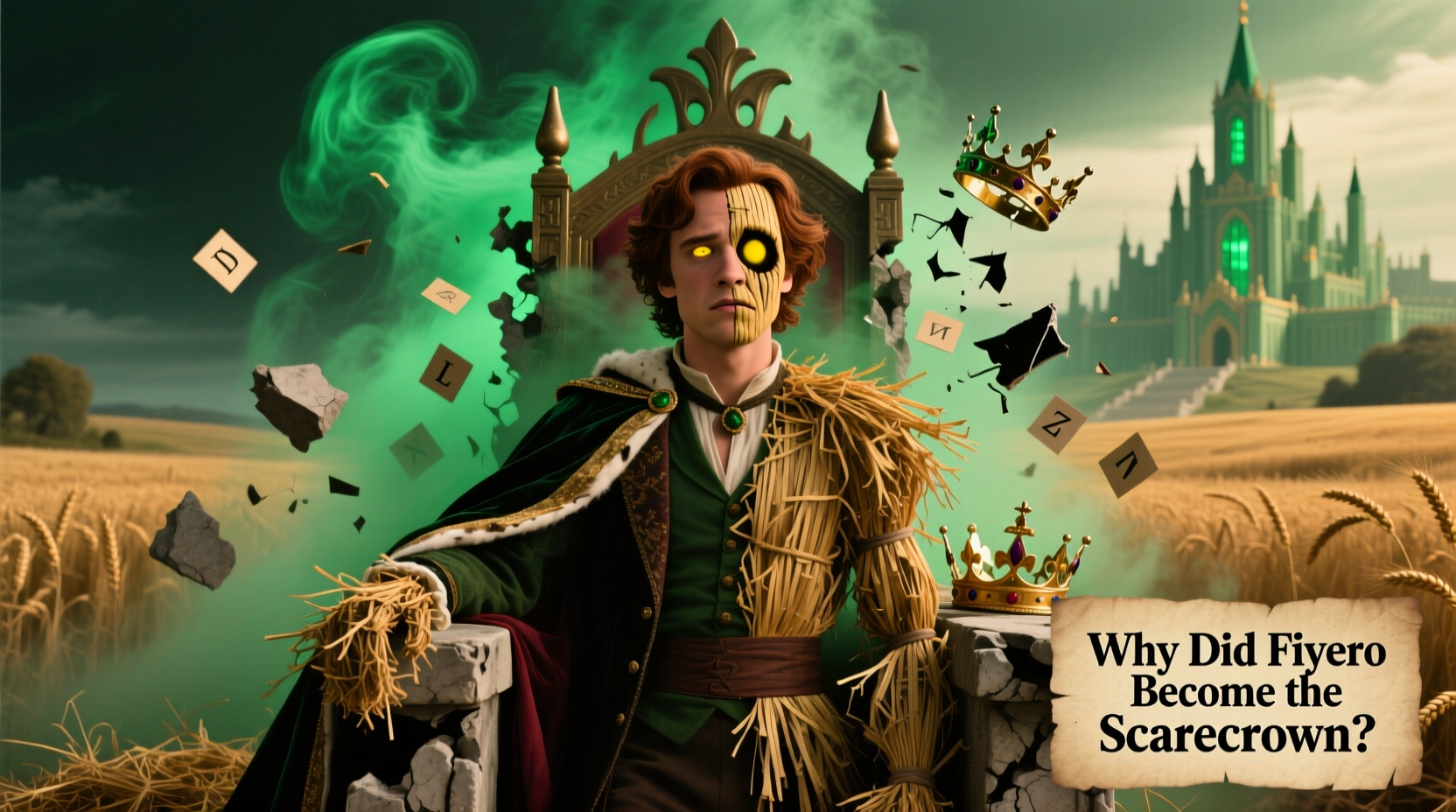
Fiyero begins as a charismatic, carefree prince from the Vinkus, initially portrayed as shallow and popularity-driven. His relationship with Elphaba, the future Wicked Witch of the West, starts with flirtation but evolves into genuine love. As Elphaba becomes increasingly isolated due to her defiance of the Wizard’s regime and her advocacy for the rights of Animals (with a capital “A”), Fiyero shifts from bystander to ally—and ultimately, to martyr.
His transformation occurs offstage between Act I and Act II. After helping Elphaba escape capture, he is captured by the Wizard’s guards. Rather than betray her, he remains silent. In retaliation, the Wizard’s forces subject him to a brutal magical punishment: they strip away his human form and reassemble him as a sentient Scarecrow, left hanging lifelessly in a cornfield—a fate both grotesque and poetic.
When Elphaba discovers him, she uses magic to restore his ability to move and speak, though not his original body. This moment marks a turning point—not just for their relationship, but for the entire moral arc of the story.
Sacrifice and Redemption: The Emotional Core
Fiyero’s metamorphosis into the Scarecrow is not merely physical—it represents a complete personal evolution. Once defined by vanity and social status, he earns true heroism through suffering and loyalty. His new form symbolizes what he has lost: his identity, comfort, and humanity. Yet paradoxically, it also reflects what he has gained: integrity, depth, and unconditional love.
As the Scarecrow, Fiyero can no longer hide behind charm or privilege. He speaks more honestly, acts more courageously, and loves more selflessly. His transformation mirrors Elphaba’s own journey—both are literally and figuratively “changed” by a world that fears difference.
“Sometimes people don’t deserve to keep their shape when their soul has already shown its true form.” — Stephen Schwartz, composer and lyricist of *Wicked*
This quote from Schwartz underscores the idea that external appearance in Wicked often misrepresents inner truth. The Wicked Witch is kind; the Wizard is corrupt; and the Scarecrow, though stitched together from rags and straw, possesses more heart and courage than any other character.
Symbolism Behind the Straw Man
The Scarecrow in L. Frank Baum’s original universe lacked confidence in his intelligence, despite being thoughtful and clever. In Wicked, the symbolism is inverted and deepened. Fiyero doesn’t lack brains—he sacrifices everything he knows to gain wisdom. The straw becomes a metaphor for disposability, reflecting how society treats those who resist authority.
Moreover, scarecrows are meant to frighten and be ignored—placed at the margins, seen but not heard. This parallels how dissenters like Elphaba and Fiyero are treated by the Emerald City regime. By turning Fiyero into a literal scarecrow, the state attempts to erase his personhood, reducing him to a warning for others. But instead of silencing him, the act cements his legacy.
| Aspect | Original Scarecrow (Oz) | Fiyero as Scarecrow (Wicked) |
|---|---|---|
| Origin | Created by Dorothy’s companions | Magically transformed as punishment |
| Motivation | Seeks brains from the Wizard | Already intelligent; seeks reunion and justice |
| Symbolism | Lack of intellect | Sacrifice, resilience, hidden wisdom |
| Role in Story | Comic relief, loyal friend | Tragic hero, romantic lead, revolutionary |
A Timeline of Transformation: How Fiyero Became the Scarecrow
- Act I – Shallow Beginnings: Fiyero flirts with Galinda and Elphaba, embodying campus charm without depth.
- Mid-Act I – Awakening: He begins questioning the Wizard’s policies after witnessing Animal oppression.
- End of Act I – Defection: He helps Elphaba escape, declaring “I’m through playing the fool.”
- Intermission – Capture and Torture: Offstage, he is taken and transformed by the Wizard’s forces.
- Act II – Rebirth: Found by Elphaba, he returns as the Scarecrow, now fully committed to resistance and love.
This progression isn’t just romantic—it’s political. Fiyero’s change illustrates how personal relationships can awaken moral responsibility. His fate also critiques authoritarian regimes that use dehumanization as a tool of control.
Real-World Parallels: A Mini Case Study
Consider the story of political dissidents who survive imprisonment but return physically altered—scarred, weakened, or silenced. Like Fiyero, they may lose their former lives but gain symbolic power. One real-world example is Natan Sharansky, a Soviet refusenik imprisoned for nine years, who later said, “They took my freedom, but not my identity.”
In much the same way, Fiyero’s transformation strips him of autonomy, yet his spirit remains unbroken. His new form becomes a living testament to resistance. When Elphaba revives him, it’s not just an act of magic—it’s an affirmation that love and memory can defy even the cruelest erasure.
Common Misconceptions About Fiyero’s Fate
- Myth: Fiyero dies and is reborn as the Scarecrow.
Truth: He survives in a magically altered state—conscious, feeling, and emotionally present. - Myth: The change is voluntary.
Truth: It’s a punitive act by the Wizard’s regime, making it a form of torture. - Myth: The Scarecrow forgets who he was.
Truth: He remembers everything, including his love for Elphaba, which drives his actions in Act II.
Expert Insight: Why This Twist Resonates
“The brilliance of turning Fiyero into the Scarecrow lies in its emotional symmetry. He becomes the man Elphaba always believed he could be—stripped bare, yes, but finally authentic.” — Dr. Lena Peterson, Theater Historian and Author of *Reimagining Oz: Modern Mythmaking on Stage*
Peterson’s analysis highlights how the twist serves dual purposes: it honors the source material while deepening character development. It also allows the audience to see love persist beyond physical form—a theme rarely explored so poignantly in mainstream musical theater.
FAQ
Is Fiyero really the same Scarecrow from The Wizard of Oz?
Yes, within the internal logic of Wicked, this version of the Scarecrow is explicitly Prince Fiyero. The musical confirms this through dialogue and emotional continuity, positioning Wicked as a prequel to Baum’s classic tale.
Why didn’t Elphaba turn him back to normal?
Despite her powerful magic, Elphaba cannot reverse the spell—likely because the transformation was designed to be irreversible by the Wizard’s sorcerers. More importantly, restoring his body might undermine the thematic message: true identity isn’t tied to appearance.
Does Fiyero remember his past life?
Absolutely. His memories remain intact. In fact, his love for Elphaba is what sustains him during captivity. His first words upon revival are tender and personal, confirming his enduring consciousness.
Conclusion: Love Beyond Form
Fiyero’s transformation into the Scarecrow is far more than a plot twist—it’s the emotional and philosophical core of Wicked. It challenges audiences to reconsider what makes someone human: Is it flesh and blood? Or is it loyalty, courage, and love? By turning a prince into a figure of mockery and then elevating him through compassion, Wicked redefines heroism.
The story reminds us that identity persists even when the world tries to erase it. Fiyero, once defined by superficial charm, becomes immortal not through power or prestige, but through sacrifice. And in the end, it’s not the crown or the costume that matters—it’s the heart beneath the straw.




 浙公网安备
33010002000092号
浙公网安备
33010002000092号 浙B2-20120091-4
Comments
No comments yet. Why don't you start the discussion?