
In William Shakespeare’s tragedy Othello, betrayal, jealousy, and manipulation converge into a devastating chain of events. At the heart of this chaos is Iago, one of literature’s most complex villains. His orchestration of deception reaches its peak when he kills his own accomplice, Roderigo. The question “Why did Iago kill Roderigo?” cuts to the core of the play’s psychological depth and moral collapse. To understand this act, we must examine Iago’s motives, his manipulation tactics, and how Roderigo’s death serves as both a practical necessity and symbolic culmination of the tragedy.
The Role of Iago: Architect of Deception
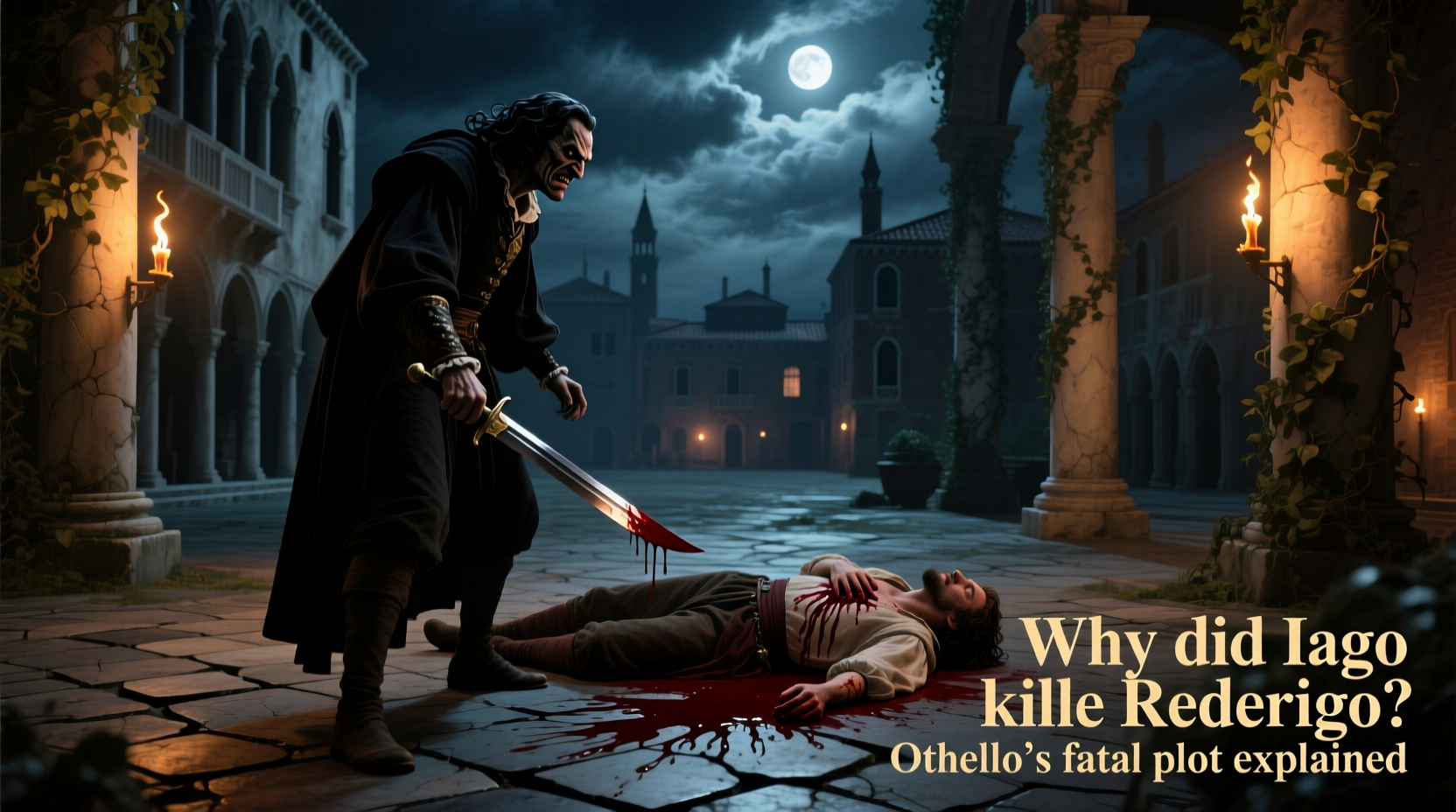
Iago is not merely a villain; he is a master strategist who exploits human weaknesses with chilling precision. Appointed as Othello’s ensign, he harbors deep resentment for being passed over for promotion in favor of Michael Cassio. This perceived injustice becomes the spark for his elaborate revenge plot. But Iago’s motivations extend beyond professional slight—he thrives on control, chaos, and the destruction of trust.
His manipulation begins early. He incites Brabantio, Desdemona’s father, against Othello by framing their marriage as an act of seduction through witchcraft. From there, he turns his focus inward, planting seeds of doubt in Othello’s mind about Desdemona’s fidelity. Every character becomes a pawn—none more tragically than Roderigo.
Roderigo: The Gullible Pawn
Roderigo is a wealthy suitor infatuated with Desdemona. Despite her marriage to Othello, he clings to hope—hope that Iago manipulates relentlessly. Promising to help him win Desdemona, Iago extracts money and jewels from Roderigo under false pretenses. In reality, Iago has no intention of helping him. Instead, he uses Roderigo’s obsession to further destabilize Othello’s world.
Roderigo participates in attacks on Cassio, disrupts public order, and even attempts murder—all at Iago’s urging. Yet, as the plot unfolds and nothing changes, Roderigo grows suspicious. In Act V, Scene 1, he confronts Iago, demanding his stolen riches back and threatening exposure: “I will make myself known to Desdemona. If she will return me my jewels, I will give over my suit and repent my unlawful solicitation.”
This moment marks a turning point. Roderigo is no longer useful—and worse, he’s dangerous.
Why Did Iago Kill Roderigo?
The murder of Roderigo is not impulsive. It is calculated, cold, and essential to Iago’s survival. Three key reasons explain why Iago kills him:
- To eliminate a liability: Roderigo now knows too much. He has funded Iago’s schemes and witnessed his treachery. If exposed, Iago’s entire plot collapses.
- To maintain control of the narrative: By killing Roderigo and framing others (particularly Cassio), Iago attempts to shift blame and preserve his reputation as honest and loyal.
- To prevent financial loss: Iago has kept the jewels meant for Desdemona. Returning them—or having Roderigo reclaim them—would expose his theft and fraud.
During the ambush on Cassio, Iago stabs Roderigo from behind after Roderigo fails to kill Cassio. Then, when Roderigo cries out, wounded but alive, Iago finishes him off without hesitation. He later tries to pin the attack on Bianca and others, showing how far he’ll go to protect his facade.
“Demand me nothing. What you know, you know. From this time forth I never will speak word.” — Iago, Act V, Scene 2
This final silence underscores his refusal to justify his actions. There is no redemption, no remorse—only the void left by unchecked malice.
The Fatal Plot: A Timeline of Manipulation
Understanding Iago’s full strategy requires tracing the progression of his deceit. Below is a step-by-step breakdown of how he engineers the tragedy, culminating in Roderigo’s death.
- Act I: Iago convinces Roderigo that Desdemona’s love for Othello is temporary and can be undermined. He begins taking money from Roderigo in exchange for false promises.
- Act II: After arriving in Cyprus, Iago orchestrates a drunken brawl involving Cassio, leading to Cassio’s demotion. He then advises Cassio to appeal to Desdemona for reinstatement—a move designed to fuel Othello’s suspicion.
- Act III: Iago plants the idea that Desdemona is unfaithful, using the handkerchief (a gift from Othello) as false evidence. He manipulates Emilia (his wife) into stealing it and places it in Cassio’s quarters.
- Act IV: Othello descends into jealous rage. Iago reinforces the illusion of betrayal, pushing Othello toward violence. Meanwhile, Roderigo grows frustrated and demands answers.
- Act V: Iago arranges for Roderigo to attack Cassio. When the plan falters, he kills Roderigo to silence him. Othello murders Desdemona, discovers the truth too late, and takes his own life. Iago is arrested, but not before murdering Emilia for exposing him.
Expert Insight: The Psychology of Iago
Scholars have long debated whether Iago is motivated by envy, racism, nihilism, or pure sadism. Harold Bloom, renowned literary critic, describes Iago as “the embodiment of amorality,” suggesting that his evil stems not from passion but from intellect divorced from conscience.
“Iago does not destroy because he loves evil; he destroys because he cannot bear that others might find happiness he himself cannot comprehend.” — Harold Bloom, Shakespeare: The Invention of the Human
This interpretation casts Iago not just as a schemer, but as a psychological force—an agent of entropy in a world built on trust and love. His murder of Roderigo isn’t personal; it’s transactional. Roderigo outlived his usefulness, and in Iago’s warped logic, that warrants elimination.
Do’s and Don’ts of Understanding Iago’s Motives
| Do | Don’t |
|---|---|
| Consider Iago’s sense of betrayal by Othello and Cassio as a catalyst | Assume Iago acts solely out of racial hatred toward Othello |
| Analyze how he exploits each character’s vulnerability | Believe Iago has a coherent endgame beyond causing suffering |
| Recognize the role of appearance vs. reality in his manipulation | Expect Iago to show remorse or self-awareness |
| Examine his language—often laced with irony and double meanings | Take his stated reasons at face value |
Frequently Asked Questions
Did Roderigo know he was being used?
Yes—increasingly so. By Act V, Roderigo explicitly accuses Iago of deception and threatens to expose him. This growing awareness is precisely what makes him a threat and leads to his murder.
Could Iago have succeeded without killing Roderigo?
Possibly, but not safely. With Roderigo alive and angry, Iago risked exposure. Eliminating him removed a direct link to his fraud and allowed Iago to manipulate the aftermath of the ambush on Cassio.
Is Iago punished in the end?
He is arrested and sentenced to torture and execution (“You are to be led hence to prison; then, to the rack”), but Shakespeare leaves the final punishment offstage. Unlike Othello or Desdemona, Iago survives physically—making his fate arguably more haunting.
Conclusion: The Cost of Trusting Appearances
The death of Roderigo is not just a plot device—it is a symbol of how easily trust can be weaponized. Iago kills him not out of passion, but because Roderigo becomes inconvenient. In doing so, Shakespeare exposes the fragility of justice, loyalty, and human connection when faced with a mind like Iago’s.
Othello trusts Iago because he appears honest. Desdemona trusts her marriage because it is built on love. Roderigo trusts Iago because he offers hope. All are destroyed—not by grand conspiracies, but by small lies that compound into catastrophe.




 浙公网安备
33010002000092号
浙公网安备
33010002000092号 浙B2-20120091-4
Comments
No comments yet. Why don't you start the discussion?