
For over a decade, MythBusters captivated audiences with explosive experiments, rigorous testing, and an unrelenting curiosity about the world. From Hollywood stunts to urban legends, the show turned scientific inquiry into must-watch television. But in 2016, after 14 seasons and more than 250 episodes, Discovery Channel brought the original series to a close. The decision sparked confusion, disappointment, and widespread speculation. Was it canceled? Did the hosts leave? Or was it simply time to move on? Understanding why MythBusters ended requires unpacking a mix of creative fatigue, network shifts, cast dynamics, and the inevitable evolution of long-running television.
The Final Season and Official Announcement
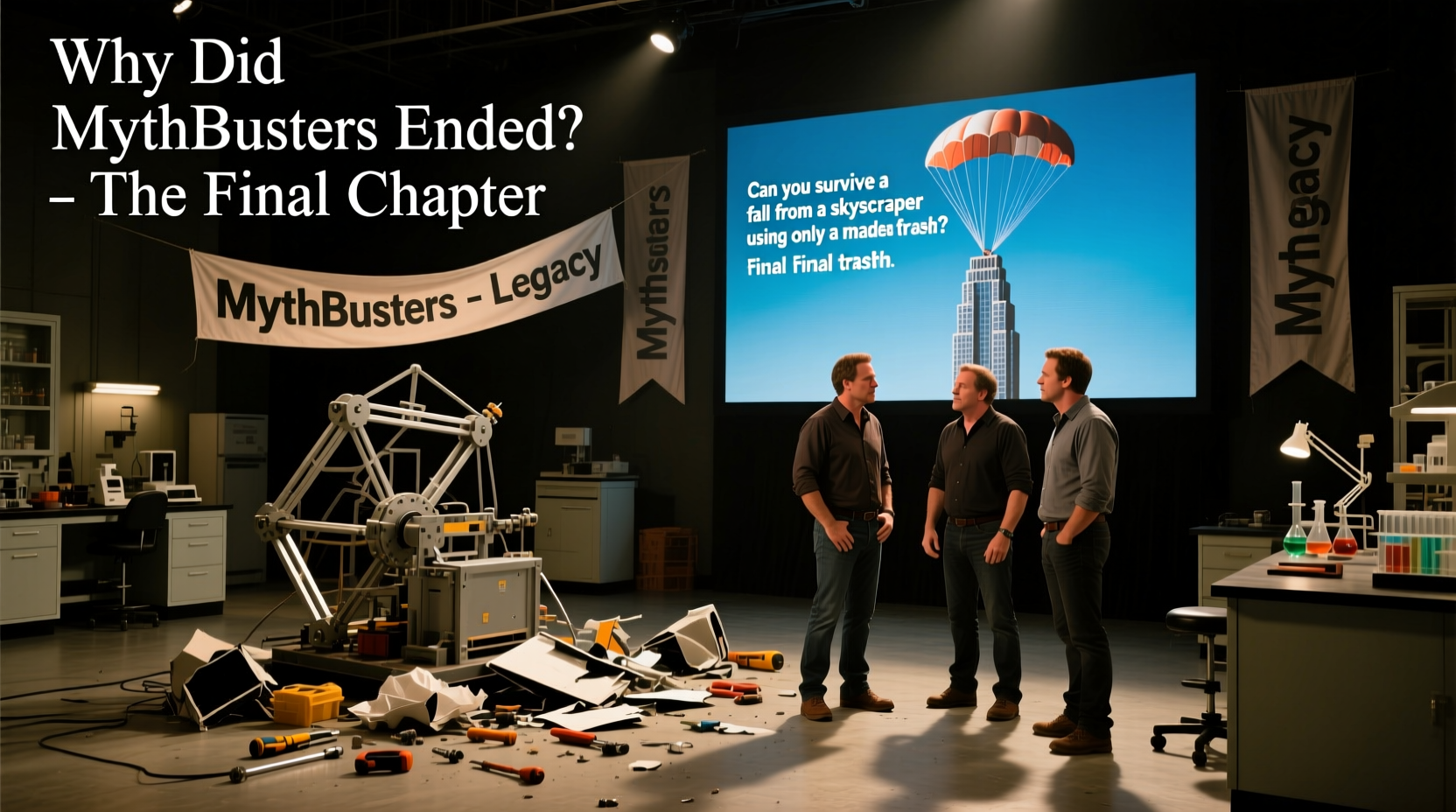
In March 2016, Discovery aired the two-part finale titled “The Explosion Special,” marking the official end of the original MythBusters era. Hosts Adam Savage and Jamie Hyneman, the show’s core duo since its 2003 debut, confirmed they were stepping away. In a joint statement, they described the conclusion not as a cancellation but as a mutual decision to pursue new opportunities after 13 years of continuous production.
“We’re sad to see it end,” Savage said in a post-finale interview. “But we also recognize that ending on a high note is better than overstaying our welcome.”
Despite this framing, internal sources and industry reports suggest the network played a significant role. By 2015, ratings had gradually declined from their peak in the late 2000s. Production costs remained high due to elaborate builds and safety protocols. Meanwhile, Discovery was shifting focus toward reality programming and lower-cost content. The combination made renewal less appealing.
“We gave everything we had to this show. But television changes. Audiences change. And sometimes, even when you still love what you do, the environment around you doesn’t support continuing.” — Adam Savage, 2016
Creative Burnout and Personal Growth
Behind the scenes, both Savage and Hyneman faced mounting physical and mental demands. Each episode required weeks of research, fabrication, testing, and filming—often under tight deadlines. The duo worked over 300 days per year at the height of the series.
Adam Savage later revealed in interviews that he experienced anxiety and burnout, particularly during the final seasons. “I wasn’t sleeping. I wasn’t present with my family. I was constantly thinking about the next build,” he admitted on his podcast in 2017. Jamie Hyneman, known for his stoic demeanor, echoed similar sentiments, noting that innovation had become harder to sustain.
Their departure wasn’t impulsive. Over several months, they discussed whether they could continue delivering fresh, meaningful content. Ultimately, they concluded that leaving while the show was still respected was preferable to risking a decline in quality.
The Failed Revival and New Hosts Experiment
Discovery didn’t abandon the MythBusters brand. In 2017, the network launched a reboot with new hosts: Jon Lung and Brian Louden, winners of the competition spin-off MythBusters: The Search. Aimed at a younger audience, the revival emphasized faster pacing and social media integration.
However, fans largely rejected the new format. Critics noted a lack of chemistry between the hosts and a shift toward spectacle over methodical science. Ratings failed to rebound, and the reboot was canceled after two seasons.
The failure underscored a key lesson: MythBusters wasn’t just a formula—it was built on the unique dynamic between Adam and Jamie. Their contrasting personalities (Savage’s enthusiasm vs. Hyneman’s precision), deep craftsmanship, and genuine respect for the scientific process were irreplaceable.
Legacy and Cultural Impact
Though the original series ended, its influence endures. MythBusters helped popularize STEM education, inspiring countless students to explore engineering, physics, and critical thinking. Schools across the U.S. incorporated episodes into curricula, using myths like “Can you really shoot around a corner?” or “Is toast really more likely to land butter-side down?” to teach experimental design.
The show also redefined science communication on television. It proved that rigor and entertainment aren’t mutually exclusive. By embracing trial, error, and occasional failure, MythBusters normalized the scientific method for millions.
| Aspect | Original Series (2003–2016) | Reboot (2017–2018) |
|---|---|---|
| Lead Hosts | Adam Savage & Jamie Hyneman | Jon Lung & Brian Louden |
| Episodes | 278 | 28 |
| Avg. Viewership (millions) | 2.0–3.5 (peak) | 0.8–1.2 |
| Tone | Methodical, hands-on, educational | Faster-paced, visually driven |
| Fan Reception | Highly positive, cult following | Mixed to negative |
Mini Case Study: How MythBusters Influenced Real-World Science
In 2012, a team of mechanical engineering students at the University of California, Davis, cited MythBusters as inspiration for their senior design project: a full-scale replica of the show’s rocket-powered surfboard. Though not intended for actual use, the build followed the same principles of hypothesis, iteration, and safety testing seen on the show.
“We watched every vehicle-based myth before starting,” said project lead Maria Tran. “It taught us how to break down complex problems and test them step by step.” The project received departmental honors and was featured in a campus science outreach program—demonstrating how MythBusters extended beyond entertainment into real educational impact.
Why Cancellation Still Matters
The term “cancellation” often carries stigma, implying failure. But in the case of MythBusters, it reflects broader industry realities. Long-form, effects-heavy programming is expensive. As streaming platforms rose and attention spans shortened, networks favored scalable formats over niche, labor-intensive productions.
Yet the show’s end wasn’t solely economic. Creative integrity played a central role. Savage and Hyneman chose to exit rather than compromise their standards. That decision preserved the show’s reputation and allowed fans to remember it fondly.
FAQ
Was MythBusters canceled or did it end voluntarily?
It was a combination. While Adam Savage and Jamie Hyneman decided they were ready to move on, Discovery Channel did not renew the show, indicating that network support had waned. The departure was framed as a mutual conclusion rather than a sudden firing.
Will there ever be another original MythBusters series?
As of 2024, there are no plans for a revival with the original hosts. Both Savage and Hyneman have pursued independent projects—Savage with YouTube and live tours, Hyneman with robotics and consulting. They’ve expressed openness to occasional collaborations but not a return to regular filming.
Did the cast members stay friends after the show ended?
Yes. Despite their contrasting styles, Savage and Hyneman have consistently spoken highly of each other. In multiple interviews, they’ve described their relationship as deeply respectful and professionally symbiotic. Kari Byron, Tory Belleci, and Grant Imahara (who left in 2014) also remain connected to the community and occasionally collaborate on science outreach.
Step-by-Step: How MythBusters Shaped Science Communication
- Identify a myth – Often drawn from movies, viral videos, or folklore.
- Research existing knowledge – Review physics principles, historical data, or prior experiments.
- Design a test – Build rigs, scale models, or simulations to replicate conditions.
- Conduct trials – Run experiments with controls and variables.
- Analyze results – Use high-speed cameras, sensors, and slow-motion playback.
- Draw conclusions – Declare the myth “busted,” “plausible,” or “confirmed.”
- Communicate clearly – Explain findings in accessible language without oversimplifying.
This process became a blueprint for science educators and communicators worldwide, proving that curiosity-driven inquiry can be both entertaining and intellectually honest.
Conclusion: The Myth Lives On
MythBusters didn’t truly end—it evolved. Its legacy persists in classrooms, maker spaces, and digital content created by a generation of fans who learned to question, test, and rebuild. While the explosions stopped rolling, the spirit of experimentation continues.
The show’s conclusion reminds us that all great things have a natural arc. Knowing when to step back isn’t failure; it’s stewardship. For Adam, Jamie, and the entire team, ending MythBusters was an act of respect—for the craft, the audience, and the integrity of science itself.




 浙公网安备
33010002000092号
浙公网安备
33010002000092号 浙B2-20120091-4
Comments
No comments yet. Why don't you start the discussion?