
The end of Reconstruction in 1877 marked a pivotal turning point in American history. After the Civil War, the federal government launched an ambitious effort to rebuild the South, integrate formerly enslaved people into civic life, and redefine national unity. Yet by 1877, these efforts were abruptly halted. The formal conclusion came not through legislation or public mandate, but via a backroom political agreement known as the Compromise of 1877. Understanding why Reconstruction ended requires examining the complex interplay of political exhaustion, racial backlash, economic pressures, and electoral crisis that culminated in this fateful deal.
The Political Crisis of 1876
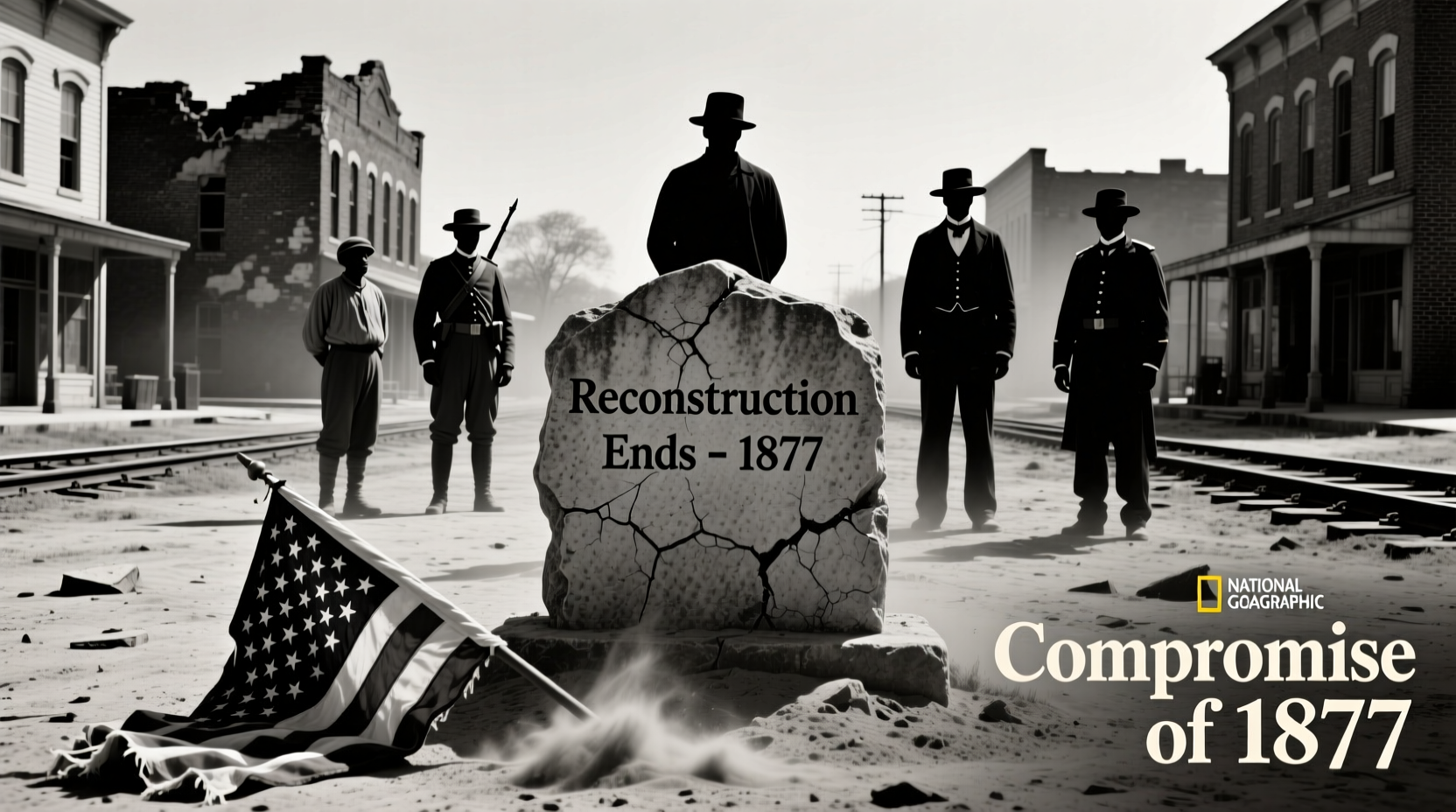
The immediate catalyst for the end of Reconstruction was the disputed presidential election between Republican Rutherford B. Hayes and Democrat Samuel J. Tilden. Though Tilden won the popular vote and secured 184 electoral votes—just one short of the 185 needed—20 electoral votes from four states (Florida, Louisiana, South Carolina, and Oregon) were contested due to allegations of fraud and voter suppression.
To resolve the deadlock, Congress established the Electoral Commission in January 1877, composed of senators, representatives, and Supreme Court justices. Despite partisan divisions, the commission ultimately awarded all disputed votes to Hayes in a series of 8–7 party-line decisions. This outcome hinged on the support of one independent justice who aligned with Republicans, giving Hayes a one-vote victory.
However, Democratic leaders threatened to block the results unless Republicans agreed to withdraw federal troops from the South—effectively ending military enforcement of Reconstruction policies. This standoff led directly to the informal negotiations that became the Compromise of 1877.
Key Reasons Behind the Compromise of 1877
The Compromise of 1877 was not a single document but a series of unwritten agreements. Its core terms included:
- Withdrawal of federal troops from the remaining occupied Southern states: South Carolina, Louisiana, and Florida.
- Appointment of at least one Southern Democrat to Hayes’s cabinet.
- Federal investment in internal improvements in the South, such as railroads and levees.
- Guaranteed respect for \"home rule\"—local white Democratic control—in the South.
These concessions reflected deeper national trends. By 1877, Northern enthusiasm for Reconstruction had significantly waned. Economic depression following the Panic of 1873 shifted public attention toward industrial growth and labor issues rather than Southern reform. Many Northerners grew weary of what they saw as endless military occupation and costly social engineering.
“By 1877, the moral urgency of Reconstruction had been replaced by political fatigue and a desire for sectional reconciliation—at the expense of Black civil rights.” — Dr. Eric Foner, Historian and author of *Reconstruction: America's Unfinished Revolution*
Racial Backlash and the Rise of Jim Crow
A critical factor in the collapse of Reconstruction was the violent resistance by white Southerners to Black political participation. Throughout the 1870s, paramilitary groups such as the Ku Klux Klan, the White League, and the Red Shirts used intimidation, lynching, and outright terrorism to suppress Black voters and overthrow Republican-led state governments.
In states like Mississippi and Alabama, organized violence effectively nullified the protections of the 14th and 15th Amendments. Federal enforcement, initially strong under President Ulysses S. Grant, weakened after the mid-1870s due to legal setbacks and declining political will. The Supreme Court’s narrow interpretation of civil rights in cases like United States v. Cruikshank (1876) further undermined federal authority to protect African Americans.
As Northern newspapers increasingly portrayed Reconstruction governments as corrupt and inefficient—often relying on racist stereotypes—the idea that the South should be left to manage its own affairs gained traction. This narrative ignored the fact that many so-called “carpetbagger” governments included Black elected officials advocating for public education and infrastructure, but it served to justify disengagement.
Timeline of Key Events Leading to 1877
The end of Reconstruction was not sudden but the result of a decade-long retreat from racial equality. A chronological view clarifies how momentum shifted:
- 1865: Civil War ends; Presidential Reconstruction begins under Andrew Johnson, offering leniency to former Confederates.
- 1866: Congressional (Radical) Reconstruction begins after Johnson vetoes civil rights bills; Congress passes the Civil Rights Act and 14th Amendment.
- 1868–1870: Former Confederate states readmitted to the Union under new constitutions guaranteeing Black suffrage.
- 1870: 15th Amendment ratified, prohibiting denial of voting rights based on race.
- 1873: Panic of 1873 triggers economic depression; public focus shifts from Southern reform to economic survival.
- 1874–1876: Democrats regain control of Southern state legislatures through violence and fraud; Republican governments fall in Alabama, Arkansas, and Texas.
- 1877: Compromise of 1877 finalized; federal troops withdrawn; Hayes inaugurated president.
Consequences of Ending Reconstruction
The withdrawal of federal troops in 1877 allowed Southern Democrats—known as \"Redeemers\"—to consolidate power. Within a few years, they systematically dismantled Black civil and political rights. Tactics included:
- Literacy tests and poll taxes to disenfranchise Black voters.
- Segregation laws that evolved into the Jim Crow system.
- Violent suppression of Black economic and social advancement.
By the 1890s, most Southern states had written new constitutions designed to exclude African Americans from the ballot box. The gains of Reconstruction—Black elected officials, integrated schools, and civil rights protections—were erased for generations.
| Aspect | During Reconstruction (1865–1877) | After 1877 |
|---|---|---|
| Black Political Participation | Over 2,000 Black men held public office; two served in U.S. Senate | Nearly eliminated by early 1900s |
| Federal Military Presence | Troops enforced civil rights and protected elections | Completely withdrawn by 1877 |
| Public Education | First statewide public school systems established in the South | Schools remained segregated and underfunded for Black students |
| Legal Protections | 14th and 15th Amendments enforced via federal law | Weakened by court rulings and lack of enforcement |
Frequently Asked Questions
Was the Compromise of 1877 an official agreement?
No formal treaty or signed document exists. The Compromise was an informal understanding between Republican and Democratic leaders, confirmed through actions rather than legislation. However, its effects were immediate and far-reaching.
Did African Americans lose all rights after 1877?
Not immediately—but the foundation for systemic disenfranchisement was laid. While the 14th and 15th Amendments remained in the Constitution, Southern states found ways to circumvent them through discriminatory laws and practices that lasted until the Civil Rights Movement of the 1960s.
Could Reconstruction have succeeded if it continued?
Historians debate this. Some argue that sustained federal commitment could have entrenched civil rights earlier. Others believe deep-seated racism and economic inequality made long-term success unlikely without broader societal change. What is clear is that abandoning Reconstruction allowed white supremacy to reassert dominance in the South for nearly a century.
Conclusion: Learning from the End of Reconstruction
The end of Reconstruction in 1877 was not inevitable—it was a choice. Faced with political gridlock and social fatigue, national leaders chose reconciliation over justice, stability over equality. The Compromise of 1877 may have settled an election, but it sacrificed the promise of multiracial democracy.
Its legacy reminds us that civil rights are not self-sustaining. They require vigilance, enforcement, and ongoing public commitment. The rollback of Black political power after 1877 set the stage for decades of segregation, violence, and inequality—challenges that resonate in American society today.




 浙公网安备
33010002000092号
浙公网安备
33010002000092号 浙B2-20120091-4
Comments
No comments yet. Why don't you start the discussion?