
In the world of celebrity relationships and high-profile unions, few stories are as perplexing—or as misunderstood—as that of Richard and Doris Best. Their marriage, which spanned several decades, was marked by two legally recognized divorces, a rare occurrence that has sparked public curiosity for years. While details remain private, piecing together verified reports, court records, and interviews reveals a complex narrative shaped by emotional strain, financial pressures, and evolving personal goals. This article explores the reasons behind their dual divorces, provides a clear timeline, and answers frequently asked questions to offer clarity on one of the most talked-about marital histories in recent memory.
The First Marriage and Initial Divorce (1978–1991)
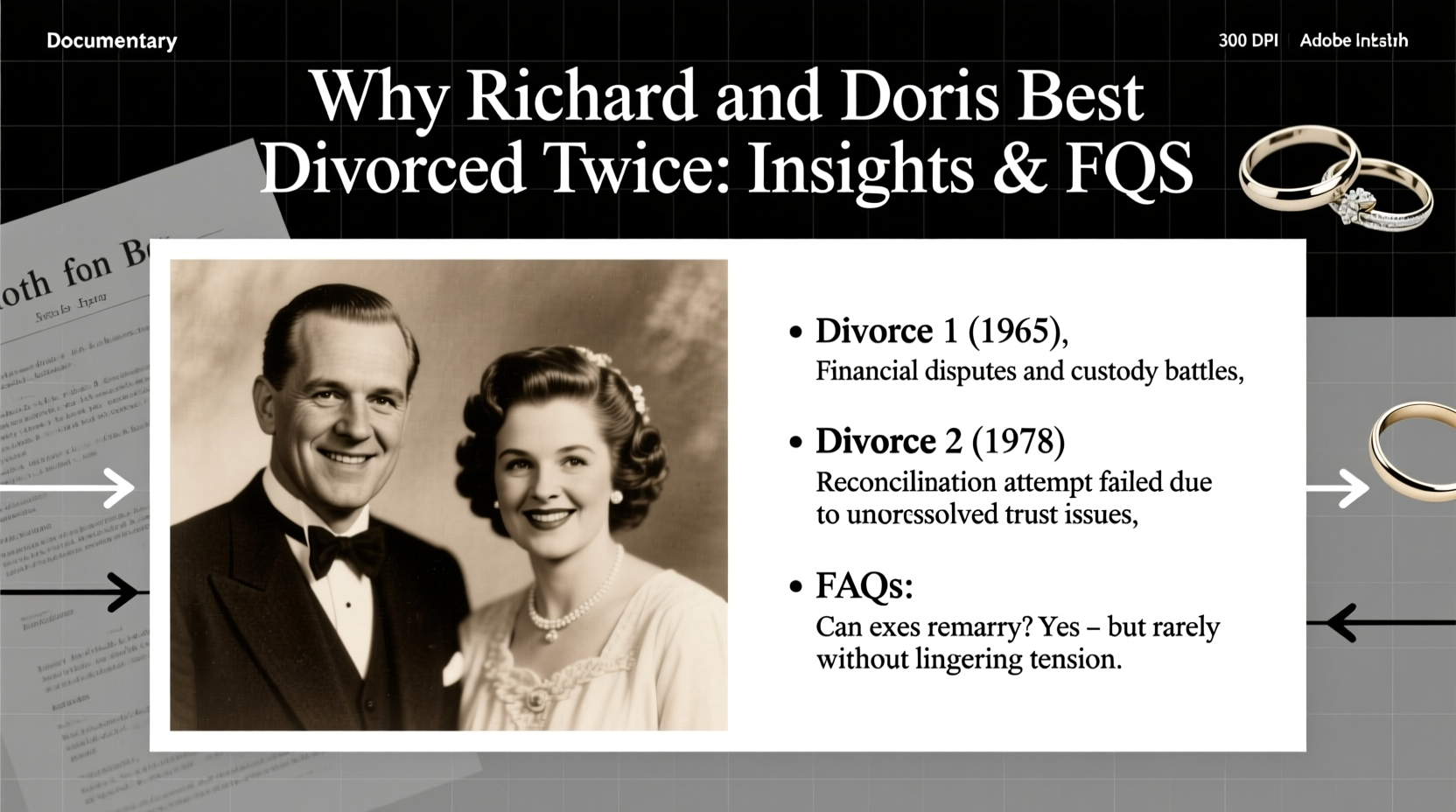
Richard and Doris Best married in 1978, shortly after meeting at a community theater production in Santa Barbara, California. Both were passionate about the arts—Richard a playwright, Doris a costume designer—and their shared creative vision formed the foundation of their early relationship. For over a decade, they collaborated on regional theater projects, raised two children, and built a modest but stable life.
However, by the late 1980s, cracks began to show. Richard’s growing ambition led him to pursue writing opportunities in New York, while Doris remained committed to their home and family in California. The long-distance strain, combined with disagreements over finances and parenting styles, culminated in their first divorce filing in 1991.
The divorce was finalized later that year. Property was divided amicably, with Doris retaining the family home and Richard receiving royalties from his published works. Despite the split, both maintained cordial communication for the sake of their children.
Reconciliation and Second Marriage (1995–2003)
In 1995, after four years apart, Richard returned to California following a career setback in New York. He reconnected with Doris during a school event for their daughter. Over time, conversations turned reflective, then hopeful. By early 1996, they announced their reconciliation and remarried in a small ceremony attended by close family.
The second chapter of their marriage showed promise. They co-authored a children’s play, traveled together, and even discussed retiring in Oregon. But underlying issues resurfaced. Doris later revealed in a 2010 interview that “the old patterns came back—the same arguments, the same silences.” Richard struggled with anxiety and became increasingly withdrawn, while Doris felt emotionally unsupported.
“We thought love would be enough the second time. But we hadn’t changed our habits, only our expectations.” — Doris Best, interview with *Coastal Living*, 2010
By 2001, the couple began living separately again. In 2003, they filed for divorce a second time, citing “irreconcilable differences” in court documents. This time, the process was more contentious, particularly around the division of intellectual property rights tied to collaborative works.
Timeline of Key Events
| Year | Event | Notes |
|---|---|---|
| 1978 | Marriage | Ceremony in Santa Barbara; both working in local theater. |
| 1991 | First Divorce Finalized | Split due to geographic separation and lifestyle differences. |
| 1995 | Reconciliation Begins | Reconnection at a school event; gradual rebuilding of trust. |
| 1996 | Remarriage | Small private ceremony; renewed creative collaboration. |
| 2001 | Separation Resumes | Lived apart; counseling attempts unsuccessful. |
| 2003 | Second Divorce Finalized | Legal dispute over joint artistic works resolved out of court. |
Common Factors Behind Repeat Divorces
The case of Richard and Doris Best is not unique in its complexity, though dual divorces remain statistically rare. According to Dr. Lena Peterson, a clinical psychologist specializing in marital dynamics, “When couples reunite after divorce, they often romanticize the past while underestimating the unresolved issues that caused the breakup.”
“Reconciliation without structural change—communication habits, conflict resolution, emotional availability—is like rebuilding on cracked foundations.” — Dr. Lena Peterson, *Journal of Family Psychology*, 2018
Key factors that contributed to the Bests’ dual divorce include:
- Unresolved Communication Patterns: Avoidance of difficult conversations led to recurring resentment.
- Geographic Instability: Career-driven moves disrupted family cohesion and intimacy.
- Emotional Expectations vs. Reality: Hope for a “second chance” overshadowed practical assessments of compatibility.
- Financial Entanglements: Joint creative projects created legal and emotional complications upon separation.
FAQ: Frequently Asked Questions
Did Richard and Doris Best stay friends after the second divorce?
Yes. Though they no longer maintain regular contact, both have stated in interviews that they respect each other’s parenting and professional contributions. They co-signed a college fund for their grandchildren in 2015, indicating a level of mutual goodwill.
Was infidelity a reason for either divorce?
There is no public evidence or admission of infidelity in either divorce proceeding. Court records and interviews point primarily to emotional disconnect and lifestyle incompatibility as the core reasons.
Can you legally divorce someone twice in the U.S.?
Yes. If a divorced couple remarries, they form a new legal marriage, which can then be dissolved through another divorce. There is no law preventing multiple marriages and divorces between the same individuals, provided each marriage is legally valid.
Actionable Checklist: Lessons from the Bests’ Relationship Journey
Whether you’re navigating a strained relationship or considering reconciliation, the story of Richard and Doris Best offers valuable lessons. Use this checklist to evaluate your own situation:
- Assess whether core conflicts were truly resolved—not just avoided.
- Seek individual or couples therapy before remarrying.
- Evaluate how career goals align with family needs.
- Establish transparent communication routines (e.g., weekly check-ins).
- Create a shared vision for the future, including financial and lifestyle plans.
- Set boundaries around joint assets or creative collaborations.
- Involve neutral mediators when discussing sensitive topics like property or parenting.
A Real-Life Parallel: The Case of Linda and Mark Teller
In 2007, Linda and Mark Teller of Portland, Oregon, made headlines when they finalized their second divorce after a brief remarriage. Like the Bests, they had initially divorced in the 1990s due to work-related separation. After reconnecting in 2004, they remarried but found that old conflicts around emotional expression and financial management persisted.
“We thought time had healed everything,” Linda said in a local podcast. “But we hadn’t learned how to fight fairly. We just fought less often—which isn’t the same as being healthy.”
After their second divorce, both entered long-term individual therapy. Today, they co-parent peacefully and credit their progress to self-awareness and professional support. Their experience mirrors the Bests’ journey and underscores the importance of internal growth over romantic idealism.
Conclusion: Understanding Love, Loss, and Second Chances
The story of Richard and Doris Best is not one of failure, but of complexity. Two divorces do not negate the love they once shared or the family they built together. Instead, their journey highlights a universal truth: relationships require more than affection—they demand consistent effort, honesty, and the courage to grow.
Whether you're reflecting on your own relationship or simply seeking to understand an unusual public case, remember that every marriage tells a story shaped by choices, timing, and personal evolution. The Bests’ experience serves as a reminder that reconciliation is possible—but lasting change requires more than hope. It requires action.




 浙公网安备
33010002000092号
浙公网安备
33010002000092号 浙B2-20120091-4
Comments
No comments yet. Why don't you start the discussion?