
The fall of the Roman Empire remains one of history’s most debated transitions. While no single event caused its demise, a complex interplay of internal decay and external pressures led to the irreversible decline of a civilization that once dominated the Mediterranean world. The Western Roman Empire officially ended in 476 CE when the last emperor, Romulus Augustulus, was deposed by the Germanic chieftain Odoacer. But this moment was not an abrupt end—it was the culmination of centuries of strain. Understanding why Rome collapsed requires examining political instability, economic deterioration, military overreach, cultural shifts, and barbarian invasions.
Political Instability and Leadership Crisis
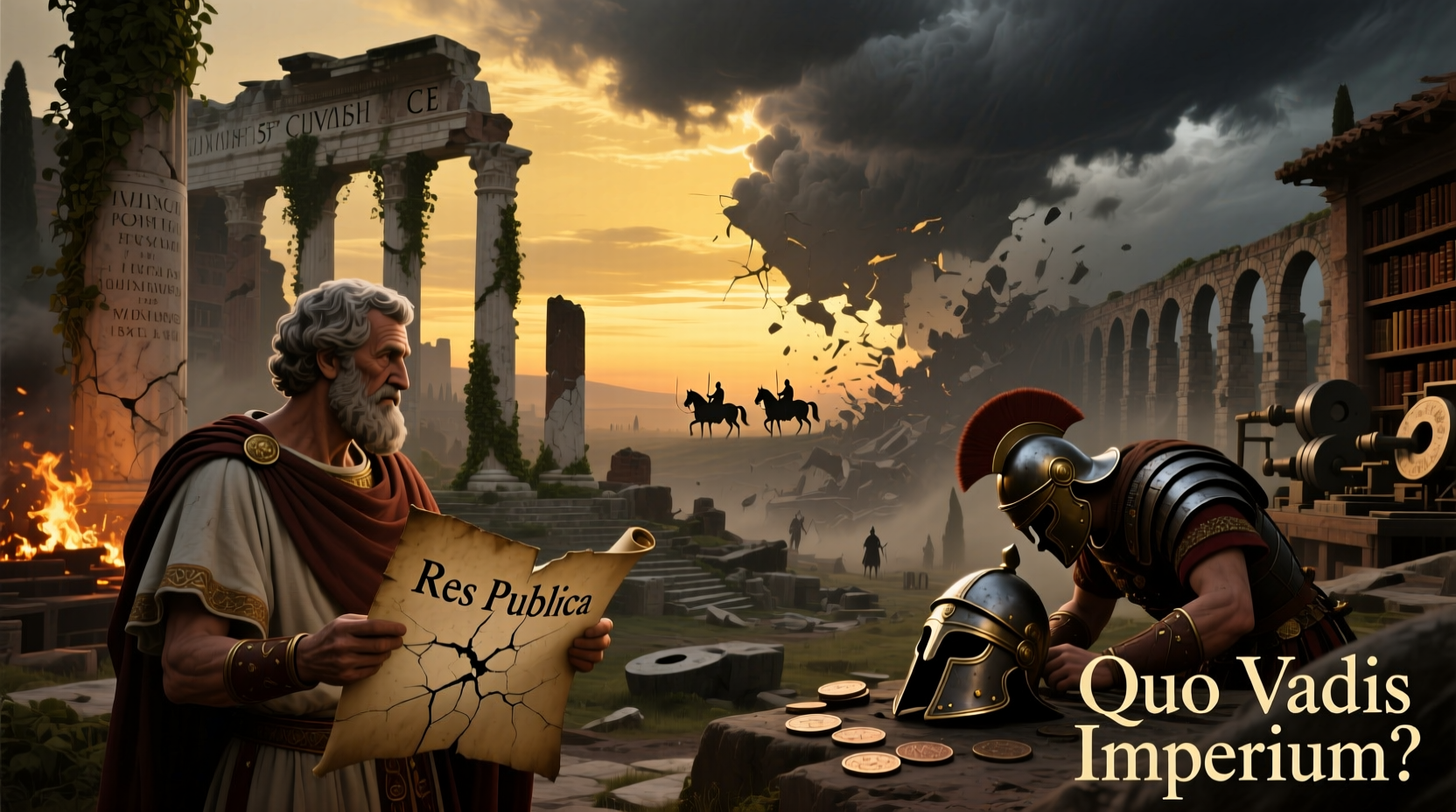
Rome’s political structure, once a model of republican governance, eroded into autocracy and chaos. By the late empire, emperors were often elevated not by merit or lineage but by the military. This created a cycle of short reigns, assassinations, and civil wars. Between 235 and 284 CE—the period known as the Crisis of the Third Century—over 20 emperors ruled, many reigning for less than a year. Frequent coups destabilized administration and weakened central authority.
The division of the empire under Diocletian in 285 CE into Eastern and Western halves aimed to improve manageability, but it also diluted unity. While the Eastern Empire (later Byzantine) thrived, the West struggled with ineffective rulers and bureaucratic inefficiency. Emperors like Honorius and Valentinian III lacked the strength to maintain order, leaving power increasingly in the hands of generals and foreign mercenaries.
Economic Decline and Taxation Burdens
The Roman economy, once fueled by conquest, trade, and slave labor, began to stagnate. As expansion halted, new sources of wealth dried up. The state faced rising costs from maintaining a vast military and bureaucracy while tax revenues declined. To compensate, emperors debased the currency—reducing silver content in coins—leading to rampant inflation.
Small farmers, burdened by heavy taxes and unable to compete with large estates worked by slaves or coloni (tenant farmers), abandoned their land. This rural depopulation reduced agricultural output and further shrank the tax base. Urban centers suffered as trade routes became unsafe and markets contracted.
| Economic Factor | Impact on the Empire |
|---|---|
| Currency Debasement | Caused hyperinflation; merchants lost trust in coinage |
| Heavy Taxation | Forced peasants off land; reduced productivity |
| Decline in Trade | Reduced urban prosperity and state revenue |
| Slave Dependency | Stifled innovation and labor mobility |
| Abandoned Farmland | Increased food insecurity and migration to cities |
Military Overextension and Reliance on Mercenaries
Rome’s military, once the backbone of imperial power, became a liability. The empire’s borders stretched across three continents, requiring constant defense against Germanic tribes, Persians, and others. Maintaining legions far from Rome strained logistics and finances.
To fill ranks, Rome increasingly recruited non-Roman soldiers—often from the very groups it sought to repel. These mercenaries lacked loyalty to the state and were more likely to follow generals who promised pay or land. The Gothic general Alaric, who sacked Rome in 410 CE, had previously served in the Roman army. When grievances went unmet, such forces turned against their employers.
“An empire that cannot defend its frontiers without hiring its enemies will eventually be conquered by them.” — Edward Gibbon, *The History of the Decline and Fall of the Roman Empire*
Barbarian Invasions and Migration Pressures
The movement of peoples during the 4th and 5th centuries accelerated the empire’s collapse. The Huns’ westward push displaced Goths, Vandals, and other Germanic tribes into Roman territory. In 376 CE, the Visigoths were allowed to settle within the empire as foederati (allied troops), but mistreatment led to the Battle of Adrianople in 378, where they annihilated a Roman army.
Subsequent waves of invasion followed: the Vandals crossed into North Africa, cutting off Rome’s grain supply; the Ostrogoths invaded Italy; and in 455, the Vandals sacked Rome itself. These incursions were not isolated raids but part of a broader pattern of migration and settlement that fragmented imperial control.
Timeline of Key Invasions Leading to Collapse
- 376 CE: Visigoths cross Danube, seeking refuge from Huns
- 378 CE: Visigoths defeat Romans at Adrianople
- 410 CE: Alaric and the Visigoths sack Rome
- 439 CE: Vandals capture Carthage, disrupting Mediterranean trade
- 455 CE: Vandals sack Rome again
- 476 CE: Odoacer deposes Romulus Augustulus, ending Western Empire
Sociocultural Decay and Loss of Civic Identity
Beyond material factors, a gradual erosion of civic values contributed to Rome’s decline. Citizenship, once a source of pride and duty, lost meaning as rights were extended widely and responsibilities diluted. Public life deteriorated; citizens withdrew from political participation, relying instead on spectacle and bread distribution (the “bread and circuses” phenomenon).
Christianity, while providing spiritual cohesion, also shifted focus from earthly governance to eternal salvation. Some historians argue this diverted energy from civic duties, though others note that the Church later preserved literacy and administration. Still, the traditional Roman virtues of discipline, service, and patriotism waned in an era of uncertainty and hedonism.
Mini Case Study: The Sack of Rome in 410 CE
The Visigothic sack of Rome in 410 shocked the ancient world. For nearly 800 years, Rome had been considered inviolable. When Alaric’s forces breached the city, it wasn’t due to a sudden military failure alone. Years of failed negotiations, broken promises, and systemic neglect had alienated the Goths. Initially loyal allies, they turned hostile after being denied land and fair treatment.
The event exposed the empire’s fragility. Rome was no longer the administrative center—emperors ruled from Ravenna—but its symbolic weight remained immense. St. Jerome lamented, “The city which had conquered the world was now conquered.” This psychological blow underscored that the empire could no longer protect its heartland.
Checklist: Factors That Accelerated Rome’s Fall
- 🔁 Frequent change of emperors and political infighting
- 📉 Economic collapse due to inflation and declining trade
- 🛡️ Military dependence on unreliable foreign mercenaries
- 🌍 Overextended borders vulnerable to invasion
- 🌾 Agricultural decline and rural abandonment
- 👥 Mass migrations and pressure from barbarian tribes
- 🏛️ Weakening of civic identity and public engagement
- ⚖️ Bureaucratic inefficiency and corruption
Frequently Asked Questions
Did Christianity cause the fall of Rome?
No single factor caused the fall, and Christianity’s role is debated. While some, like Edward Gibbon, argued it weakened martial spirit, modern scholars emphasize that Christianity coexisted with Roman governance for centuries. In fact, the Eastern (Byzantine) Empire remained Christian and survived for another thousand years. More critical were structural issues like economics and military strain.
Was the fall of Rome sudden or gradual?
It was gradual. The deposition of Romulus Augustulus in 476 is symbolic, but the Western Empire had been crumbling for decades. Cities lost autonomy, provinces broke away, and real power shifted to warlords. The transition was less a collapse than a transformation into early medieval kingdoms.
Why did the Eastern Roman Empire survive?
The Eastern Empire had stronger economies, denser populations, and more defensible borders. Its capital, Constantinople, was strategically located and well-fortified. It also maintained effective administration and adapted to changing threats, surviving until 1453 as the Byzantine Empire.
Conclusion: Lessons from Rome’s Fall
The fall of the Roman Empire offers enduring lessons about the fragility of even the most powerful states. No empire is immune to internal decay, economic mismanagement, or external shocks. Rome’s downfall was not inevitable, but the cumulative effect of poor decisions, systemic weaknesses, and missed opportunities made recovery impossible.
Today, nations facing polarization, inequality, climate challenges, and geopolitical strain can learn from Rome’s trajectory. Institutions must adapt. Economies need sustainable foundations. And societies thrive when citizens remain engaged and leaders act with integrity.




 浙公网安备
33010002000092号
浙公网安备
33010002000092号 浙B2-20120091-4
Comments
No comments yet. Why don't you start the discussion?