
In the animated landscape where stylistic choices often serve narrative depth, Studio Trigger’s 2019 feature film Promare stands out not just for its kinetic energy and flamboyant character designs, but for a seemingly whimsical yet deeply intentional visual choice: the pervasive use of neon Christmas lights. At first glance, these pulsing, glowing strands might appear to be mere aesthetic flair—an extension of the studio’s love for over-the-top visuals. But beneath the spectacle lies a calculated artistic decision that reinforces the film’s emotional core, thematic contrasts, and cultural commentary. The neon lights are not decoration; they are symbolism made visible.
Promare, directed by Hiroyuki Imaishi and co-written by Kazuki Nakashima, follows a world divided between humans and the Burnish—beings who spontaneously combust and can manipulate fire. Amid high-speed chases, explosive battles, and operatic dialogue, the visual language remains consistently saturated, jagged, and electric. And within this charged aesthetic, the recurring image of tangled, flickering Christmas lights becomes a quiet but persistent motif—one that pulses through both literal and metaphorical spaces.
The Aesthetic Rebellion of Studio Trigger
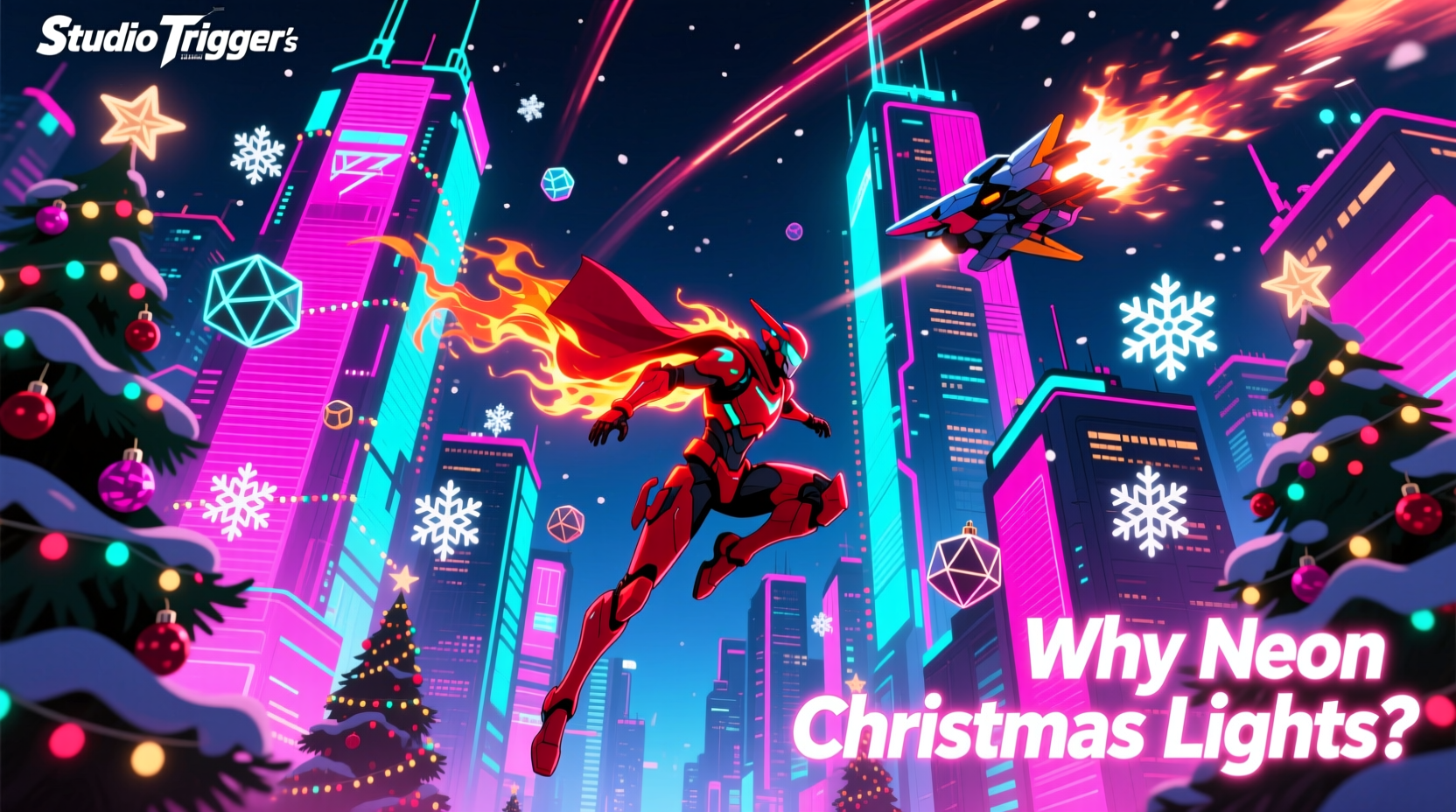
Studio Trigger has built its reputation on visual audacity. From Kill la Kill’s sentient clothing to Gurren Lagann’s spiral-powered mechs, the studio thrives on excess. Their style rejects subtlety in favor of maximalism—bold lines, extreme close-ups, and color palettes that feel like sensory overload. In this context, the use of neon Christmas lights fits perfectly within their established design philosophy: if something looks cool, feels energetic, and adds emotional texture, it belongs.
But unlike other visual flourishes, the Christmas lights in Promare appear with narrative intentionality. They are not randomly scattered; they emerge during key moments of vulnerability, transition, or human connection. Often strung across alleyways, makeshift homes, or rebel hideouts, these lights suggest warmth in environments defined by conflict and alienation. They represent pockets of humanity amid technological dystopia and ideological warfare.
Fire as Emotion, Light as Memory
The Burnish are beings of fire—not just in power, but in identity. Fire is their curse and their gift, feared by society yet intrinsic to their existence. Studio Trigger uses light throughout Promare as an extension of emotional states. Characters don’t just emit flames; they radiate color, energy, and psychological intensity. Neon Christmas lights, then, function as a domesticated form of fire—a safe, controlled, and beautiful expression of what the Burnish embody uncontrollably.
This contrast is critical. While the Burnish burn with raw, destructive passion, the Christmas lights glow gently, persistently. They do not consume; they illuminate. In scenes where Galo Thymos visits Krazor X’s hidden community or walks through underground Burnish shelters, the soft blink of multicolored bulbs suggests resilience, hope, and the persistence of joy even under oppression. The lights become a metaphor for suppressed identity—still shining, even when hidden from public view.
“Light doesn’t have to destroy to be powerful. Sometimes, its greatest strength is simply being seen.” — Commentary by Dr. Lena Sato, Anime Visual Studies Scholar, Kyoto University of Art
The use of Christmas lights also introduces a layer of temporal dissonance. Traditionally associated with holidays, nostalgia, and family, their presence in a futuristic, war-torn setting creates a poignant tension. These lights evoke memories of celebration and belonging—things the Burnish have been denied. Their continued use becomes an act of resistance: a refusal to let fear extinguish warmth.
Cultural Context: Japanese Urban Aesthetics and Nostalgia
To fully grasp the significance of neon Christmas lights in Promare, one must consider Japan’s unique relationship with artificial illumination. In cities like Tokyo, Osaka, and Yokohama, neon signs and decorative lighting are not limited to holiday seasons. Entire districts—such as Roppongi or Shinjuku—are known for their dazzling nightscapes, blending commercial signage with seasonal decorations year-round. Christmas lights, in particular, have taken on a life beyond religious meaning; they symbolize festivity, romance, and urban charm, even in a largely non-Christian society.
Studio Trigger taps into this cultural phenomenon, using the lights as a bridge between global pop culture and localized urban experience. The chaotic tangle of wires and bulbs mirrors the complexity of modern city life—messy, vibrant, and alive. But more importantly, it evokes a sense of impermanence. Christmas lights are temporary by nature; they are installed for a season and eventually taken down. In Promare, their persistence in unstable environments suggests a desire to hold onto fleeting moments of peace.
| Visual Element | Symbolic Meaning | Scene Example |
|---|---|---|
| Neon Christmas Lights | Hope, memory, fragile beauty | Burnish hideout illuminated at night |
| Blue Flames | Controlled destruction, cold ideology | Leader’s final transformation |
| Red & Orange Fire | Passion, rebellion, life force | Galo’s suit activation |
| Dark Cityscapes | Societal fear, isolation | Opening chase sequence |
Mini Case Study: The Hideout Scene – Light as Sanctuary
One of the most telling uses of the Christmas light motif occurs in the underground sanctuary where rogue Burnish take refuge. After Galo infiltrates the base, he discovers not a militant cell, but a community living in quiet defiance. The walls are lined with salvaged electronics, fabric scraps, and strings of blinking red, green, and blue lights. Children play beneath them. Music hums softly in the background. There is no overt mention of Christmas—but the atmosphere is unmistakably festive.
This scene subverts expectations. Audiences anticipate danger, radicalization, or violence. Instead, they find normalcy. The lights here do not signal celebration in the traditional sense, but survival. They mark a space where identity is preserved, not weaponized. For the Burnish, fire is not just destruction—it is warmth, creativity, and self-expression. The Christmas lights become a visual echo of that truth: light can be gentle. It can belong to the people.
Later, when the hideout is raided and the lights are shattered or cut off, the loss is felt viscerally. The darkness that follows isn't just physical—it represents erasure. The destruction of the lights parallels the attempted eradication of Burnish culture. In this way, the motif evolves from passive decoration to active symbol of resistance and mourning.
Design Philosophy: Chaos with Purpose
Hiroyuki Imaishi, director of Promare, is known for his belief that animation should prioritize feeling over realism. In interviews, he has stated that “if it looks exciting and makes the audience feel something, it works.” This philosophy extends to every frame of Promare, where physics are ignored, perspectives warp, and colors bleed beyond outlines. Within this unrestrained visual language, the Christmas lights serve as grounding elements—points of familiarity in an otherwise alien world.
Yet their placement is never random. The lights often follow diagonal or zigzag patterns, mirroring the film’s overall design ethos: dynamic, unpredictable, and emotionally charged. They guide the viewer’s eye toward characters, doorways, or emotional focal points. In quieter moments, they pulse slowly, syncing with breathing or heartbeat rhythms. During action sequences, they flicker rapidly, amplifying tension. This integration of motif and motion illustrates how Studio Trigger treats visual elements as narrative tools, not just set dressing.
Step-by-Step: How the Motif Develops Across the Film
- Introduction (Act 1): Christmas lights appear subtly in city backgrounds—decorative, almost unnoticed. They establish a world where artificial light is normalized.
- Discovery (Midpoint): Galo enters the Burnish hideout; the lights become central to the environment, signaling safety and community.
- Conflict (Act 2 Climax): The hideout is attacked; lights are destroyed. Darkness returns, symbolizing cultural suppression.
- Reclamation (Final Battle): As Galo and Lio embrace their shared identity, fire takes on a new form—bright, colorful, and uncontrolled in a positive sense. The visual palette echoes the earlier Christmas lights, now internalized as power.
- Resolution (Ending): In the rebuilt city, strands of lights reappear—this time openly, publicly. They are no longer hidden, signifying acceptance and integration.
Frequently Asked Questions
Are the Christmas lights actually mentioned in the script?
No, the term “Christmas lights” does not appear explicitly in the dialogue or official script notes. However, concept art and background design documents show deliberate placement of bulb strings resembling holiday lighting. The intent was visual storytelling, not textual reference.
Do the colors of the lights have specific meanings?
While not codified, color usage aligns with broader film themes: red for passion and fire, blue for control and authority, green for growth and rebellion. The mix of colors in communal spaces emphasizes diversity and unity among the Burnish.
Could the lights symbolize LGBTQ+ identity?
Many viewers interpret the lights—and the Burnish themselves—as metaphors for marginalized identities, including queer communities. The idea of hiding one’s true self, creating safe spaces, and facing societal rejection resonates strongly. The colorful, defiant glow of the lights parallels pride symbols, making this reading both plausible and powerful.
Checklist: Identifying Symbolic Motifs in Anime
- Watch for repeated visual elements (lights, colors, objects)
- Note when and where they appear—during emotional peaks, transitions, or quiet moments
- Consider cultural context: does the object have symbolic meaning in Japanese or global culture?
- Ask: Does the motif change over time? Is it destroyed, restored, or transformed?
- Compare it to character arcs—does it mirror personal growth or regression?
“The best anime visuals don’t just impress—they linger. They haunt you because they mean something.” — Akira Endo, Animation Director & Critic
Conclusion: Light as Legacy
Studio Trigger didn’t choose neon Christmas lights for Promare because they were trendy or easy to animate. They chose them because they carry emotional resonance—because a single blinking bulb can represent defiance, memory, and the stubborn persistence of joy. In a film about fire, the lights remind us that not all flames are destructive. Some are small, handmade, and strung up by those who refuse to live in the dark.
The motif works because it feels real, even in a world of flamethrower gauntlets and mecha suits. Everyone has seen Christmas lights—draped over balconies, wrapped around trees, hanging in cafes. That familiarity makes the Burnish’s struggle more relatable. Their fight isn’t for domination; it’s for the right to exist quietly, to shine without fear.




 浙公网安备
33010002000092号
浙公网安备
33010002000092号 浙B2-20120091-4
Comments
No comments yet. Why don't you start the discussion?