
The Tyrannosaurus rex, one of the most iconic predators in Earth’s history, looms large in both fossil records and popular imagination. Towering up to 40 feet long and packing a bite force capable of crushing bone, it was the apex predator of its time. Yet, one feature consistently draws fascination—and amusement: its disproportionately small arms. Each arm was roughly the length of a human toddler, with only two clawed fingers. This striking mismatch between massive body and minuscule limbs has puzzled scientists and enthusiasts alike for over a century. What possible function could such tiny appendages serve? And why did evolution allow them to persist?
Far from being useless evolutionary leftovers, emerging research suggests that T. rex’s arms may have played specific, specialized roles. While no definitive answer exists, multiple compelling theories grounded in anatomy, biomechanics, and evolutionary biology offer plausible explanations.
Anatomical Reality: How Small Were T. Rex Arms?
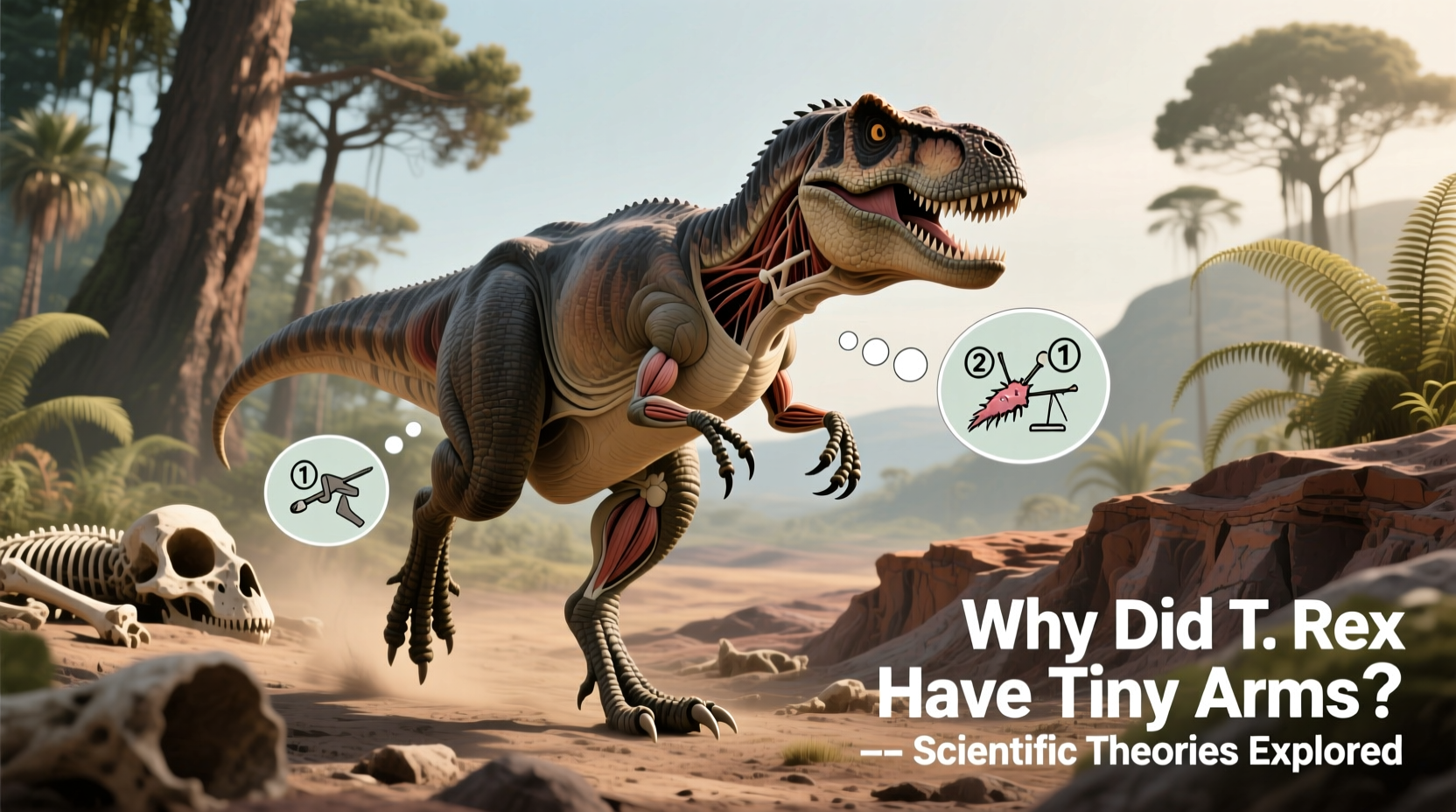
To understand the debate, it's essential to grasp just how small—and surprisingly robust—T. rex forelimbs actually were. Despite their short length (about 3 feet or less), they were heavily muscled and anchored by strong bones. The humerus, radius, and ulna were thick and sturdy, indicating significant strength relative to size. Fossil evidence shows well-developed attachment points for muscles, suggesting these arms weren't vestigial but functional in some capacity.
Each hand bore two sharp claws, up to nearly a foot long, capable of inflicting deep lacerations. Though too short to reach the mouth or touch the dinosaur’s own back, they were not flimsy. CT scans and biomechanical modeling suggest the arms could exert considerable force—enough to pull with intent.
Leading Scientific Theories on T. Rex Arm Function
Over the decades, paleontologists have proposed several hypotheses about the role of these compact limbs. None are mutually exclusive, and recent consensus leans toward multifunctional use rather than a single purpose.
1. Mating and Mounting Assistance
One of the most widely accepted theories is that T. rex used its arms during mating. Given the animal’s immense size and weight—up to 9 tons—climbing onto a partner would require stabilization. Short, powerful arms could have helped brace the male against the female’s back, preventing slippage during copulation. This theory aligns with observations in modern reptiles and birds, where forelimbs play crucial roles in reproductive positioning.
“Even modestly sized limbs can provide critical leverage during close-contact behaviors like mating.” — Dr. Julia Sankey, Paleobiologist and Dinosaur Locomotion Researcher
2. Rising from a Resting Position
T. rex likely spent periods resting or sleeping lying down. With a center of gravity far forward due to its massive head and torso, getting upright again would be challenging. Some researchers propose that the arms acted as stabilizers or push-off points when rising. While they couldn’t bear full body weight alone, combined with leg movement, they might have provided initial lift or balance correction.
3. Intraspecific Combat and Display
Another possibility is that the arms were used in combat between rival T. rex individuals—perhaps during territorial disputes or dominance displays. The sharp claws could deliver slashing wounds at close range, particularly to softer areas like the neck or underbelly. Alternatively, the arms might have been involved in ritualized non-lethal combat, minimizing risk while asserting dominance.
In this context, the arms could also have served a display function. Bright skin, feathers, or motion-based signaling (like raising the arms) might have communicated aggression, submission, or readiness to mate. Modern birds, descendants of theropod dinosaurs, often use limb movements in courtship rituals—supporting the idea that even reduced limbs retain behavioral significance.
4. Holding Prey During Feeding
Though T. rex primarily relied on its jaws to kill and consume prey, some scientists speculate that the arms helped restrain struggling animals at close range. Imagine a juvenile or mid-sized herbivore pinned beneath the tyrant king’s chest—short arms with strong claws could prevent escape just long enough for a fatal bite. This function would be especially useful if T. rex occasionally hunted smaller, agile prey.
Evolutionary Trade-offs: Why Shrink the Arms?
Rather than asking “what were they for,” a more insightful question might be: “why didn’t they grow larger?” Evolution doesn’t aim for perfection—it favors traits that enhance survival and reproduction. In T. rex’s case, natural selection appears to have favored increasingly powerful jaws and enhanced sensory systems at the expense of forelimb development.
As tyrannosaurids evolved over millions of years, their skulls became longer, deeper, and more robust. Jaw muscles expanded dramatically, allowing bite forces estimated at over 8,000 pounds per square inch—among the strongest of any terrestrial animal. This shift in predatory strategy likely reduced reliance on the arms for hunting, making investment in larger forelimbs unnecessary.
Additionally, shrinking the arms may have improved balance and agility. A lighter front end could help counterbalance the heavy tail and reduce rotational inertia, aiding quick turns. Energy saved by reducing muscle mass in the forelimbs could be redirected to brain development, olfaction, or locomotion.
| Theory | Plausibility | Supporting Evidence |
|---|---|---|
| Mating assistance | High | Anatomical strength; parallels in modern species |
| Assisting in rising | Moderate | Biomechanical models show limited utility |
| Prey restraint | Moderate | Claw structure supports gripping/laceration |
| Intraspecific combat | High | Common in dominant predators; scarred fossils |
| Vestigial/evolutionary leftover | Low | Too muscular and innervated to be non-functional |
Mini Case Study: The Evolution of Tyrannosaur Arms Over Time
Examining earlier tyrannosaur relatives reveals a gradual reduction in arm size. Dilong paradoxus, an early tyrannosauroid from 125 million years ago, had proportionally longer arms with three fingers. Later genera like Gorgosaurus and Albertosaurus show intermediate stages—shorter arms, but still functional. By the time Tyrannosaurus rex emerged around 68 million years ago, the arms had reached their smallest proportions.
This evolutionary trajectory suggests a slow, adaptive process rather than sudden mutation. As the skull and jaw took over primary predatory functions, forelimbs diminished—but retained enough structure to perform secondary roles. This pattern mirrors other cases in nature where organs reduce in size but remain functional (e.g., whale pelvises, human appendix).
FAQ: Common Questions About T. Rex Arms
Could T. rex use its arms to eat?
No direct evidence suggests T. rex used its arms to bring food to its mouth. Its arms were too short to reach its head, and feeding was almost entirely jaw-dependent. However, they may have helped hold prey steady during consumption.
Did T. rex hatchlings have proportionally larger arms?
Fossil evidence is limited, but studies of related species suggest juvenile tyrannosaurs may have had relatively longer arms than adults. This ontogenetic shift could imply different behavioral uses at various life stages—perhaps juveniles used arms more actively before relying solely on jaws as they matured.
Were the arms completely useless?
Far from it. While they couldn’t perform tasks requiring reach or fine manipulation, their strength, claw structure, and neural complexity indicate purposeful function. Calling them “useless” misunderstands evolutionary efficiency—they were adapted for specific, close-range actions.
Conclusion: Rethinking “Tiny” in Context
The so-called “tiny arms” of T. rex are not a flaw or evolutionary mistake—they are a product of highly specialized adaptation. In prioritizing cranial power and sensory acuity, tyrannosaurs traded forelimb length for unparalleled predatory dominance. Their arms, though short, were strong, clawed, and likely instrumental in key behaviors like mating, combat, and stabilization.
Understanding T. rex requires moving beyond superficial impressions. Its arms remind us that function isn’t always obvious, and nature often finds efficient, unexpected solutions. Rather than laughing at its stubby limbs, we should marvel at a creature so perfectly honed by evolution that even its smallest parts had a role to play.




 浙公网安备
33010002000092号
浙公网安备
33010002000092号 浙B2-20120091-4
Comments
No comments yet. Why don't you start the discussion?