
The Beatles didn’t just define a generation—they redefined music. From their explosive arrival in the 1960s to their revolutionary studio work, they became the most influential band in history. Yet, by 1970, the group had disbanded, leaving fans stunned and historians searching for answers. The breakup wasn’t triggered by a single event but by a complex web of artistic divergence, financial mismanagement, interpersonal friction, and evolving individual ambitions. Understanding why the Beatles broke up requires peeling back layers of myth, emotion, and documented conflict.
Creative Evolution and Artistic Independence
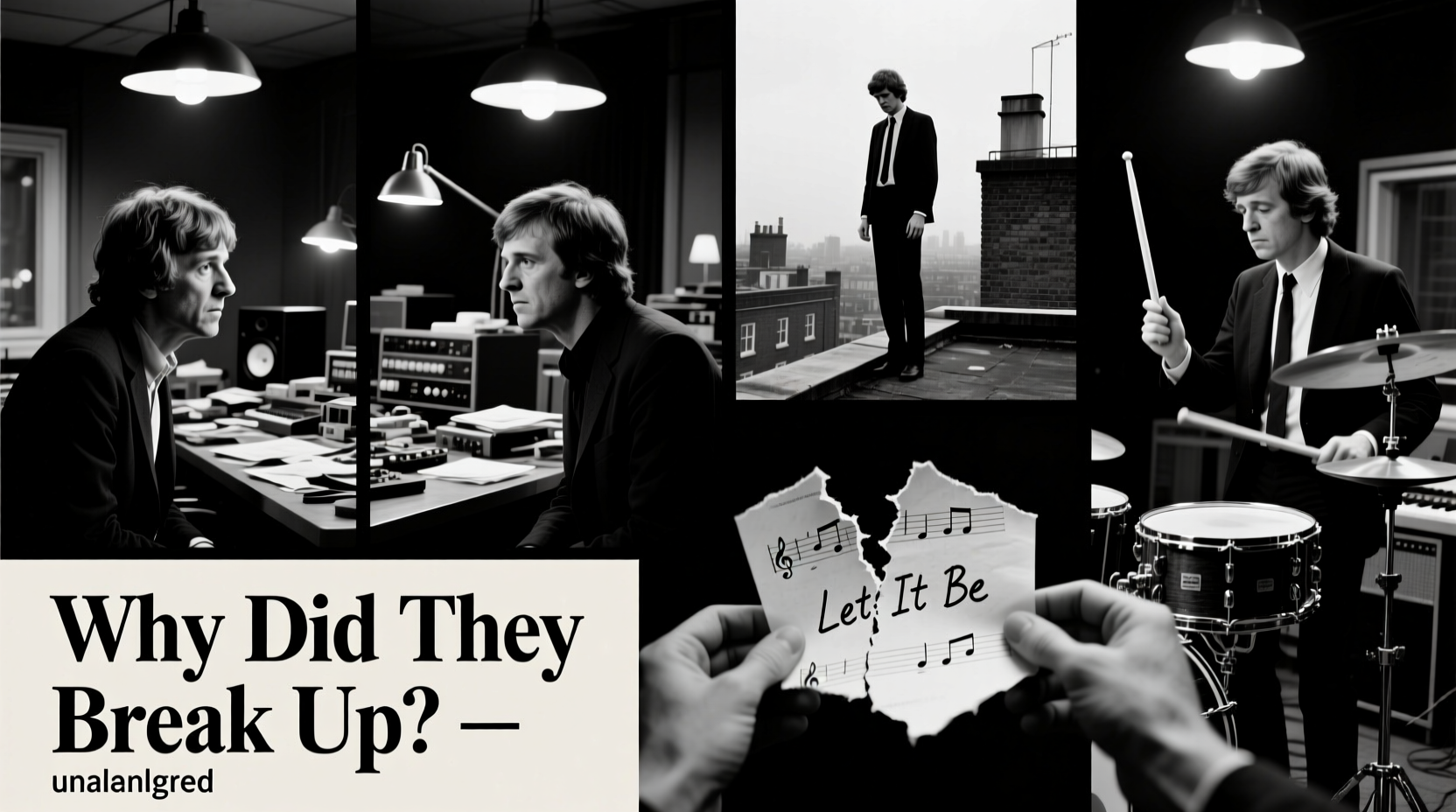
By the late 1960s, each Beatle had matured into a distinct musical voice. John Lennon was exploring raw, introspective songwriting. Paul McCartney leaned toward melodic pop craftsmanship. George Harrison emerged as a serious composer with spiritual depth. Ringo Starr developed a unique rhythmic identity beyond mere timekeeping. This growth, while artistically rich, eroded the collaborative spirit that once defined the band.
The recording of The White Album (1968) marked a turning point. Instead of working as a unified unit, members often recorded separately, with minimal input from one another. Lennon later admitted: “The Beatles were not a group anymore—we were four individuals doing our own thing.” This fragmentation intensified during the Let It Be sessions in early 1969, where tension was palpable and creative disagreements frequent.
Business Conflicts and Financial Mismanagement
One of the most significant catalysts for the breakup was the band’s chaotic business structure. After Brian Epstein’s death in 1967, the Beatles lacked a unifying manager. Attempts to self-manage through Apple Corps quickly spiraled into financial disarray, with unchecked spending, poor investments, and legal entanglements.
Paul McCartney championed Allen Klein as the band’s financial advisor, but John, George, and Ringo distrusted Klein due to his aggressive tactics and past controversies. Meanwhile, McCartney preferred Lee Eastman, an American lawyer and father of his future wife, Linda. This divide wasn’t just professional—it became deeply personal.
The dispute over management culminated in a public rift. In December 1969, Lennon informally left the band after Klein was appointed head of Apple, though he didn’t publicly announce it until September 1970. McCartney later stated, “I couldn’t understand why we were letting someone like Klein take control when we knew so little about him.”
“We were all going through changes. Business-wise, we were flying blind. And when you’re flying blind, someone always ends up getting hurt.” — George Harrison, 1980 interview
Personal Relationships and Marital Influences
The personal lives of the Beatles played a crucial role in their dissolution. As their marriages and relationships evolved, so did their priorities and loyalties.
John Lennon’s relationship with Yoko Ono became a flashpoint. Her constant presence in the studio—unprecedented for a non-member—was seen by some as intrusive. Ringo Starr temporarily quit during the White Album sessions, citing feeling musically sidelined. George Harrison resented Yoko’s influence, once remarking, “She’s got nothing to do with music. Why is she here?”
Conversely, Paul McCartney’s marriage to Linda Eastman introduced its own dynamics. While Linda was welcomed by some, others viewed her as part of the growing Eastman family influence in the band’s affairs. These personal alliances began to mirror the business split, deepening the divide.
Moreover, the loss of Brian Epstein—their trusted manager and emotional anchor—left a void no one could fill. His ability to mediate conflicts and maintain unity was irreplaceable. Without him, the band struggled to navigate both internal and external pressures.
Timeline of Key Events Leading to the Breakup
- August 1967: Brian Epstein dies of a drug overdose, leaving the Beatles without managerial leadership.
- 1968: Recording of The White Album reveals growing isolation among members; George temporarily quits.
- January 1969: Let It Be sessions are fraught with tension; Yoko Ono’s presence intensifies friction.
- May 1969: The Beatles begin work on Abbey Road, their final recorded album, though tensions remain high.
- December 1969: John Lennon privately tells the others he’s leaving the band.
- April 10, 1970: Paul McCartney announces his departure via press release, effectively making the split public.
- September 1970: Legal dissolution of the partnership is confirmed, marking the official end.
The Role of Individual Ambitions
By the end of the 1960s, each member was eager to explore solo projects. The constraints of being “a Beatle” increasingly felt limiting.
- John Lennon wanted to express political and personal truths without censorship or compromise.
- Paul McCartney sought creative freedom to craft intimate, personal albums like his 1970 debut McCartney.
- George Harrison had songs like “All Things Must Pass” that were too numerous and profound to fit within Beatles albums.
- Ringo Starr pursued acting and solo music, enjoying the autonomy outside the band’s shadow.
These aspirations weren’t inherently destructive, but the lack of a shared vision made reconciliation difficult. What had once been a collective mission fractured into four separate journeys.
Table: Solo Debut Albums vs. Final Beatles Contributions
| Member | Last Major Beatles Work | Solo Debut Album | Notable Post-Beatles Achievement |
|---|---|---|---|
| John Lennon | Abbey Road (1969) | John Lennon/Plastic Ono Band (1970) | “Imagine” (1971), global peace anthem |
| Paul McCartney | Let It Be (1970) | McCartney (1970) | Founding Wings, sustained chart success |
| George Harrison | Abbey Road (1969) | All Things Must Pass (1970) | Organized the Concert for Bangladesh (1971) |
| Ringo Starr | Let It Be (1970) | Sentimental Journey (1970) | Acting roles, children’s music, All-Starr Band |
Persistent Theories About the Breakup
Over the decades, several theories have emerged about the true cause of the breakup. While some hold more weight than others, each reflects a facet of the band’s unraveling.
1. The Yoko Ono Theory
This widely circulated theory blames Yoko Ono for the breakup, claiming her presence disrupted the band’s chemistry. While her role was controversial, many historians now view this narrative as reductive and unfairly misogynistic. As Ringo Starr noted in 2013, “Yoko didn’t break up the Beatles. We broke up the Beatles.”
2. The Money Motive
Financial chaos at Apple Corps created distrust. Unpaid taxes, lawsuits, and competing interests turned former allies into wary stakeholders. The inability to agree on a manager sealed the business collapse.
3. The Artistic Burnout Theory
After ten years of relentless touring, recording, and public scrutiny, the Beatles were exhausted. The pressure to constantly innovate took a toll. As George Harrison said, “We were like a well-oiled machine that just ran out of oil.”
4. The Paul vs. John Rivalry
Once close collaborators, Lennon and McCartney grew apart creatively and personally. John felt Paul was becoming controlling; Paul saw John as detached and influenced by Yoko. Their songwriting partnership, once the engine of the band, cooled significantly after 1968.
Mini Case Study: The Let It Be Sessions – A Microcosm of Collapse
The January 1969 Let It Be sessions at Twickenham Studios offer a vivid case study of the band’s disintegration. Intended as a return to live performance and simplicity, the project instead exposed deep fractures.
John arrived emotionally distant, often sitting silently. Paul pushed for tight arrangements, which frustrated George, who felt creatively stifled. Ringo felt underappreciated. Tensions peaked when George walked out, declaring, “I think I’ll leave the band now.” He returned only after the sessions moved to Apple Studios and the format shifted toward a less pressured environment.
Though the rooftop concert remains one of rock’s most iconic moments, it was a bittersweet finale—a fleeting moment of unity amid ongoing discord. The documentary film, delayed for over a year, captured not a triumphant comeback but a band on the brink.
Frequently Asked Questions
Did the Beatles officially announce their breakup?
No formal group announcement was made. Paul McCartney publicly announced his departure on April 10, 1970, through a press release accompanying his solo album. This was interpreted globally as the end of the band, though the legal dissolution wasn’t finalized until later that year.
Why did Paul McCartney sue the other Beatles?
In December 1970, Paul filed a lawsuit in London’s High Court to legally dissolve the Beatles’ partnership. His primary motivation was to sever ties with Allen Klein, whom he distrusted, and to gain control over the band’s assets through court supervision. The lawsuit accelerated the official end of the group.
Could the Beatles have stayed together if Brian Epstein had lived?
Many insiders believe Epstein’s presence might have prolonged the band’s life. He was a skilled negotiator and unifier. However, given the rapid personal and artistic evolution of the members by 1968, even Epstein may not have been able to overcome the fundamental shifts in their goals and relationships.
Actionable Checklist: Lessons from the Beatles’ Breakup
While few face the pressures of global fame, the Beatles’ story offers universal lessons about collaboration and change.
- Establish clear leadership or mediation early. Without a trusted manager, decisions became battlegrounds.
- Communicate openly about creative differences. Suppressed frustrations led to resentment.
- Set boundaries around personal relationships in professional spaces. Blurred lines caused discomfort and distraction.
- Plan for succession. The loss of Epstein revealed a lack of contingency planning.
- Recognize when to evolve—apart or together. Growth doesn’t always mean staying united.
Conclusion: Legacy Beyond the Split
The Beatles’ breakup was inevitable, not because they stopped loving music, but because they kept evolving. Their legacy isn’t diminished by the split—it’s amplified by it. Each member went on to meaningful careers, proving that endings can be beginnings in disguise.
Understanding the breakup requires empathy. It wasn’t betrayal, laziness, or sudden hatred. It was the natural conclusion of a journey that had transformed four Liverpool lads into global icons—and then into individuals seeking peace, purpose, and expression beyond a shared name.




 浙公网安备
33010002000092号
浙公网安备
33010002000092号 浙B2-20120091-4
Comments
No comments yet. Why don't you start the discussion?