
The riddle “Why did the chicken cross the road?” is one of the most universally recognized jokes in the English-speaking world. Its simplicity, timing, and punchline—“To get to the other side”—have cemented it as a cornerstone of comedic culture. But beneath its surface-level absurdity lies a rich tapestry of linguistic evolution, social commentary, and psychological intrigue. This article delves into the riddle’s origins, analyzes its staying power, and explores how such a simple question has endured across generations.
Origins of the Riddle: A Historical Perspective
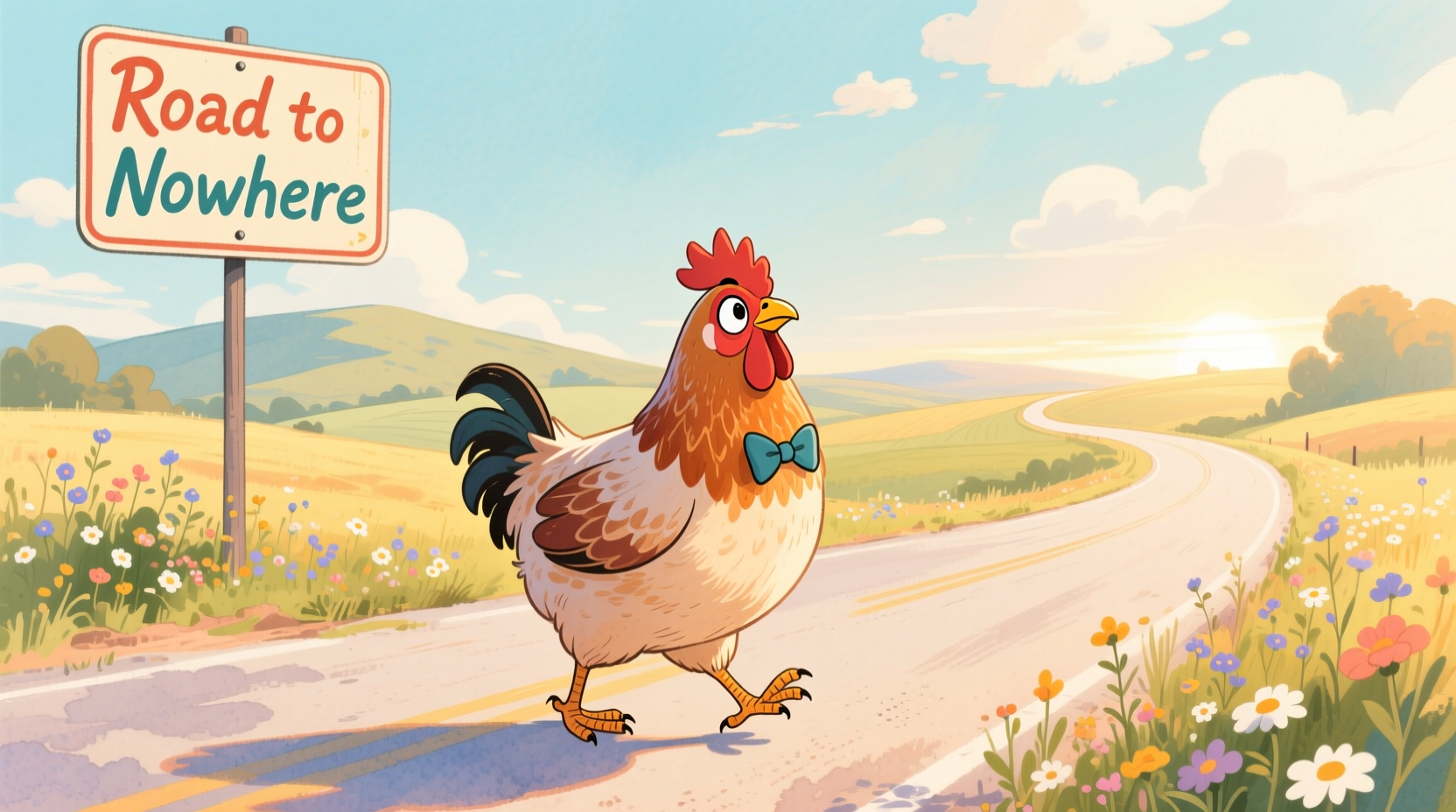
The earliest known appearance of the riddle dates back to 1847 in *The Knickerbocker*, a New York-based literary magazine. The version published then read: “Sometimes poultry, like people, are found crossing the road.” While not phrased as a direct question, it carried the same thematic essence. By the 1890s, variations began appearing in newspapers and joke books, often framed as a humorous exchange between two characters.
One of the first documented uses in its now-familiar form appeared in a 1896 issue of *The Oxford Magazine*: “Why did the fowl cross the road? To get on the other side.” This marked a shift toward the standardized structure we recognize today—a setup followed by a literal, deadpan answer that subverts expectations.
Interestingly, the joke emerged during a period of rapid urbanization and industrial growth. As roads became more prominent and transportation more complex, the image of a chicken navigating a busy thoroughfare may have resonated as both absurd and oddly relatable. The riddle’s minimalism made it accessible, easy to remember, and highly repeatable—key ingredients for viral spread long before the internet.
The Psychology Behind the Punchline
What makes “To get to the other side” funny? On the surface, it isn’t. It’s a tautology—an answer that restates the obvious. Yet, this is precisely where the humor lies. The joke sets up an expectation of cleverness or wordplay, only to deliver a completely literal response. This subversion of cognitive expectations triggers what psychologists call “incongruity resolution,” a core mechanism in humor processing.
Dr. Peter McGraw, director of the Humor Research Lab at the University of Colorado, explains:
“The funniest moments occur when something seems wrong, then suddenly makes sense in an unexpected way. With the chicken riddle, the surprise isn’t in the answer—it’s in the lack of surprise. That anti-joke structure disarms the listener and creates amusement through deflation.” — Dr. Peter McGraw, Humor Research Expert
This principle explains why the joke works best when delivered straight-faced. The absence of embellishment amplifies the contrast between expectation and reality, making the mundane response feel almost rebellious in its honesty.
Cultural Evolution and Modern Variations
Over time, the original riddle has become a template for satire, political commentary, and creative reinterpretation. Writers, comedians, and educators have repurposed it to reflect contemporary issues, often replacing the punchline with character-specific motivations.
Here are some notable variations:
- Philosophical: “To fulfill its destiny on the other side.”
- Political: “It was a bipartisan effort to bridge divides.”
- Scientific: “To test the hypothesis that chickens can traverse paved surfaces.”
- Cyberpunk: “Because the network on this side had been hacked.”
These adaptations highlight the riddle’s flexibility as a vehicle for expression. Its skeletal structure allows for infinite customization while maintaining instant recognition. In classrooms, teachers use it to teach logic and critical thinking; in comedy clubs, it serves as a springboard for absurdism.
A Timeline of Key Moments in the Riddle’s Cultural Journey
| Year | Event | Significance |
|---|---|---|
| 1847 | First thematic mention in *The Knickerbocker* | Lays conceptual groundwork for the riddle |
| 1896 | Appears in *The Oxford Magazine* in near-final form | Establishes standard question-answer format |
| 1950s | Becomes staple of children’s joke books | Enters mainstream popular culture |
| 1980s–90s | Used in TV sitcoms and stand-up routines | Adopted as comedic shorthand and satire tool |
| 2000s–Present | Widely shared online, meme-ified, remixed | Digital age ensures global, continuous reinvention |
Why the Riddle Endures: Simplicity, Universality, and Utility
The longevity of the chicken riddle can be attributed to three key factors: simplicity, universality, and utility.
Simplicity ensures it’s easily remembered and repeated across age groups. Unlike complex puns or culturally specific references, this riddle requires no background knowledge. Even young children grasp the basic scenario—something moving from one place to another.
Universality means it transcends borders. Translations exist in dozens of languages, each adapting the joke while preserving its structural integrity. In German: “Warum überquerte das Huhn die Straße?” Answer: “Um auf die andere Seite zu kommen.” The formula remains intact.
Utility gives it functional value beyond humor. Educators use it to demonstrate logical fallacies or to spark discussions about perspective. Therapists employ it in cognitive exercises to encourage flexible thinking. And marketers have leveraged it in ad campaigns to create memorable, light-hearted engagement.
Mini Case Study: The Chicken Riddle in Education
In a third-grade classroom in Portland, Oregon, teacher Maria Lopez used the chicken riddle to introduce a unit on cause and effect. She began by asking the classic question and recording student responses. While most gave the traditional answer, others suggested imaginative alternatives: “It was chasing a bug,” “It wanted to meet a friend,” or “It was running away from a fox.”
Lopez then guided students to categorize answers as “literal” vs. “creative,” discussing how context shapes interpretation. The exercise not only reinforced reading comprehension skills but also encouraged divergent thinking. By week’s end, students were creating their own animal-based riddles, applying grammatical structures and narrative logic in a playful format.
The success of the lesson demonstrated how even the simplest joke can serve as a powerful pedagogical tool when framed intentionally.
Frequently Asked Questions
Is the chicken riddle considered a real joke?
Yes, though it functions as an “anti-joke.” Its humor comes not from wit or surprise, but from the disappointment of a literal answer following a setup that implies deeper meaning. This reversal is what makes it psychologically effective and culturally persistent.
Has the riddle ever been used in serious research?
Surprisingly, yes. Cognitive scientists have used variations of the riddle to study how people process ambiguity and resolve incongruities. Linguists analyze its syntax to understand how minimal narratives convey meaning. Even AI researchers have tested chatbots’ ability to recognize and generate similar joke structures.
Are there any older riddles than this one?
Definitely. One of the oldest known riddles comes from ancient Mesopotamia (circa 2350 BCE): “There is a house. One enters it blind, comes out seeing. What is it?” Answer: A school. Compared to such symbolic puzzles, the chicken riddle is a modern product of democratic humor—accessible, egalitarian, and stripped of elitism.
Conclusion: Crossing the Road to Deeper Understanding
The chicken didn’t just cross the road—it crossed into the collective consciousness. What began as a simple play on expectation has evolved into a cultural artifact, studied, repeated, and reimagined across continents and centuries. Its brilliance lies not in complexity, but in clarity. It reminds us that sometimes, the most profound insights come from accepting things exactly as they appear.
So next time someone asks, “Why did the chicken cross the road?” consider not just the answer, but the journey behind the question. And if you're sharing it, do so with intention—whether to teach, to laugh, or simply to connect.




 浙公网安备
33010002000092号
浙公网安备
33010002000092号 浙B2-20120091-4
Comments
No comments yet. Why don't you start the discussion?