
In June 1919, the Treaty of Versailles was signed in France, formally ending World War I between Germany and the Allied Powers. While U.S. President Woodrow Wilson played a central role in shaping its terms—particularly the creation of the League of Nations—the United States ultimately refused to ratify the treaty. This decision marked a pivotal moment in American foreign policy and global diplomacy. Understanding why the U.S. rejected the Treaty of Versailles requires examining political divisions, ideological differences, and national priorities at a critical juncture in history.
The Role of Woodrow Wilson and the Fourteen Points
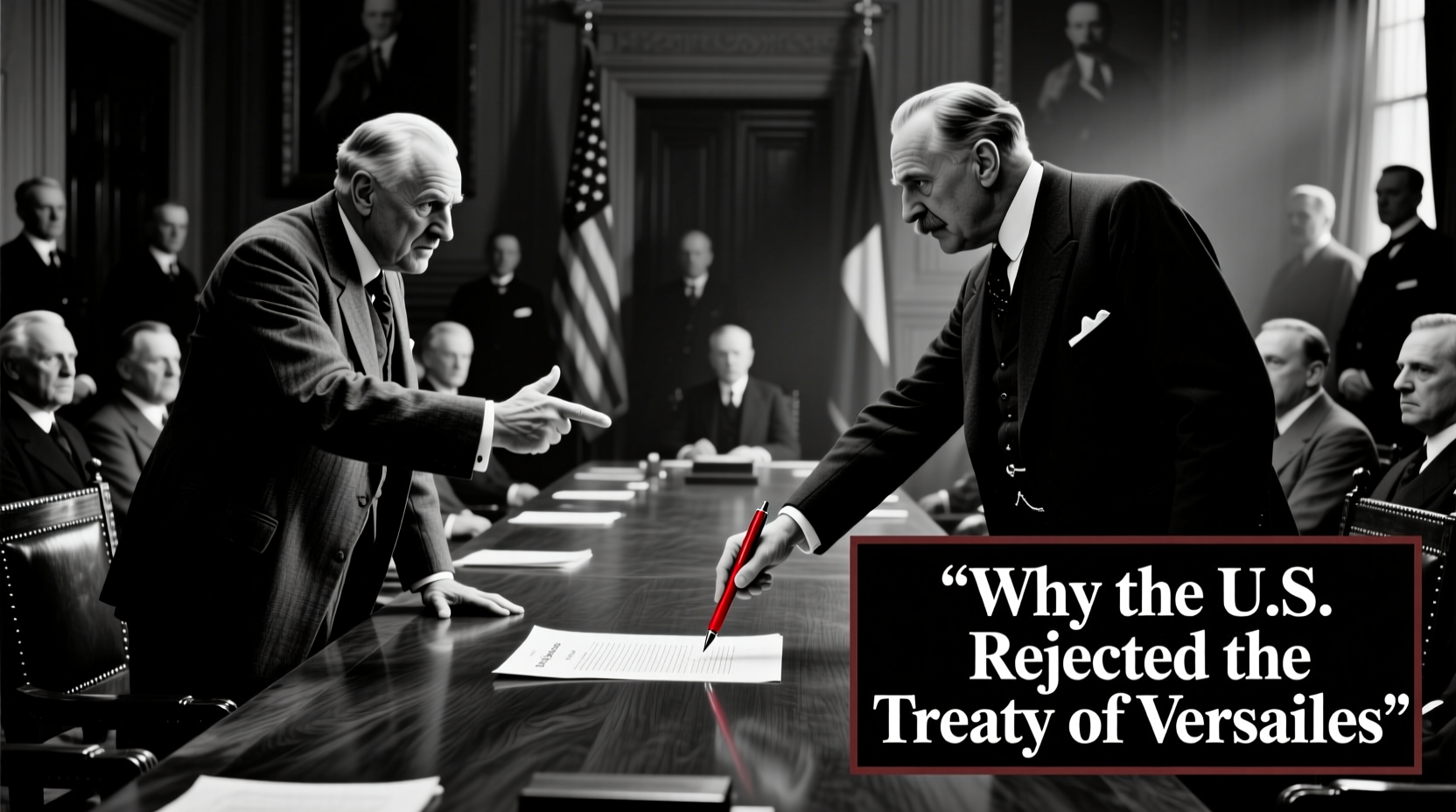
President Woodrow Wilson entered the Paris Peace Conference with a vision for a just and lasting peace. His \"Fourteen Points\" speech, delivered in January 1918, outlined principles such as open diplomacy, freedom of the seas, arms reduction, and self-determination for nations. Most notably, Point 14 called for a \"general association of nations\" to guarantee mutual protection against aggression—the foundation of what would become the League of Nations.
Wilson believed that American involvement in the League was essential to prevent future wars. He saw it not as a military alliance but as a forum for peaceful conflict resolution. However, his idealism clashed with the harsher realities favored by European powers like Britain and France, who sought punitive measures against Germany. Despite compromises, Wilson returned home convinced the treaty—though imperfect—was necessary for long-term stability.
“We can have no reserve. We must give ourselves without reservation to the cause of peace.” — Woodrow Wilson, September 1919
Senate Opposition and the Struggle for Ratification
Ratifying treaties requires a two-thirds majority in the U.S. Senate. Although Democrats controlled the presidency, Republicans held a narrow majority in the Senate after the 1918 midterm elections. This political reality made approval far from certain. The strongest opposition came from Senator Henry Cabot Lodge of Massachusetts, the Republican Majority Leader and chairman of the Senate Foreign Relations Committee.
Lodge and his allies, known as the \"Reservationists,\" were not opposed to the League of Nations in principle. Instead, they demanded amendments—specifically \"reservations\"—to protect U.S. sovereignty. Their primary concern was Article X of the League Covenant, which required member nations to assist any other member threatened by external aggression. Critics argued this could commit American troops to foreign conflicts without Congressional approval, undermining constitutional authority.
Other senators, known as \"Irreconcilables,\" went further. Figures like William Borah of Idaho and Hiram Johnson of California rejected the League entirely, viewing it as a dangerous entanglement in European affairs. They championed American independence and feared permanent alliances would erode national autonomy.
Isolationism and Public Sentiment
Beyond Capitol Hill, broader public opinion influenced the debate. After four years of war and significant loss, many Americans wanted to return to normalcy. The slogan “Back to Normal” gained traction, reflecting a desire to focus on domestic issues rather than international commitments.
Isolationism had deep roots in U.S. foreign policy, dating back to George Washington’s Farewell Address warning against \"entangling alliances.\" While Wilson framed the League as a moral imperative, opponents painted it as a trap that could drag the U.S. into endless wars. Veterans' groups, farmers, and rural communities often echoed these sentiments, skeptical of elite-driven internationalism.
Propaganda and misinformation also played a role. Some critics falsely claimed the League would impose taxes or conscript soldiers. Others argued that joining would mean abandoning neutrality and becoming enforcers of European interests. These fears resonated in an era before widespread global engagement.
Wilson’s Failed Campaign and Health Crisis
Determined to win public support, Wilson embarked on an unprecedented cross-country speaking tour in September 1919. Over three weeks, he delivered 36 speeches to massive crowds, passionately defending the treaty and the League. But the grueling pace took a severe toll on his health.
On October 2, 1919, Wilson suffered a debilitating stroke that left him partially paralyzed and largely incapacitated. Confined to the White House, he remained defiant, urging Democrats to reject any version of the treaty with reservations. His inability to negotiate or compromise effectively ended any chance of reconciliation with the Senate.
With Wilson sidelined and Senate Republicans unwilling to accept the treaty unaltered, multiple votes failed to achieve the necessary two-thirds majority. In March 1920, the final vote on the treaty—including Lodge’s proposed reservations—was defeated. The U.S. never ratified the Treaty of Versailles and instead signed separate peace agreements with Germany, Austria, and Hungary in 1921.
Key Reasons for U.S. Rejection: A Summary Table
| Reason | Description | Key Figures/Groups |
|---|---|---|
| Opposition to Article X | Fear that the U.S. could be forced into war without Congressional approval | Henry Cabot Lodge, Reservationists |
| Isolationist ideology | Belief in avoiding permanent foreign entanglements | William Borah, Irreconcilables |
| Partisan politics | Republican-controlled Senate resisting Democratic president's agenda | Republican Senators |
| Wilson’s inflexibility | Refusal to accept compromises or reservations | Woodrow Wilson |
| Public war-weariness | Desire to focus on domestic recovery after WWI | American public, veterans |
Consequences of Non-Ratification
The U.S. rejection of the Treaty of Versailles had profound consequences. Without American participation, the League of Nations lacked the military and economic power needed to enforce its decisions. Its effectiveness was undermined from the start, contributing to its failure to prevent aggression in the 1930s by Japan, Italy, and Germany.
Domestically, the episode highlighted the limits of presidential power and the strength of congressional authority in foreign policy. It also signaled a retreat from global leadership, reinforcing a period of isolationism that lasted until the outbreak of World War II.
In hindsight, historians debate whether a compromised treaty with reservations might have allowed U.S. entry into the League and altered the course of the 20th century. As Walter Lippmann, a prominent journalist of the era, observed:
“The tragedy is not that the Senate rejected the treaty, but that Wilson would not let it be saved by compromise.” — Walter Lippmann, 1937
Mini Case Study: The Lodge Reservations
In early 1920, Senator Lodge introduced 14 reservations to the treaty, the most important being that the U.S. would not be bound by Article X without explicit Congressional consent. Many moderate Democrats and even some Wilson supporters believed this compromise could secure ratification while protecting national sovereignty.
However, Wilson ordered Democratic senators to oppose any treaty with reservations. As a result, the measure failed by seven votes—just short of the required majority. This moment illustrates how personal conviction, when rigidly applied, can override pragmatic governance. Had Wilson accepted the reservations, the U.S. might have joined the League, potentially reshaping international relations in the interwar period.
FAQ
Did the U.S. ever join the League of Nations?
No. Despite Wilson’s efforts, the U.S. never ratified the Treaty of Versailles and therefore did not join the League of Nations. The organization operated without American participation until its dissolution in 1946.
What happened to Germany after the U.S. rejected the treaty?
The U.S. signed a separate peace treaty with Germany—the Treaty of Berlin—in 1921. This agreement restored peace but did not include reparations enforcement or security guarantees tied to the League.
Could the U.S. have prevented WWII if it had joined the League?
This remains debated. While American involvement might have strengthened the League’s credibility, structural weaknesses and lack of enforcement mechanisms limited its power. Still, earlier collective action might have deterred Axis expansion in the 1930s.
Conclusion: Lessons from a Pivotal Decision
The U.S. rejection of the Treaty of Versailles was not due to a single cause, but a convergence of political division, ideological resistance, and personal drama. Wilson’s idealism collided with Senate pragmatism, isolationist tradition, and institutional checks on executive power. The outcome reshaped America’s role in the world for decades.
Understanding this moment offers valuable lessons about the balance between principle and compromise, the importance of bipartisan cooperation in foreign policy, and the enduring tension between global engagement and national sovereignty. As modern leaders face complex international challenges, the legacy of Versailles serves as a reminder: visionary goals require not only bold ideas, but also the skill to build consensus.




 浙公网安备
33010002000092号
浙公网安备
33010002000092号 浙B2-20120091-4
Comments
No comments yet. Why don't you start the discussion?