
In the aftermath of World War II, much of Europe lay in ruins—economies were shattered, infrastructure destroyed, and millions displaced. Amid this devastation, the United States launched one of the most ambitious foreign aid programs in history: the Marshall Plan. Officially known as the European Recovery Program (ERP), it was introduced in 1948 and provided over $13 billion (equivalent to more than $150 billion today) in economic assistance to Western European countries. But why did the U.S. invest so heavily in rebuilding its former rivals and allies alike? The answer lies in a complex mix of humanitarian concern, strategic foresight, economic self-interest, and geopolitical calculation during the early Cold War era.
Historical Context: Post-War Europe in Crisis
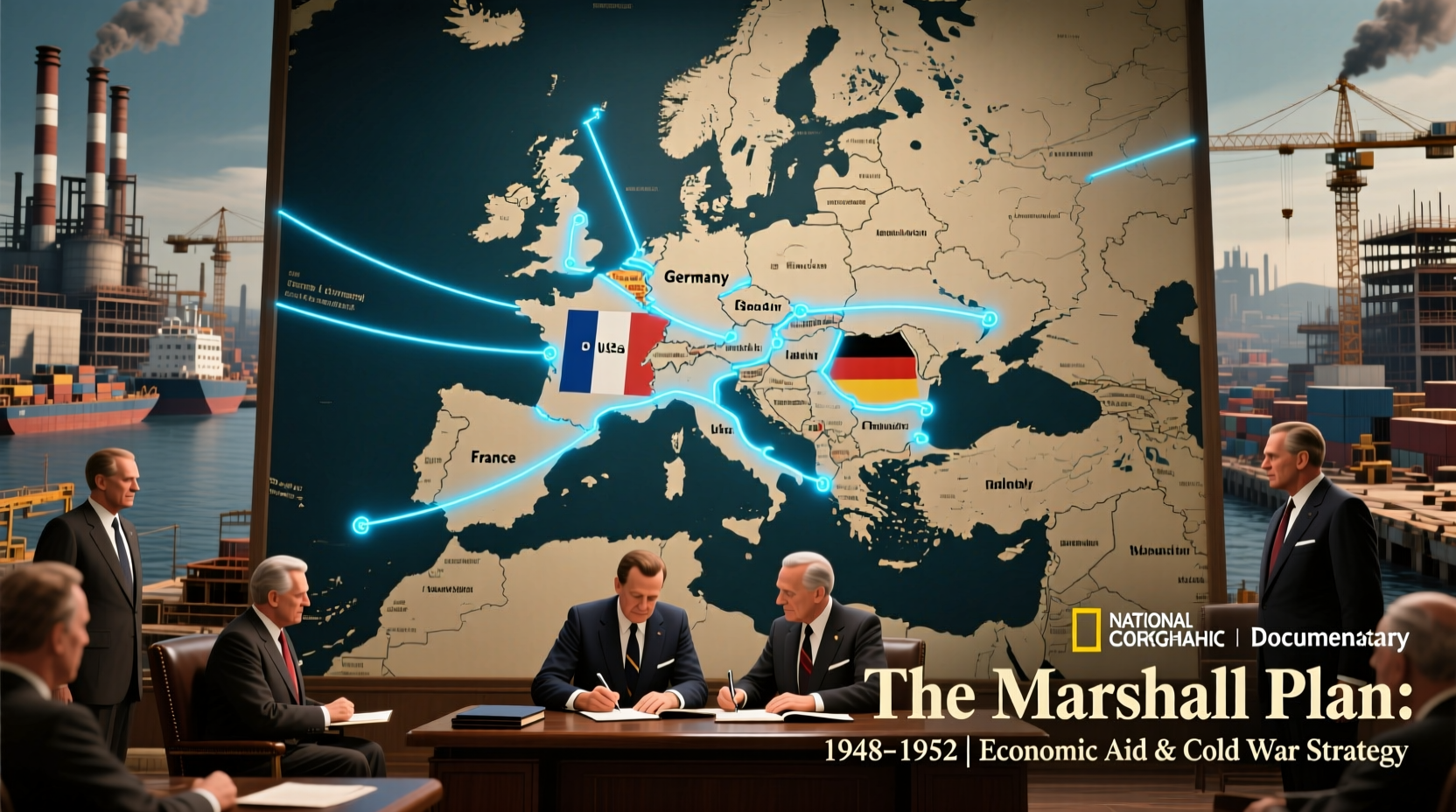
By 1945, Europe faced an unprecedented crisis. Industrial output had plummeted, food shortages were rampant, and political instability threatened democratic institutions. Countries like Germany, France, Italy, and the United Kingdom struggled to restart their economies. Inflation soared, unemployment spiked, and communist parties gained traction by capitalizing on public desperation.
The Soviet Union, meanwhile, consolidated control over Eastern Europe, establishing satellite states and rejecting American aid. This growing East-West divide signaled the beginning of the Cold War. The U.S., having emerged from the war as the world’s leading economic and military power, recognized that a weak and unstable Europe could become fertile ground for authoritarian ideologies—not just communism, but also extremism and revanchism.
As Secretary of State George C. Marshall stated in his pivotal Harvard commencement address on June 5, 1947:
“Europe must have a stable foundation upon which to build its future… Our policy is directed not against any country or doctrine but against hunger, poverty, desperation, and chaos.” — General George C. Marshall, 1947
Key Reasons Behind the U.S. Decision to Implement the Marshall Plan
The motivations behind the Marshall Plan were multifaceted, blending moral responsibility with hard-nosed realism. Here are the primary drivers:
1. Preventing the Spread of Communism
One of the most pressing concerns for U.S. policymakers was the rise of Soviet influence in Western Europe. Communist parties made significant electoral gains in France and Italy in 1946–1947. A starving, disillusioned population was seen as vulnerable to ideological manipulation. By restoring economic stability, the U.S. aimed to undercut support for leftist movements and strengthen democratic governments.
2. Reviving Global Trade and U.S. Economic Interests
A prosperous Europe meant strong trading partners. Before the war, Europe was a major market for American goods. With economies in freefall, demand for U.S. exports collapsed. The Marshall Plan helped rebuild purchasing power abroad, ensuring that American farmers, manufacturers, and exporters could continue selling their products overseas.
3. Avoiding Another Global Depression
Policymakers remembered the economic collapse following World War I, when punitive reparations and protectionist policies contributed to the Great Depression and eventually led to World War II. They feared a repeat cycle. Rebuilding Europe wasn’t just charity—it was insurance against future global instability.
4. Strengthening Transatlantic Alliances
The Marshall Plan deepened diplomatic ties between the U.S. and Western Europe. It laid the groundwork for NATO (founded in 1949) and fostered a sense of shared purpose. Countries receiving aid were encouraged to cooperate economically, promoting regional integration—an early step toward what would later become the European Union.
5. Demonstrating Leadership in the Post-War Order
The U.S. sought to position itself as the leader of the “free world.” Unlike the punitive approach after WWI, the Marshall Plan projected American generosity and long-term vision. It contrasted sharply with Soviet domination in the East, enhancing America’s soft power and moral authority.
Impact of the Marshall Plan: Measurable Outcomes and Long-Term Effects
The results of the Marshall Plan were transformative. Between 1948 and 1952, 16 nations received financial aid, technical assistance, and resources to rebuild industries, modernize agriculture, and stabilize currencies. The economic revival was rapid and widespread.
| Country | Aid Received (1948–1952) | GDP Growth (1948–1952) | Notable Outcome |
|---|---|---|---|
| West Germany | $1.4 billion | +60% | Industrial production doubled; \"economic miracle\" began |
| France | $2.8 billion | +50% | Modernized transportation and energy sectors |
| Italy | $1.5 billion | +45% | Reduced inflation; strengthened democratic institutions |
| United Kingdom | $3.3 billion | +30% | Stabilized currency; rebuilt export capacity |
Beyond raw numbers, the plan fostered institutional cooperation. The Organisation for European Economic Co-operation (OEEC), created to administer aid, became a platform for economic coordination and set precedents for future European integration.
“The Marshall Plan didn’t just feed people—it restored hope, rebuilt institutions, and reconnected nations through mutual interest.” — Dr. Helen Rothwell, Cold War Historian
Mini Case Study: West Germany’s Economic Transformation
No country exemplified the success of the Marshall Plan more than West Germany. In 1948, the nation was still under Allied occupation, its cities reduced to rubble, and its currency nearly worthless. Hyperinflation and black markets dominated daily life.
With Marshall aid, West Germany received funds to rebuild factories, modernize railroads, and import essential raw materials. Crucially, the aid came with economic reforms—currency stabilization, price liberalization, and encouragement of private enterprise. Under Chancellor Konrad Adenauer and economist Ludwig Erhard, West Germany embraced a social market economy.
By 1955, industrial output had tripled compared to 1938 levels. Unemployment dropped sharply, living standards rose, and political stability took root. This “Wirtschaftswunder” (economic miracle) turned a defeated enemy into a key ally and economic powerhouse—proving that investment in recovery could yield profound geopolitical dividends.
Step-by-Step Timeline of the Marshall Plan Implementation
- June 1947: George Marshall announces the European Recovery Program at Harvard University.
- July 1947: 16 European nations meet in Paris to draft a joint recovery plan; USSR withdraws after opposing conditions.
- April 1948: U.S. Congress passes the Economic Cooperation Act, officially launching the Marshall Plan.
- 1948–1950: Aid begins flowing in the form of grants, loans, food, fuel, machinery, and technical advisors.
- 1951: Most recipient countries surpass pre-war production levels.
- 1952: The Marshall Plan concludes; the OEEC continues promoting economic cooperation.
Frequently Asked Questions
Why didn’t the Soviet Union participate in the Marshall Plan?
The USSR was invited but rejected the offer, viewing it as a tool for American imperialism. Stalin feared that economic integration with the West would weaken Soviet control over Eastern Europe. He pressured satellite states like Poland and Czechoslovakia to refuse aid as well.
Was the Marshall Plan successful?
Overwhelmingly yes. Industrial production in recipient countries increased by 35% on average between 1948 and 1952. Trade networks revived, inflation stabilized, and democratic governments gained legitimacy. Economists widely regard it as one of the most effective foreign aid programs ever implemented.
Did the Marshall Plan really prevent communism in Western Europe?
While other factors were at play, the plan played a critical role. By improving living standards and restoring confidence in democratic governance, it reduced the appeal of radical ideologies. In Italy and France, communist electoral momentum slowed significantly by the early 1950s.
Conclusion: Lessons for Today’s Global Challenges
The Marshall Plan stands as a landmark example of how strategic generosity can serve both moral and national interests. It demonstrated that investing in others’ recovery isn’t weakness—it’s a form of strength. In an age of climate crises, refugee flows, and rising authoritarianism, the principles behind the plan remain relevant: stability requires investment, cooperation yields security, and leadership means building bridges, not just walls.




 浙公网安备
33010002000092号
浙公网安备
33010002000092号 浙B2-20120091-4
Comments
No comments yet. Why don't you start the discussion?