
The outbreak of World War I in 1914 marked one of the most catastrophic turning points in modern history. What began as a regional conflict in the Balkans escalated into a global war involving empires, colonies, and millions of soldiers. Understanding why World War I started requires examining not just the immediate spark—the assassination of Archduke Franz Ferdinand—but also the deep-rooted political, military, and social forces that had been building for decades. This article breaks down the primary causes and contributing factors that made large-scale war almost inevitable by 1914.
The Immediate Trigger: The Assassination of Archduke Franz Ferdinand
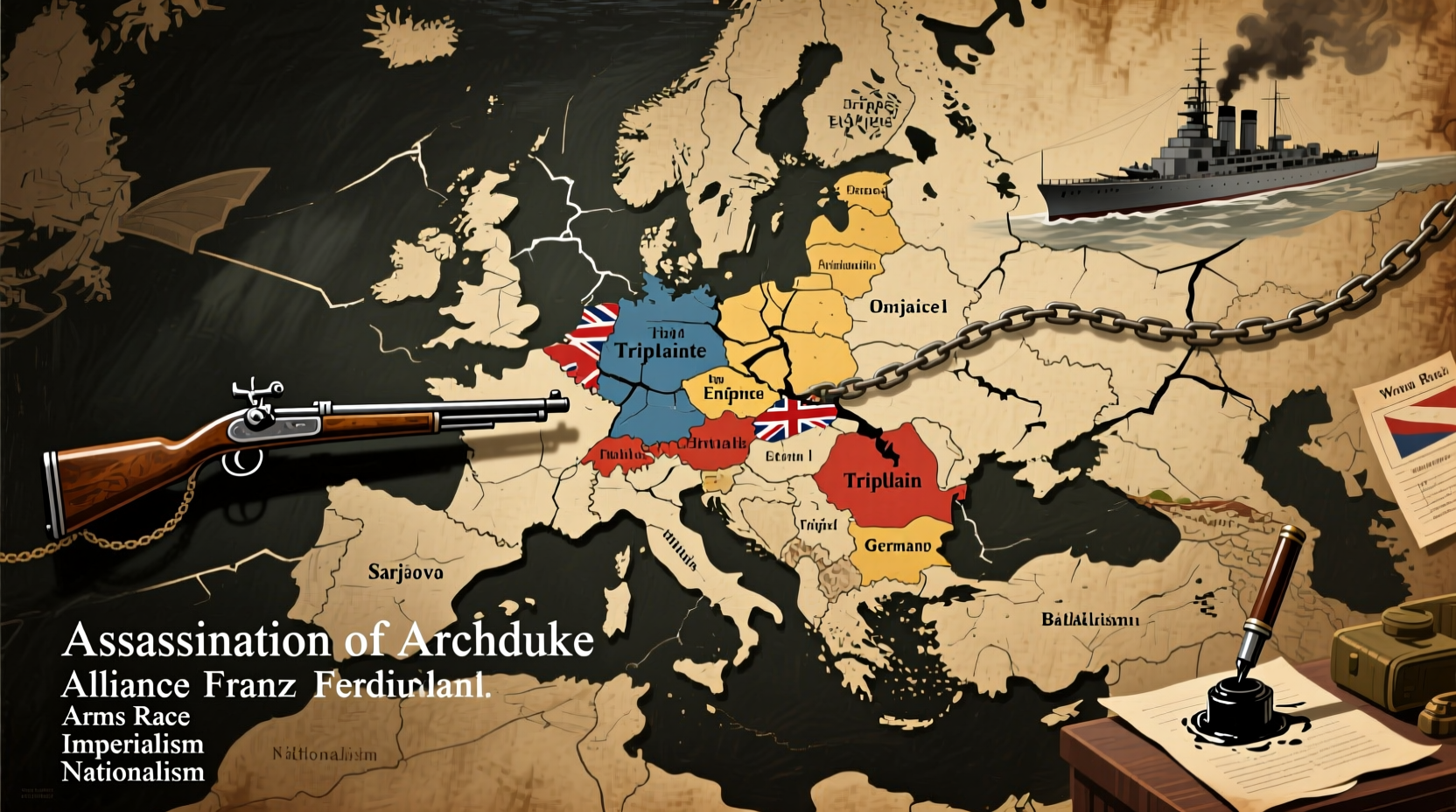
On June 28, 1914, Archduke Franz Ferdinand, heir to the Austro-Hungarian throne, was assassinated in Sarajevo by Gavrilo Princip, a Bosnian Serb nationalist affiliated with the Black Hand, a secret Serbian military society. The assassination occurred during the Archduke’s visit to Bosnia, which Austria-Hungary had annexed in 1908—much to the anger of Serbian nationalists who viewed Bosnia as rightfully part of a greater Serbia.
Austria-Hungary, backed by Germany, saw the assassination as an opportunity to suppress Serbian nationalism. On July 23, it issued a harsh ultimatum to Serbia, demanding full cooperation in investigating the plot and allowing Austrian officials to operate within Serbian territory. While Serbia accepted most demands, it rejected key provisions as violations of sovereignty. Austria-Hungary declared war on July 28, setting off a chain reaction across Europe.
Alliance Systems: The Web That Pulled Europe into War
One of the most significant structural causes of World War I was the system of military alliances that divided Europe into two opposing camps:
- The Triple Alliance (1882): Germany, Austria-Hungary, and Italy (though Italy later remained neutral).
- The Triple Entente (1907): France, Russia, and the United Kingdom.
These alliances were originally designed as deterrents—meant to prevent war by ensuring mutual defense. But by 1914, they had become rigid commitments that turned localized conflicts into continental ones. When Austria-Hungary declared war on Serbia, Russia mobilized in support of its Slavic ally. Germany, fearing a two-front war, declared war on Russia (August 1) and then on France (August 3). To reach France quickly, Germany executed the Schlieffen Plan, invading neutral Belgium. This prompted Britain, bound by treaty to protect Belgian neutrality, to enter the war on August 4.
“The alliance systems didn’t cause the war, but they guaranteed its scale.” — Margaret MacMillan, historian and author of *The War That Ended Peace*
Militarism and the Arms Race
In the decades before 1914, European powers engaged in intense militarization. Military budgets soared, conscription became widespread, and nations developed detailed war plans. Germany and Britain competed fiercely in naval construction, each striving to outbuild the other in battleships—a race symbolized by the launch of the British HMS Dreadnought in 1906.
This arms race fostered a culture where war seemed not only possible but even desirable. Military leaders held increasing influence over policy, and war plans like Germany’s Schlieffen Plan assumed rapid mobilization was essential. Once mobilization orders were given, there was little room for diplomacy or retreat—machinery had been set in motion.
Pre-War Military Spending (Approximate, 1913)
| Country | Military Expenditure (Millions of GBP) |
|---|---|
| Germany | 60 |
| United Kingdom | 50 |
| France | 40 |
| Russia | 35 |
| Austria-Hungary | 25 |
Imperial Rivalries and Nationalism
By 1914, European powers had carved up much of Africa and Asia, leading to frequent diplomatic clashes over colonies. While these tensions didn’t directly cause the war, they poisoned international relations. For example, the Moroccan Crises of 1905 and 1911 brought France and Germany to the brink of war over influence in North Africa.
Nationalism played a dual role. In Western Europe, it fueled patriotic fervor and pride in national strength. In the Balkans, it was a destabilizing force. Ethnic groups within multi-ethnic empires like Austria-Hungary and the Ottoman Empire sought independence. Pan-Slavic sentiment, supported by Russia, encouraged South Slavs to resist Austro-Hungarian rule. This environment made the Balkans a “powder keg” waiting for a spark—provided, ultimately, by the assassination in Sarajevo.
Key Nationalist Movements Contributing to Tensions
- German nationalism promoting imperial expansion
- French desire to reclaim Alsace-Lorraine (lost in 1871)
- Slavic nationalism in Serbia and Bosnia
- Irish nationalism affecting British stability
Economic Competition and Industrial Pressures
Beneath the surface of political and military tensions lay fierce economic competition. Germany’s rapid industrial growth threatened Britain’s economic dominance. By 1914, Germany had surpassed Britain in steel production and chemical innovation. France and Russia also sought to strengthen their economies through colonial exploitation and infrastructure projects.
Some historians argue that ruling elites saw war as a way to redirect internal social pressures. With rising labor movements and socialist parties gaining power, war offered a unifying cause that could rally populations and distract from domestic unrest. In this view, war became not just geopolitically acceptable but politically useful.
Step-by-Step Timeline of Escalation (July 1914)
- June 28: Archduke Franz Ferdinand assassinated in Sarajevo.
- July 5: Germany gives Austria-Hungary a “blank check” assurance of support.
- July 23: Austria-Hungary issues an ultimatum to Serbia.
- July 25: Serbia responds partially accepting terms; Austria rejects reply.
- July 28: Austria-Hungary declares war on Serbia.
- July 30: Russia begins general mobilization.
- August 1: Germany declares war on Russia.
- August 3: Germany declares war on France.
- August 4: Germany invades Belgium; Britain declares war on Germany.
FAQ
Was World War I avoidable?
Many historians believe it was. Diplomatic solutions were still possible in late July 1914. However, inflexible mobilization schedules, mistrust between powers, and overconfidence in short wars reduced the space for negotiation. Some leaders believed war was inevitable sooner or later, making them less inclined to compromise.
Why did the United States enter World War I?
The U.S. initially remained neutral. It entered the war in April 1917 due to unrestricted German submarine warfare (which sank American ships, including the Lusitania), the Zimmermann Telegram (a German proposal to Mexico to join the war against the U.S.), and growing economic ties to the Allies.
Did any country want war in 1914?
None of the major powers desired a full-scale continental war, but some—particularly elements within the German and Austrian military leadership—saw strategic advantages in fighting soon rather than later. Others believed war would be brief and victorious. Miscalculation, more than malice, drove the descent into conflict.
Mini Case Study: The July Crisis Diplomacy Failure
In early July 1914, British Foreign Secretary Sir Edward Grey attempted to mediate between Austria-Hungary and Russia, proposing a conference to resolve the dispute. However, Germany dismissed the idea, believing Austria-Hungary had the right to punish Serbia. Russia, feeling obligated to defend a fellow Slavic nation, refused to back down. Without a neutral forum and with each side interpreting the crisis through the lens of alliance loyalty, diplomacy collapsed. The failure of the “Grey Initiative” illustrates how even well-intentioned efforts can falter when structural tensions override peace-seeking impulses.
Checklist: Key Factors That Led to World War I
- ✅ Assassination of Archduke Franz Ferdinand (immediate trigger)
- ✅ Complex alliance systems locking nations into war
- ✅ Militarism and aggressive war planning (e.g., Schlieffen Plan)
- ✅ Intense nationalism, especially in the Balkans
- ✅ Imperial rivalries and economic competition
- ✅ Failure of diplomacy during the July Crisis
- ✅ Public and elite belief in the inevitability or glory of war
Conclusion
The causes of World War I were neither simple nor singular. They emerged from a convergence of long-term structural pressures—militarism, alliances, imperialism, and nationalism—and short-term miscalculations during the July Crisis. No single nation bears sole responsibility, though historians continue to debate the roles of Germany, Austria-Hungary, Russia, and others.
Understanding how World War I began is not merely an academic exercise. It offers timeless lessons about the dangers of unchecked nationalism, the fragility of peace in polarized systems, and the speed with which diplomacy can fail when trust erodes. As global tensions rise in the 21st century, reflecting on 1914 reminds us that peace must be actively maintained—not assumed.




 浙公网安备
33010002000092号
浙公网安备
33010002000092号 浙B2-20120091-4
Comments
No comments yet. Why don't you start the discussion?