
In the whimsical yet emotionally layered world of Adventure Time, even the most seemingly trivial moments can spiral into profound questions. One such moment—“Why did you eat my fries?”—has echoed through fan communities for years. Spoken by Finn the Human in a tone laced with betrayal and confusion, this line isn’t just about snack theft; it’s symbolic of deeper themes like trust, miscommunication, and the fragile nature of friendship. While the scene appears brief and humorous on the surface, its lasting impact suggests something more complex beneath.
The phrase originates from a minor exchange between Finn and Jake in Season 4, Episode 17: “The Suitor.” After returning home hungry, Finn discovers his leftover fries are gone—eaten by Jake, who claims he thought they were abandoned. What follows is a rapid escalation of emotion that feels disproportionate to the situation, prompting viewers to wonder: why does this matter so much? To truly understand the weight of those five words, we must explore the characters’ dynamics, narrative context, and the show’s broader storytelling philosophy.
The Context Behind the Fries
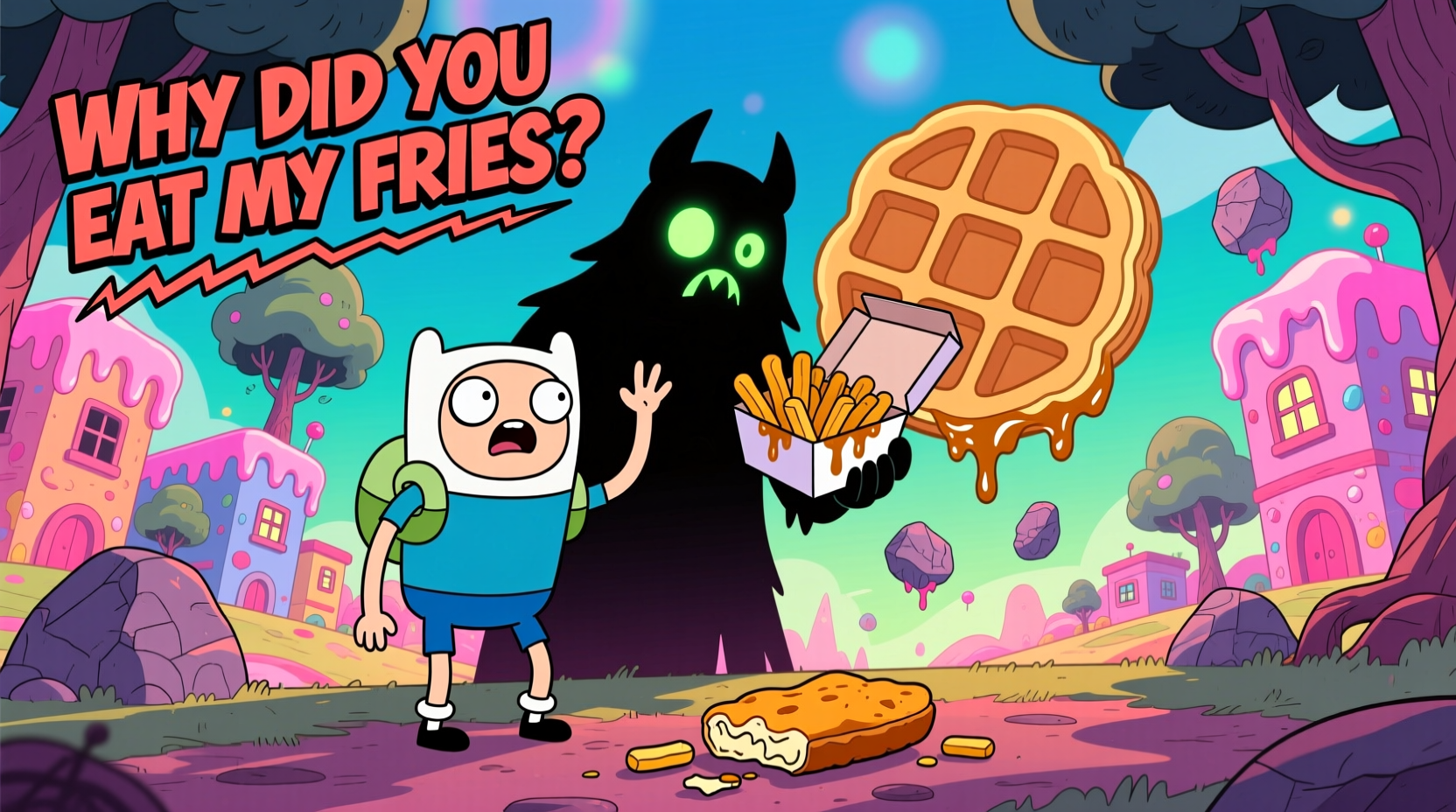
Finn and Jake live together in a treehouse in the Land of Ooo—a post-apocalyptic realm where magic, technology, and absurdity coexist. Their relationship is foundational to the series: adoptive brothers, best friends, and constant companions. Yet, despite their bond, misunderstandings arise frequently, often rooted in differing perspectives. In “The Suitor,” Finn has been emotionally drained after a failed romantic encounter with Flame Princess. He returns home seeking comfort—symbolized by his cold fries—and finds them gone.
Jake, ever the laid-back optimist, eats the fries without thinking, assuming they were trash. His logic isn’t malicious—he operates on instinct and convenience. But Finn interprets the act differently. The fries represent more than food; they’re a small promise of normalcy, a personal possession in a chaotic world. When that is taken—even unintentionally—it triggers a sense of violation.
Symbolism of Food in Adventure Time
Food in Adventure Time frequently serves as a metaphor for care, connection, and identity. Consider the Candy People, whose very existence is edible; or Marceline’s aversion to cooked meals, symbolizing her resistance to domestication; or BMO cooking for Finn as an expression of love. Even simple acts like sharing a sandwich carry emotional significance.
In this light, the missing fries become a microcosm of neglect. It’s not about hunger—it’s about being seen. Finn didn’t ask for grand gestures. He wanted something small, predictable, and his. When Jake dismisses the issue with a shrug (“They were just fries”), it amplifies the disconnect. This moment mirrors real-life tensions where one person perceives a minor act as deeply personal, while the other sees it as inconsequential.
Character Psychology: Finn vs. Jake
Finn, raised as a warrior, often struggles with emotional regulation. He internalizes pressure to be brave, moral, and selfless. Moments of vulnerability—like craving comfort food after heartbreak—are rare and therefore precious. When even that is disrupted, his reaction stems from accumulated stress rather than the fries alone.
Jake, meanwhile, embodies emotional fluidity and adaptability. He avoids confrontation, uses humor to deflect tension, and lives in the present. His inability to grasp Finn’s frustration isn’t indifference—it’s a cognitive mismatch. Where Finn sees boundary violation, Jake sees cleanup.
“We don’t always need big betrayals to feel hurt. Sometimes, it’s the tiny assumptions others make about us that cut deepest.” — Dr. Lena Reyes, Media Psychologist
A Timeline of Escalation
Let’s break down the sequence of events to understand how a fry theft spiraled into a philosophical dilemma:
- Finn leaves the fries on the table. Intentionally or not, he marks them as his with the expectation they’ll remain.
- Jake sees uneaten food and disposes of it. From his perspective, he’s tidying up—an act of care.
- Finn returns and notices the absence. His disappointment is immediate and visceral.
- Jake responds casually. “I thought they were garbage.” No apology, no acknowledgment of Finn’s feelings.
- Finn asks: “Why did you eat my fries?” The question isn’t logistical—it’s existential. It’s asking: “Do you see me?”
This timeline reveals how communication gaps widen when emotional needs go unspoken. Neither character is wrong, but both fail to bridge the gap in perception.
Fan Theories and Cultural Impact
The line gained cult status almost immediately. Memes flooded Reddit, Tumblr, and Twitter, often repurposed in unrelated contexts to express betrayal over trivial matters. But within dedicated fan circles, deeper interpretations emerged:
- The Fries Were a Test: Some argue Finn subconsciously wanted Jake to respect his space. The reaction was less about the fries and more about asserting autonomy.
- Residual Trauma: Given Finn’s history of abandonment (biological parents, leaving the Ice King), losing something small may trigger subconscious fears of loss.
- Metaphor for Growing Apart: As Finn matures, his needs evolve. Jake, ageless and unchanging, may no longer fully understand him.
These theories highlight how Adventure Time masterfully embeds psychological depth into comedic moments. The writers, led by Pendleton Ward and later Adam Muto, consistently used absurdity to explore real human emotions.
Do’s and Don’ts of Interpreting Animated Dialogue
| Do | Don’t |
|---|---|
| Consider the emotional state of the character before the scene | Assume all dialogue is meant to be taken literally |
| Analyze recurring symbols (food, objects, settings) | Ignore tone, delivery, and facial expressions |
| Look at long-term character arcs | Treat isolated scenes as standalone jokes |
| Engage with creator interviews and commentary | Dismiss fan interpretations as “overthinking” |
A Real-Life Parallel: The Case of the Missing Lunch
Consider Sarah, a project manager at a tech startup. One Tuesday, she returned from a stressful client meeting to find her homemade lunch—carefully packed the night before—gone from the office fridge. A coworker had mistaken it for expired food and tossed it. When Sarah confronted them, the response was, “It wasn’t labeled! I was doing everyone a favor.”
Like Finn, Sarah wasn’t upset about the meal itself. She was upset because her effort, routine, and personal space were disregarded. The incident strained their working relationship for weeks. This mirrors the core issue in the fry scene: when we assume ownership of others’ belongings—even with good intentions—we risk undermining trust.
Practical Takeaways for Viewers and Creators
Whether you're analyzing media or navigating relationships, the “fry incident” offers valuable lessons:
Actionable Checklist: Preventing Small Conflicts
- Label your belongings clearly, especially food
- Ask before disposing of someone else’s items
- Validate feelings even if the cause seems trivial
- Communicate expectations about shared spaces
- Apologize sincerely when assumptions lead to conflict
FAQ: Common Questions About the Scene
Was Jake really in the wrong?
Not morally, but emotionally, yes. He failed to recognize Finn’s attachment to the fries. Intent doesn’t negate impact.
Did the writers plan for this line to become iconic?
Unlikely. In commentary, staff writers described it as a throwaway joke. Its resonance grew organically from audience empathy.
Is there any official explanation?
No direct statement exists, but storyboard artist Rebecca Sugar has noted that the show often used humor to mask pain—a theme central to Finn’s arc.
Conclusion: Why the Fries Still Matter
The mystery of “Why did you eat my fries?” endures because it reflects universal experiences: being misunderstood, craving recognition, and the quiet ache of overlooked boundaries. In a world obsessed with epic battles and cosmic villains, Adventure Time reminded us that some of the deepest wounds come from the people closest to us—over something as small as a cold fry.
Understanding this moment isn’t just about dissecting animation. It’s about learning to listen better, to honor the small things others hold dear, and to recognize that every “little thing” might be someone’s lifeline.




 浙公网安备
33010002000092号
浙公网安备
33010002000092号 浙B2-20120091-4
Comments
No comments yet. Why don't you start the discussion?