
Richard Nixon’s resignation in August 1974 marked a pivotal moment in American history. As the first U.S. president to resign from office, his departure came amid the Watergate scandal and looming articles of impeachment. While President Gerald Ford later granted him a full and unconditional pardon, a lingering question remains: Why didn’t Nixon simply pardon himself before stepping down?
The idea of a self-pardon raises profound constitutional, legal, and ethical dilemmas. Though never tested in court, the concept challenges foundational principles of justice—particularly the notion that no one should be a judge in their own case. This article examines the constitutional framework, historical context, expert interpretations, and practical realities that likely deterred Nixon from attempting a self-pardon.
The Constitutional Framework of Presidential Pardons
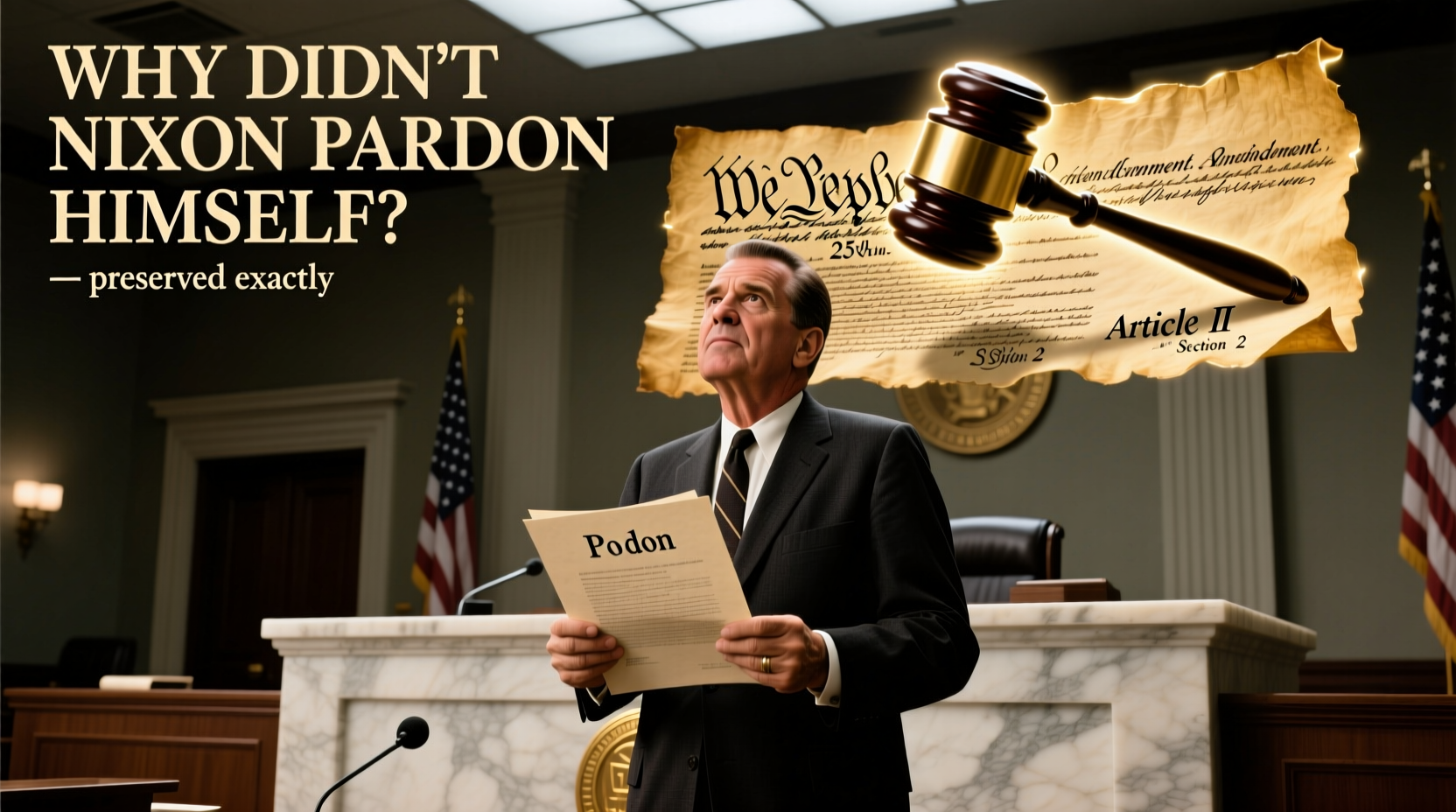
The power to issue pardons is enshrined in Article II, Section 2 of the U.S. Constitution, which grants the president “Power to grant Reprieves and Pardons for Offenses against the United States, except in Cases of Impeachment.” This authority allows the president to forgive federal crimes, commute sentences, or erase convictions.
However, the Constitution does not explicitly address whether a president can pardon themselves. The omission has led to decades of scholarly debate. Legal experts are divided on whether such an act would be valid, enforceable, or even constitutional.
Supporters of broad executive power argue that the pardon clause contains no language excluding self-pardons, suggesting it may be permissible by default. Critics counter that allowing self-forgiveness would violate basic tenets of fairness and due process.
“Presidential power does not mean personal impunity. The pardon power is meant to serve the public interest, not protect the president from accountability.” — Laurence H. Tribe, Harvard Law Professor
Why Nixon Chose Not to Self-Pardon
Nixon had access to top legal minds during his final days in office. His administration considered various legal strategies, including the possibility of a self-pardon. However, several key factors likely dissuaded him:
- Uncertain Legal Validity: No court had ever ruled on a self-pardon. Attempting one risked immediate legal challenge, potentially prolonging the crisis rather than ending it.
- Political Fallout: A self-pardon would have been seen as an overt act of self-dealing, further eroding public trust and possibly inciting unrest.
- Desire for Legacy Preservation: Nixon hoped to retire with some dignity intact. A self-pardon might have cemented his image as a man above the law.
- Availability of Alternative Solutions: He could resign and rely on a successor—someone less tainted—to grant clemency, preserving the appearance of legality.
A Closer Look: The Nixon-Ford Pardon Timeline
The sequence of events following Nixon’s resignation reveals a carefully orchestrated transition designed to avoid constitutional ambiguity while still achieving clemency.
- August 8, 1974: Nixon announces his resignation, effective August 9.
- August 9, 1974: Nixon submits a formal letter of resignation; Gerald Ford assumes presidency.
- September 8, 1974: President Ford issues Proclamation 4311, granting Nixon a “full, free, and absolute pardon” for all federal offenses committed during his presidency.
- October 17, 1974: Nixon testifies before a House subcommittee, accepting the pardon and waiving indictment.
Ford justified the pardon as a means to heal the nation and end the “long national nightmare” of Watergate. In doing so, he preserved the structural integrity of the pardon power—issuing it from one branch of government to another, rather than allowing a single individual to wield both accusation and absolution.
Could a President Legally Pardon Themselves?
This remains an unresolved constitutional question. There is no binding precedent, but numerous legal scholars, Department of Justice memos, and judicial opinions suggest self-pardons would not hold up.
In 1974, the Office of Legal Counsel (OLC) issued a memo stating: “Under the fundamental rule that no one may be a judge in his own case, the President cannot pardon himself.” Though non-binding, this opinion carried significant weight within the Nixon administration.
More recently, during the Trump presidency, the OLC reaffirmed this position in internal discussions, though no formal updated memo was released. Federal judges, including those ruling on Trump-related cases, have referenced the principle that self-pardons would likely be invalid.
| Argument | For Self-Pardon | Against Self-Pardon |
|---|---|---|
| Text of Constitution | No explicit prohibition | Pardon power implies external application |
| Legal Precedent | None exists | OLC memo opposes it; common law bars self-judgment |
| Practical Consequences | Swift closure for presidency | Undermines rule of law; invites abuse |
| Historical Practice | Nobody has tried | All past pardons involved separate parties |
Mini Case Study: The Trump Self-Pardon Speculation
During the final weeks of Donald Trump’s presidency, speculation grew that he might pardon himself before leaving office. Legal advisors reportedly discussed the possibility amid investigations into election interference and January 6 Capitol riot involvement.
Ultimately, Trump did not issue a self-pardon. Instead, he granted clemency to over 140 allies and associates—but excluded himself. Legal analysts widely agreed that any self-pardon would face immediate judicial review and likely be overturned.
This near-precedent underscores how political leaders continue to confront the same constitutional dilemma Nixon faced: even if a self-pardon seems legally plausible, its legitimacy hinges on public and judicial acceptance—neither of which can be guaranteed.
Expert Insight on Executive Accountability
The debate over self-pardons touches on broader concerns about executive overreach and the balance of powers.
“The presidency is not a monarchy. The pardon power is a tool of mercy and justice, not a shield for corruption. Allowing self-forgiveness would fundamentally distort that purpose.” — Akhil Reed Amar, Yale Law School Professor
Legal ethicists emphasize that the appearance of impartiality matters as much as the law itself. Even if a self-pardon were technically allowed, its symbolic impact could destabilize democratic norms.
FAQ
Has any president ever tried to pardon themselves?
No. While Richard Nixon and Donald Trump both considered the option, neither attempted a self-pardon. The legal uncertainty and political consequences made the risk too great.
Can Congress override a presidential pardon?
No. Once granted, a presidential pardon cannot be overturned by Congress or the courts. However, it only applies to federal offenses and does not prevent state-level prosecution.
Would a self-pardon stop criminal charges at the state level?
No. A presidential pardon only covers federal crimes. State prosecutors, such as those in New York or Georgia, could still pursue charges regardless of any federal clemency.
Checklist: Key Considerations Before Any Presidential Self-Pardon
- Is the legal validity of a self-pardon recognized by the Department of Justice?
- Would federal courts likely uphold such a pardon?
- How would the public and media react to a self-pardon?
- Could the act trigger impeachment or further investigation?
- Are there alternative paths to clemency through a successor?
- Does the pardon cover only federal crimes, leaving state charges intact?
- Will the move damage the long-term credibility of the presidency?
Conclusion
Nixon did not pardon himself because the constitutional risks outweighed the potential benefits. Despite having the theoretical ability to attempt such a move, he—and his advisors—recognized that legitimacy matters more than technical loopholes. By resigning and accepting a pardon from Ford, Nixon avoided a direct confrontation with the judiciary and preserved a fragile semblance of legal order.
The enduring lesson is clear: power must be exercised with restraint. Even when the law appears silent, moral and institutional boundaries shape what is truly permissible. As future presidents face similar crossroads, the Nixon precedent will remain a cautionary tale about the limits of executive authority.




 浙公网安备
33010002000092号
浙公网安备
33010002000092号 浙B2-20120091-4
Comments
No comments yet. Why don't you start the discussion?