
In anime, it's common to see characters with vibrant blue, pink, green, or even rainbow-colored hair—even in stories grounded in realism. At first glance, this might seem jarring: a high school drama set in modern-day Tokyo features a protagonist with electric-purple hair; a gritty crime thriller includes a detective whose silver-white locks glow under neon lights. These choices defy real-world biology, yet they persist across decades of animation. Why? The answer lies not in oversight, but in deliberate artistic, cultural, and narrative design.
Colorful hair in anime is more than a stylistic quirk—it’s a functional storytelling device. Even when the setting, dialogue, and plot strive for authenticity, exaggerated hair color serves as a visual shorthand that enhances character identity, emotional expression, and audience engagement. This article explores the historical roots, psychological impact, and production logic behind this phenomenon, especially within anime that otherwise aim for realism.
The Role of Visual Identity in Character Design
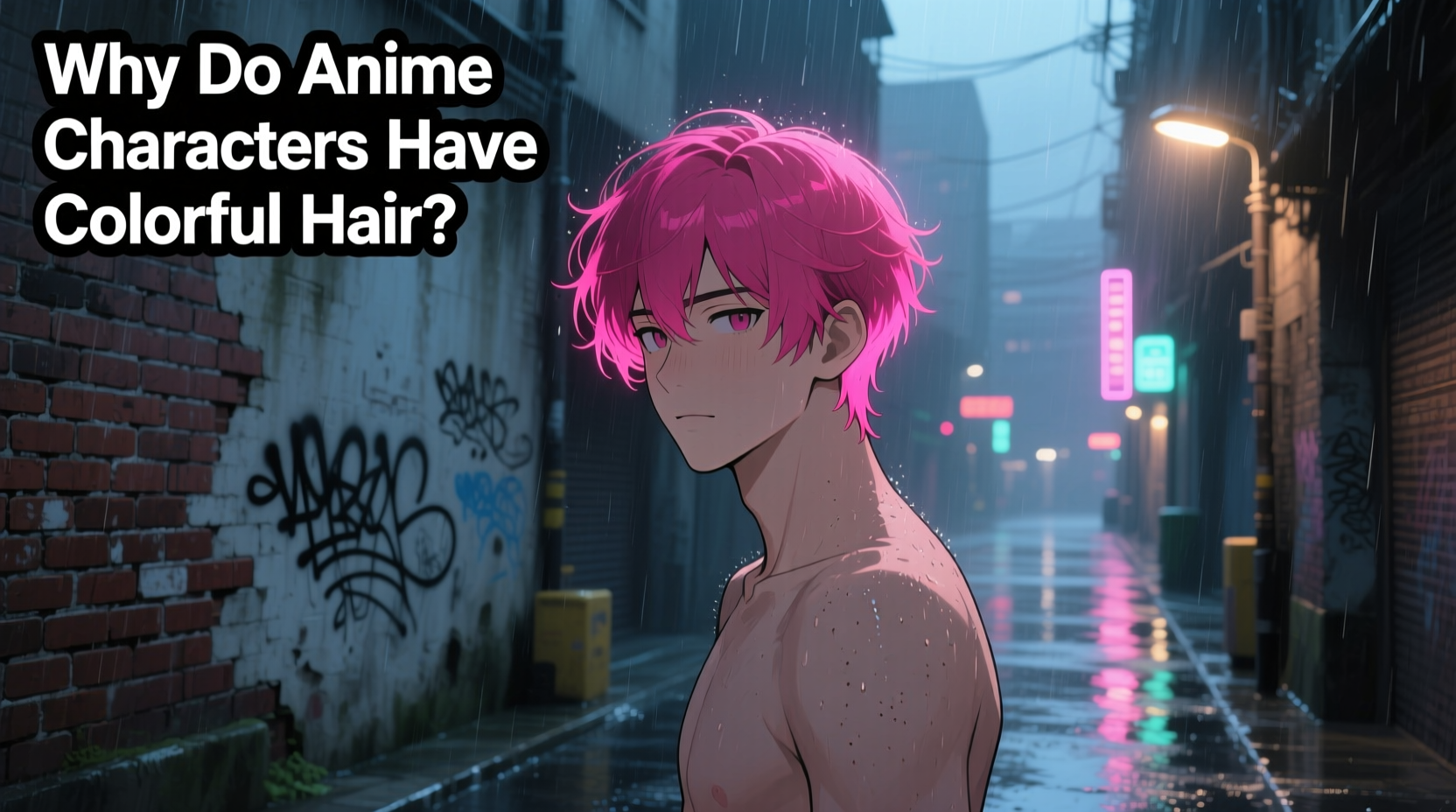
In any visual medium, immediate recognition is crucial. Anime, often produced on tight schedules with limited animation frames, relies heavily on strong silhouettes and distinct features to help viewers identify characters quickly. Hair color is one of the most efficient tools for differentiation.
Consider a classroom scene with 30 students. If all had naturally colored black, brown, or blonde hair, distinguishing individuals would require closer attention to facial features or clothing—details that may be simplified due to budget constraints. But introduce a girl with magenta pigtails or a boy with lime-green spikes, and identification becomes instant.
This principle applies even more strongly in realistic series where emotional nuance and interpersonal dynamics are central. When the story focuses on subtle human behavior, having visually striking characters prevents confusion without distracting from the narrative. The contrast allows audiences to focus on dialogue and emotion rather than struggling to remember who is who.
Cultural Context and Artistic Tradition
The use of non-naturalistic hair colors predates modern anime. Early 20th-century Japanese manga artists, influenced by Western cartoons and theatrical kabuki makeup, embraced stylization over realism. Osamu Tezuka, often called the \"God of Manga,\" used exaggerated features—including bold hair colors—to convey personality and emotion, much like Disney animators did with facial expressions.
By the 1980s, as anime gained global traction, studios like Studio Pierrot and Toei Animation solidified this aesthetic. Series such as Urusei Yatsura and Sailor Moon featured fantastical elements, but their influence bled into more grounded genres. Even when later works moved toward realism—like Monster, March Comes in Like a Lion, or Barakamon—the tradition of expressive hair remained embedded in design language.
“In Japan, hair color isn't expected to signal realism. It's part of the character’s aura—their inner world made visible.” — Dr. Ayano Suzuki, Cultural Analyst at Kyoto University of Art & Design
This cultural lens matters. In Western media, physical accuracy often correlates with credibility. But in Japanese animation, symbolic representation holds equal weight. A character’s teal hair might represent calm intelligence; fiery red could suggest passion or impulsiveness. These associations aren’t arbitrary—they’re learned through repeated exposure and genre conventions.
Narrative Function: Color as Emotional Code
Beyond identification, hair color functions as an emotional code. In realistic anime dealing with trauma, mental health, or personal growth, subtle shifts in appearance can mirror internal change. While full transformations are rare in grounded stories, initial hair color sets a tone.
- Pink – Often linked to warmth, kindness, or vulnerability (e.g., Shizuka in Doraemon, though gentle, stands out in mundane settings).
- Blue – Associated with introspection, stability, or melancholy (Rei Ayanami in Neon Genesis Evangelion uses pale blue hair to emphasize her detached demeanor).
- White/Silver – Suggests wisdom beyond years, isolation, or otherworldliness (Light Yagami in Death Note has ash-blond hair that subtly distances him from ordinary teens).
- Green – Less common, but often denotes uniqueness or environmental connection (seen in characters like Kanao Tsuyuri in Kimetsu no Yaiba, whose realism is balanced by symbolic coloring).
In realistic narratives, these cues operate beneath conscious awareness. Viewers don’t analyze them directly, but they shape perception. A bullied student with bright orange hair in a slice-of-life drama isn’t just “different”—their color marks them as an outsider, amplifying themes of alienation without needing exposition.
Production Practicality and Budget Constraints
Animation is expensive. Realistic shading, dynamic lighting, and accurate textures demand time and resources. One way studios reduce complexity is by simplifying hair rendering. Bright, solid colors are easier to animate consistently across episodes than natural gradients found in real hair.
Moreover, digital coloring pipelines favor flat tones. Once a character model is approved, every frame uses the same palette. Changing hair to jet-black would require meticulous matching to avoid looking muddy under different lighting—something avoided by using clean, saturated hues.
| Hair Type | Animation Difficulty | Cost Impact | Used In |
|---|---|---|---|
| Natural Brown/Black | High (requires shading variation) | ↑↑ | Films with cinematic budgets (e.g., Grave of the Fireflies) |
| Vibrant Solid Color | Low (flat fill, easy replication) | ↓ | Most TV anime, including realistic ones |
| Multi-Toned/Ombre | Very High (gradient consistency) | ↑↑↑ | Limited to key scenes or special editions |
This doesn’t mean studios *can’t* depict realistic hair—they choose not to, because efficiency supports sustainability. For long-running series aiming for emotional depth over spectacle, maintaining a consistent look across hundreds of episodes takes precedence over photorealism.
Real-World Parallels and Audience Expectations
While anime characters may live in fictional worlds, their struggles often mirror real life. Yet audiences accept colorful hair because it aligns with established norms. Just as comic book heroes wear costumes in everyday settings, anime viewers suspend disbelief around appearance to engage with deeper themes.
A compelling example is Clannad, a deeply emotional family drama known for its realistic portrayal of grief, parenthood, and societal pressures. Despite this, protagonist Tomoya Okazaki has slick, dark-blue hair—a shade unseen in nature. Yet few viewers question it, because the color has become synonymous with his rebellious yet sensitive persona.
“People don’t watch Clannad to critique hair dye technology. They watch to feel something. The blue hair helps—it makes him memorable, iconic.” — Kenji Morita, Senior Animator at Kyoto Animation
This acceptance stems from decades of conditioning. Generations have grown up seeing colorful hair as normal within anime. It’s no longer seen as “unrealistic” but as part of the genre’s visual grammar—like stage lighting in theater.
Mini Case Study: My Hero Academia vs. Shirobako
Compare two anime: My Hero Academia, a superhero action series, and Shirobako, a workplace drama about anime production. One is fantastical; the other is hyper-realistic in theme and setting.
Yet both feature characters with vivid hair. In My Hero Academia, Izuku Midoriya’s green curls match his Quirk and symbolize growth and resilience. That fits. But in Shirobako, Aoi Miyamori has bright pink hair while working at a Tokyo animation studio—hardly a place encouraging flamboyance.
Why keep the color? Because Aoi is the audience’s entry point. Her pink hair makes her instantly recognizable during crowded office scenes and signals her energetic, optimistic nature. The show never comments on it—because within the anime world, it’s unremarkable. The message is clear: personality matters more than pigment.
Expert Insight: Bridging Symbolism and Reality
Dr. Haruka Tanaka, a media psychologist specializing in visual cognition, explains how color bypasses rational processing:
“Our brains process color faster than facial details. In fast-paced scenes—like conversations in a bustling cafeteria—hair acts as a tracking beacon. Over time, we associate those colors with traits. So when we see a quiet boy with lavender hair, we expect sensitivity, not confusion.” — Dr. Haruka Tanaka, Osaka Institute of Media Studies
This cognitive efficiency benefits realistic storytelling. When emotions run high, viewers don’t need reminders of who’s speaking—their hair does the work silently.
Checklist: Understanding Colorful Hair in Realistic Anime
To fully appreciate this design choice, consider the following points:
- ✅ Does the character need to stand out in group scenes?
- ✅ Does the hair color reflect personality or emotional arc?
- ✅ Is the series constrained by animation budget or schedule?
- ✅ Has the audience been conditioned to accept stylized looks?
- ✅ Would natural hair make the character blend in too much?
- ✅ Is the color used consistently to build brand identity (for merchandising, posters, etc.)?
If most answers are yes, then colorful hair isn’t a flaw—it’s a strategic decision.
Frequently Asked Questions
Isn’t colorful hair unrealistic, even for anime?
It is biologically inaccurate, yes—but so are many aspects of visual storytelling. Theater actors wear makeup under bright lights; film protagonists often have perfect skin despite living in war zones. Anime prioritizes clarity and symbolism over literal realism. Hair color is part of that suspension of disbelief.
Do Japanese people actually dye their hair these colors?
Some do, especially among youth subcultures in cities like Harajuku or Shibuya. However, most public schools and workplaces enforce strict dress codes limiting unnatural colors. Anime exaggerates this trend for effect, but it’s rooted in real cultural expression.
Could anime switch to realistic hair without losing quality?
Technically, yes—but it would come at a cost. More nuanced shading requires higher budgets and longer production times. Some films, like Your Name or The Wind Rises, achieve near-photorealistic hair, but they are exceptions. For weekly TV series, practicality favors stylization.
Conclusion: Embracing the Language of Style
Colorful hair in realistic anime isn’t a contradiction—it’s a convergence of art, psychology, and industry necessity. It allows creators to communicate instantly, sustain long-form narratives efficiently, and craft characters that linger in memory. Rejecting it in favor of realism would strip anime of one of its most powerful tools.
Next time you watch a grounded drama featuring a lead with crimson bangs or seafoam-green strands, don’t dismiss it as whimsy. See it as intentionality—a silent cue that guides your empathy, sharpens your focus, and deepens your connection to the story.




 浙公网安备
33010002000092号
浙公网安备
33010002000092号 浙B2-20120091-4
Comments
No comments yet. Why don't you start the discussion?