
Anime has long been celebrated for its dynamic action sequences, exaggerated expressions, and stylized movement. One of the most recognizable visual tropes across countless series—from Dragon Ball to My Hero Academia—is the way characters sprint: torso leaning forward dramatically, one leg extended behind, and arms pulled tightly backward, palms facing outward. At first glance, it appears as if they’re cutting through the air like rockets. But is this pose rooted in real-world aerodynamics, or is it simply a clever animation shortcut? The answer lies at the intersection of artistic tradition, production efficiency, and cultural storytelling.
The Iconic Anime Running Pose: A Visual Signature
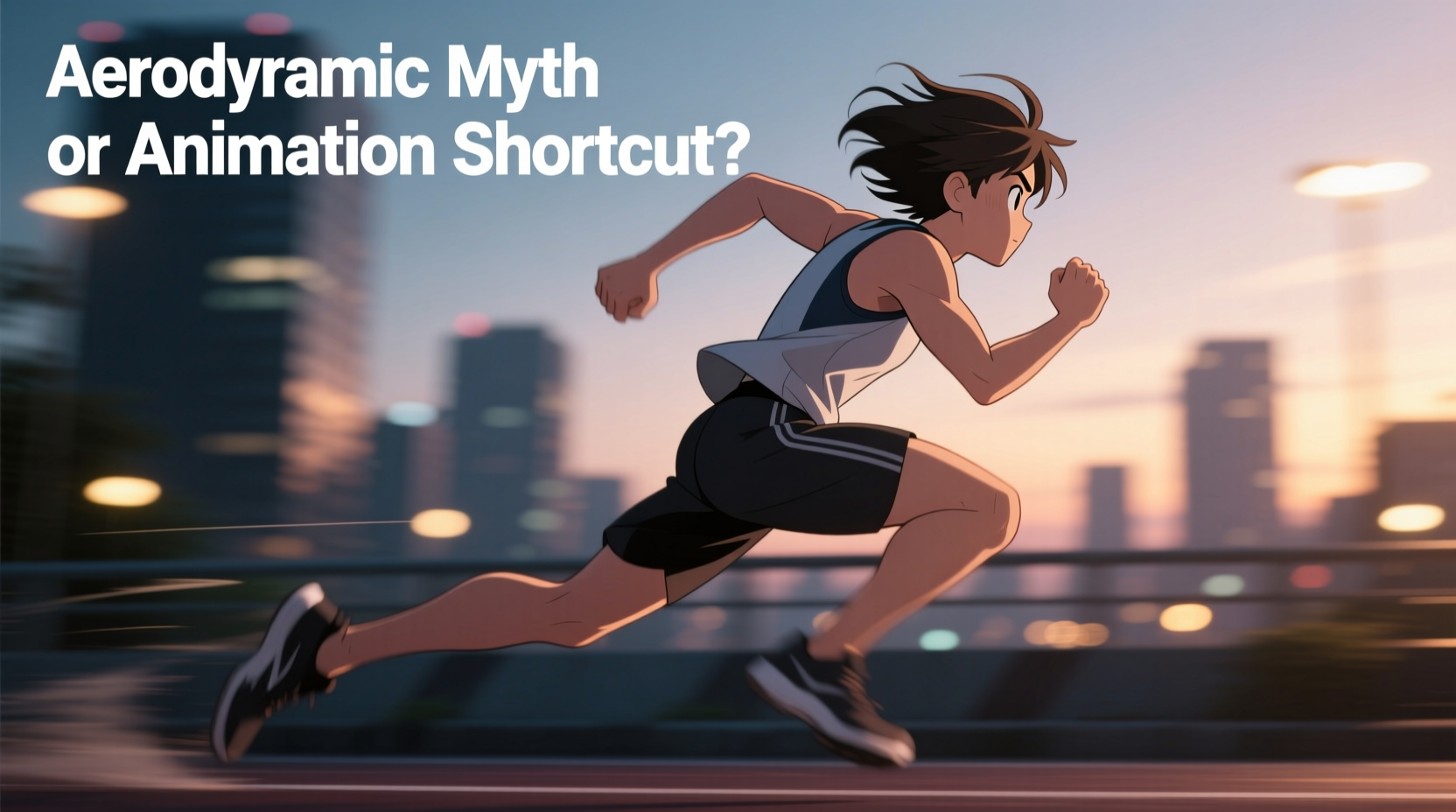
The “arms-back” running stance is more than just a recurring visual quirk—it’s an established stylistic convention. In this pose, the character’s arms are held straight back, parallel to the ground, while their body leans aggressively forward. Their legs stretch into a long stride, often mid-air, creating a sense of extreme speed. This image is so ingrained in anime culture that it’s frequently parodied, referenced, and even used as a meme template online.
What makes this pose stand out is not just its frequency but its consistency. Whether the character is a high school student racing to class or a superpowered warrior dashing toward battle, the same posture appears. This uniformity suggests a deliberate choice rather than an accidental trend.
Aerodynamics: Myth or Misinterpretation?
One common theory is that the arms-back pose improves aerodynamics, reducing drag and allowing the character to move faster—like a cyclist tucking into a streamlined position. However, from a biomechanical standpoint, this explanation doesn’t hold up under scrutiny.
In reality, human runners generate propulsion through coordinated arm swings that counterbalance leg movement. Holding arms rigidly back would disrupt balance, reduce momentum, and increase energy expenditure. Furthermore, palms facing backward create additional frontal surface area, increasing air resistance rather than minimizing it. True aerodynamic efficiency in sprinting involves minimizing cross-sectional area and maintaining smooth airflow—neither of which is achieved by the anime pose.
“Anime isn’t trying to replicate physics; it’s trying to convey emotion and motion through symbolic visuals.” — Dr. Kenji Tanaka, Animation Historian and Professor at Tokyo University of the Arts
The idea that the pose is aerodynamically sound is largely a post-hoc justification—a fan theory that sounds plausible but lacks scientific basis. Instead, the pose should be understood not as a reflection of real-world physics, but as a visual metaphor for speed.
Animation Efficiency: The Practical Side
Beyond symbolism, there’s a pragmatic reason for the prevalence of the arms-back run: it’s easier and faster to animate. Traditional hand-drawn animation requires dozens of frames per second, each drawn or adjusted by hand. Repetitive motions like running cycles must be optimized to save time and resources.
The arms-back pose simplifies the animation process in several ways:
- Reduced limb articulation: Keeping arms straight and fixed minimizes the need for detailed joint movement.
- Fewer keyframes: The static arm position allows animators to reuse the same drawing across multiple frames.
- Emphasis on forward thrust: The pose exaggerates forward momentum without requiring complex leg mechanics.
- Easier in-betweening: The linear motion makes it simpler to draw intermediate frames between strides.
In the early days of anime production, especially during the 1970s and 1980s, studios operated under tight budgets and deadlines. Pioneering animators developed stylized techniques to convey motion efficiently. The arms-back run became a staple because it communicated speed clearly while minimizing labor. Over time, it evolved from a necessity into a stylistic hallmark.
Case Study: The Evolution in Speed Racer and Neon Genesis Evangelion
One of the earliest examples of this running style can be seen in Speed Racer (known in Japan as Mach GoGoGo), where characters often dash with arms swept back. Though crude by today’s standards, the animation effectively conveyed urgency and velocity using minimal movement.
Decades later, Neon Genesis Evangelion employed a similar technique during action sequences involving the EVA units. Despite their massive size, the mechs were animated running with stiff, backward-swept limbs—mirroring human anime runners. Director Hideaki Anno acknowledged the influence of classic anime tropes, noting that familiar visual language helped audiences instantly recognize motion and intent, even in surreal contexts.
This continuity illustrates how a practical animation solution became embedded in the visual grammar of Japanese animation.
Cultural and Symbolic Significance
The arms-back run transcends technical convenience—it carries symbolic weight. In Japanese visual storytelling, motion is often expressed through abstraction rather than realism. Speed is not shown through blurred backgrounds alone but through exaggerated body positions that suggest force and direction.
This approach aligns with broader principles in manga and anime aesthetics, where emotions are depicted through outsized eyes, sweat drops, or explosive hair dynamics. Similarly, the running pose is a form of visual hyperbole—an instant cue that a character is moving fast, determined, or entering a critical moment.
Moreover, the pose often appears during pivotal scenes: a hero rushing to save a friend, a rival launching an attack, or a protagonist breaking through personal limits. Its recurrence in climactic moments reinforces its association with intensity and resolve.
| Aspect | Realistic Running | Anime Arms-Back Run |
|---|---|---|
| Arm Movement | Natural swing, bent elbows | Arms straight back, palms outward |
| Body Angle | Slight forward lean | Extreme forward tilt (45°+) |
| Purpose | Efficient locomotion | Visual representation of speed |
| Animation Complexity | High (many moving parts) | Low (static limbs, reusable frames) |
| Biomechanical Accuracy | High | Low |
Modern Trends and Digital Animation
With the rise of digital animation tools, the need for such shortcuts has diminished. Software like Toon Boom, RETAS, and Adobe Animate allows for smoother interpolation, automated in-betweens, and more fluid motion. Yet, the arms-back run persists—even in high-budget productions.
This endurance speaks to its cultural resonance. Modern anime creators retain the pose not out of necessity, but as a nod to tradition and audience expectation. It functions like a visual shorthand: when viewers see a character adopt the stance, they immediately understand the context—someone is moving fast, with purpose.
Some contemporary series even subvert the trope for comedic or dramatic effect. In Gintama, characters perform the pose while standing still, mocking its ubiquity. Meanwhile, Attack on Titan uses realistic running animations during intense combat, contrasting with occasional stylized flashes that echo classic anime forms.
Step-by-Step: How the Pose Is Constructed in Animation
- Keyframe 1 – Launch Position: Character bends knees, leans torso forward, arms begin to retract.
- Keyframe 2 – Mid-Air Extension: One leg extends forward, the other back; arms snap straight behind, palms flat.
- Hold Frame: The pose is sustained for 2–3 frames to emphasize speed.
- Transition: Limbs return to normal running cycle or lead into a jump/attack.
- Background Motion: Speed lines, blurred scenery, or particle effects enhance the illusion of velocity.
This sequence prioritizes clarity over realism. The extended hold on the arms-back frame ensures the audience registers the burst of speed, even in fast-paced editing.
Expert Insight: The Role of Stylization in Motion
“In Western animation, motion often follows physical laws closely. In anime, motion follows emotional logic. The arms-back run isn’t about how people *do* run—it’s about how it *feels* to run at full power.” — Mika Sato, Lead Animator at Studio Bones
This distinction is crucial. Anime prioritizes emotional impact and narrative clarity over photorealism. The arms-back run isn’t meant to deceive viewers into thinking it’s aerodynamic; it’s designed to evoke excitement, tension, or awe. Like a superhero soaring through the sky with a flowing cape, the pose is part of a larger visual language built on exaggeration and symbolism.
FAQ
Is the anime running pose ever used in real life?
No. Competitive sprinters use coordinated arm swings to maintain balance and drive forward motion. Holding arms back would hinder performance and is not observed in any athletic context.
Do all anime use the arms-back running style?
Not all, but most mainstream action and shonen anime do—at least occasionally. More grounded or realistic series, such as Monster or March Comes in Like a Lion, avoid the trope in favor of naturalistic movement.
Has the pose influenced non-anime media?
Yes. Western cartoons, video games, and internet memes have adopted the pose as a symbol of exaggerated speed. It appears in titles like Honkai: Star Rail and Teen Titans Go!, often for comedic effect.
Checklist: Identifying the Anime Run in Media
- ✅ Character leans forward at an extreme angle
- ✅ Arms are fully extended backward, palms facing rear
- ✅ Legs are split in a long stride, often mid-air
- ✅ Accompanied by speed lines or motion blur
- ✅ Occurs during a moment of high intensity or determination
- ✅ Reused across multiple characters and series
Conclusion: Embracing the Trope
The anime character running with arms back is neither a product of aerodynamic science nor an outdated relic. It is a deliberate fusion of artistic expression and production pragmatism. While it defies real-world physics, it excels in its true purpose: conveying speed, urgency, and emotional intensity in a single, iconic image.
Understanding this pose enriches our appreciation of anime as a unique art form—one that values symbolic communication as much as technical accuracy. Whether born from budget constraints or creative vision, the arms-back run endures because it works. It captures the spirit of motion in a way that resonates across cultures and generations.




 浙公网安备
33010002000092号
浙公网安备
33010002000092号 浙B2-20120091-4
Comments
No comments yet. Why don't you start the discussion?