
At first glance, the way many anime characters run—with their arms pulled tightly behind them—seems to defy basic human biomechanics. In real life, running involves coordinated arm swing: one arm forward as the opposite leg strides ahead. Yet in countless anime scenes, from high-speed chases to dramatic sprinting entrances, characters bolt forward with arms pinned backward like jet-powered action figures. This stylistic choice is more than just an artistic quirk; it reflects a deliberate fusion of animation efficiency, expressive exaggeration, and narrative emphasis that prioritizes visual impact over physical realism.
This article unpacks the reasoning behind this distinctive animation trope, contrasting real-world physics with the conventions of Japanese animation. We’ll examine how motion is stylized for clarity and drama, explore production constraints that influence movement design, and reveal why breaking the rules of anatomy often serves the story better than strict accuracy ever could.
The Physics of Real Human Running
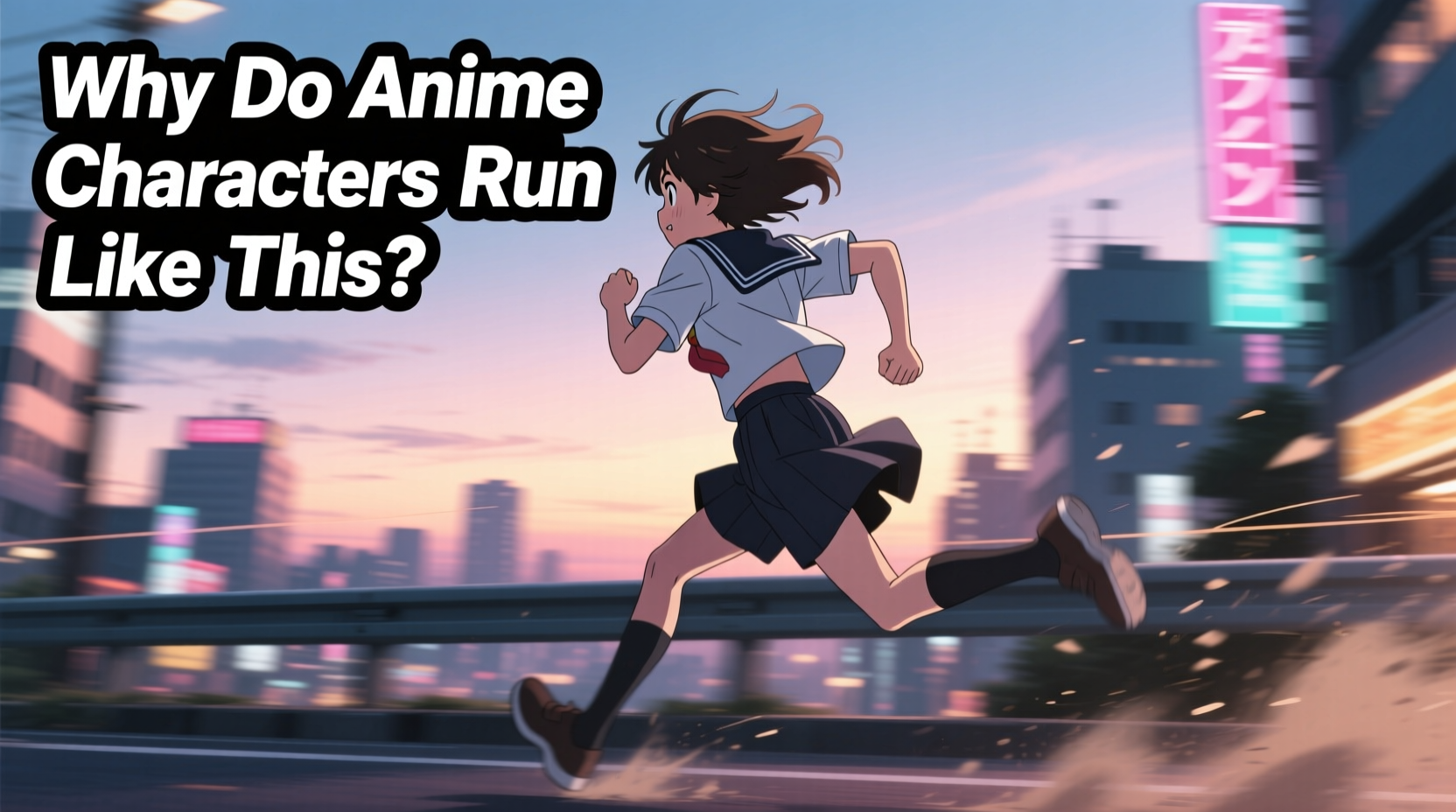
In reality, running is a complex interplay of balance, momentum, and energy conservation. When humans sprint, the arms naturally swing in opposition to the legs—a left arm moves forward as the right leg steps forward, and vice versa. This counterbalance helps stabilize the torso, reduces rotational forces, and contributes to propulsion efficiency.
Biomechanical studies show that arm swing can contribute up to 10% of forward thrust during maximal sprinting. The range of motion is dynamic: elbows bent at approximately 90 degrees, hands rising near chin level in front and swinging back past the hip. Any restriction of arm movement—such as holding arms stiffly at the sides or behind the back—significantly reduces speed and increases energy expenditure.
So when anime characters run with arms locked behind them, they are not only violating anatomical logic but also depicting a physically inefficient (and nearly impossible) form of locomotion. And yet, this motion persists across decades of animation. Why?
“Animation doesn’t aim to replicate reality—it aims to represent emotion, intent, and motion through symbolic language.” — Naoko Yamada, Director (Kyoto Animation)
Animation Style Over Physical Accuracy
Japanese animation has long embraced stylization as a core principle. Unlike Western animation traditions that sometimes lean toward naturalism (e.g., Disney’s attention to lifelike motion), anime frequently uses abstraction to convey meaning quickly and dramatically. The “arms-back” running pose is one such abstraction.
This posture emerged in early television anime due to limited frame counts and budget constraints. Animators needed to depict fast motion without drawing every subtle nuance of muscle movement. By simplifying the runner’s silhouette—straight legs, rigid torso, arms pulled back—the character reads instantly as “moving fast,” even if the motion isn’t biomechanically correct.
Over time, this shorthand evolved into a recognizable visual code. Audiences now associate the arms-back stance with urgency, determination, or heroic resolve. It's less about how someone runs and more about how fast they *feel* like they’re going. In this context, realism takes a backseat to emotional resonance.
Visual Storytelling and Emotional Impact
Anime relies heavily on visual metaphors to communicate internal states. A character charging into battle with arms behind them isn’t just running—they’re surging forward with unstoppable willpower. The exaggerated posture amplifies their momentum, making the audience *feel* the speed.
Consider a scene where a protagonist races toward a collapsing bridge to save a friend. If the animator used realistic running mechanics, the motion might look smooth—but potentially underwhelming. With arms back, body leaning forward, and legs stretched in extreme extension, the image becomes iconic. It transcends mere locomotion and enters the realm of symbolism: forward motion as destiny.
This technique aligns with broader anime aesthetics, such as “speed lines,” blurred backgrounds, and impact frames—all tools designed to heighten perception of velocity. The arms-back run fits seamlessly within this toolkit, functioning not as a mistake, but as a calculated stylistic device.
Case Study: Sprinting in Haikyuu!!
In the volleyball anime Haikyuu!!, characters frequently dash across the court during intense rallies. While some sequences use relatively accurate running cycles, others switch to the classic arms-back sprint during key moments—particularly when a character makes a sudden, emotionally charged move.
For example, when Hinata Shoyo sprints to make an improbable dig, the animation shifts into a stylized mode: arms behind, legs elongated, background streaking. This isn’t meant to mimic real volleyball footwork; it’s designed to emphasize his explosive effort and sheer determination. The audience understands immediately: this is a pivotal moment, elevated beyond ordinary action.
The contrast between realistic and exaggerated motion actually enhances both. Viewers appreciate the grounded movements in calm scenes and feel the heightened intensity when the animation breaks form.
Production Efficiency and Frame Economy
One of the most practical reasons for the arms-back running style lies in animation production logistics. Traditional hand-drawn anime operates under tight deadlines and budgets. Full, fluid running cycles require multiple unique drawings per second—often 8 to 12 frames just for one second of motion.
To save time and resources, animators developed reusable “cycles” and simplified poses. The arms-back run requires fewer distinct frames because the upper body remains mostly static. Combined with a looping leg motion and a moving background, it creates the illusion of speed with minimal effort.
This approach, known as “limited animation,” was pioneered by Osamu Tezuka and became standard in TV anime. Rather than aiming for cinematic realism, studios focused on strategic highlights—key expressions, impactful poses, and dramatic timing—while economizing on continuous motion.
| Motion Type | Frames Needed (per second) | Production Cost | Emotional Impact |
|---|---|---|---|
| Realistic Running Cycle | 8–12 | High | Moderate (naturalistic) |
| Arms-Back Sprint (Limited Animation) | 4–6 | Low | High (stylized) |
| Full Motion with Effects | 12+ | Very High | Maximum (cinematic) |
As the table shows, the arms-back style offers a cost-effective way to maintain pacing without sacrificing perceived intensity. For weekly series with recurring action scenes, this efficiency is essential.
Evolution and Exceptions in Modern Anime
While the arms-back run remains common, modern anime increasingly blends stylization with greater anatomical fidelity. High-budget films and streaming-exclusive series often feature fully animated running sequences that respect real-world physics.
Studio productions like Your Name (Makoto Shinkai) or Chainsaw Man (MAPPA) showcase fluid, biomechanically accurate sprints when the narrative demands immersion. These moments stand out precisely because they break from convention—audiences notice the extra effort and interpret it as a sign of importance.
Yet even in these advanced works, the arms-back pose hasn’t disappeared. It reappears in comedic contexts, nostalgic homages, or hyperbolic action beats. Its persistence proves that it’s not outdated—it’s simply serving a different purpose than realism.
Checklist: Identifying Purpose Behind Anime Running Styles
- Assess the scene tone: Is it dramatic, comedic, or urgent?
- Observe the background: Are speed lines or motion blur used?
- Note arm position: Arms back = stylized speed; natural swing = realism.
- Count the frames: Repetitive loops suggest limited animation.
- Listen to music/sound: Does audio amplify the sense of motion?
- Consider character focus: Is the run part of a transformation or climax?
Frequently Asked Questions
Is the arms-back running style unique to anime?
No, but it’s most prevalent and codified in Japanese animation. Similar stylizations appear in Western cartoons (e.g., Looney Tunes), but anime has systematized the pose as a recurring visual motif rather than a one-off gag.
Do animators know this isn’t realistic?
Absolutely. Most professional animators understand human anatomy and motion principles. The choice to use arms-back running is intentional—not ignorance, but artistic license. As one industry veteran put it: “We’re not making documentaries—we’re making feelings visible.”
Can both styles coexist in the same show?
Yes, and they often do. Many anime alternate between realistic and exaggerated motion depending on context. A quiet walking scene may use natural gait, while a climactic dash reverts to the iconic arms-back sprint for maximum impact.
Step-by-Step: How to Animate a Stylized Anime Run
- Define the intent: Is the character running for survival, joy, or comedy? This determines the level of exaggeration.
- Simplify the upper body: Keep arms fixed behind the back or slightly bent at the elbows.
- Exaggerate leg extension: Stretch the leading leg forward, trailing leg back, to imply speed.
- Tilt the torso: Lean the character forward aggressively to enhance momentum.
- Add motion effects: Use speed lines, dust clouds, or blurred backgrounds to reinforce movement.
- Loop the cycle: Create a 4–6 frame sequence that repeats smoothly.
- Sync with sound: Match footstep sounds and music tempo to the rhythm of the run.
This method prioritizes readability and impact over anatomical precision, aligning with the core values of traditional anime production.
“The goal isn’t to copy reality, but to create a stronger version of it—one where emotion drives motion.” — Masaaki Yuasa, Animator and Director
Conclusion: Embracing the Language of Stylization
The arms-back running pose in anime isn’t a flaw—it’s a dialect within a larger visual language. Rooted in economic necessity and refined through decades of storytelling, it communicates speed, urgency, and emotional drive more effectively than photorealistic animation might in certain contexts.
Understanding this distinction allows viewers to appreciate anime not as failed attempts at realism, but as successful experiments in expressive form. The next time you see a character racing across the screen with arms locked behind them, don’t question the physics—recognize the artistry. That pose carries history, intention, and a deep understanding of how to make still images feel alive.




 浙公网安备
33010002000092号
浙公网安备
33010002000092号 浙B2-20120091-4
Comments
No comments yet. Why don't you start the discussion?