
Sleep is a foundational pillar of health, influencing everything from cognitive function to immune resilience. Yet millions struggle to achieve restful, uninterrupted sleep—often due to environmental factors within their control. One of the most effective yet underutilized tools for improving sleep quality is the blackout curtain. While many people associate these heavy drapes with hotel rooms or shift workers, their benefits extend far beyond convenience. By manipulating light exposure in the sleeping environment, blackout curtains can significantly enhance sleep onset, duration, and depth. But do they truly block all light? And how exactly does darkness influence our biology? This article explores the science behind light’s impact on sleep, examines the effectiveness of blackout curtains across different light types, and provides practical guidance for selecting and using them effectively.
The Science of Light and Sleep Regulation
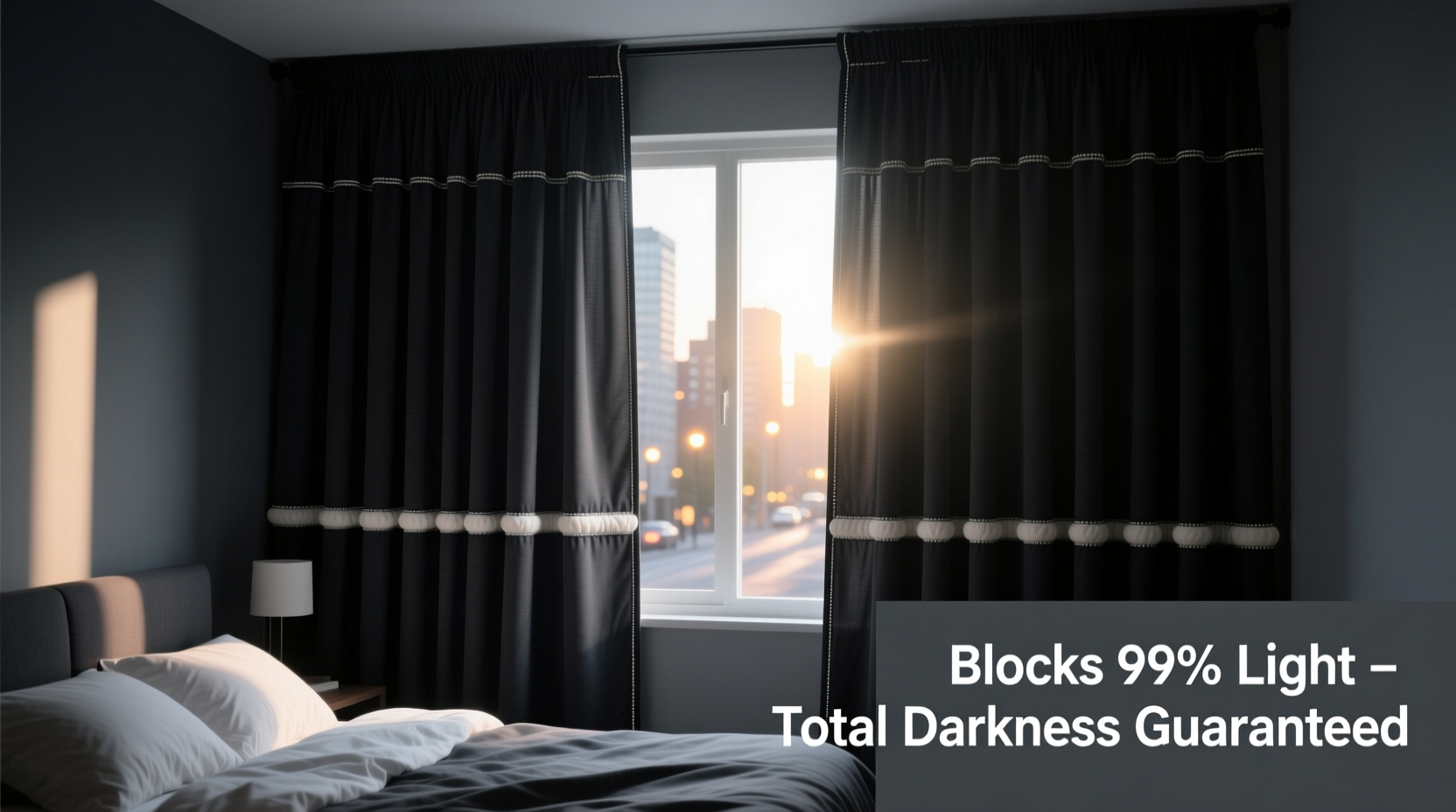
The human body operates on a circadian rhythm—a roughly 24-hour internal clock regulated primarily by light exposure. This biological system governs when we feel alert and when we feel sleepy. At the heart of this process is melatonin, a hormone produced by the pineal gland in response to darkness. As evening approaches and ambient light diminishes, melatonin levels rise, signaling the brain that it's time to wind down.
Exposure to light—especially blue-rich wavelengths found in daylight and digital screens—suppresses melatonin production. Even small amounts of artificial light at night can delay melatonin release, disrupting sleep onset and reducing overall sleep quality. A study published in the Journal of Clinical Endocrinology & Metabolism found that participants exposed to room light during sleep experienced a 50% suppression of melatonin compared to those in complete darkness.
“Light is the most potent environmental cue for synchronizing our circadian rhythms. Controlling light exposure at night is as critical as managing caffeine or screen time.” — Dr. Jamie Zeitzer, Stanford Center for Sleep Sciences and Technology
This sensitivity to light explains why even streetlights, glowing electronics, or early morning sun can interfere with sleep continuity. The goal, therefore, isn’t just to reduce visible brightness but to create an environment that supports natural hormonal cycles. That’s where blackout curtains come into play—not merely as window coverings, but as tools for circadian hygiene.
How Blackout Curtains Improve Sleep Quality
Blackout curtains are specifically designed to minimize light penetration through windows. Unlike standard drapes or blinds, which may filter or diffuse light, true blackout curtains prevent nearly all external illumination from entering the room. Their construction typically includes multiple layers: a tightly woven fabric face, a bonded opaque backing (often foam or acrylic), and sometimes a thermal or noise-dampening middle layer.
When properly installed, blackout curtains contribute to better sleep in several measurable ways:
- Faster sleep onset: A darker room accelerates melatonin production, helping individuals fall asleep more quickly.
- Reduced nighttime awakenings: Sudden bursts of light—such as car headlights or dawn glow—can trigger micro-arousals. Blocking this light promotes uninterrupted sleep.
- Improved REM and deep sleep: Consistent darkness supports stable progression through sleep stages, enhancing restorative phases.
- Better alignment with natural rhythms: Especially useful for people working night shifts, living in high-latitude regions with extended daylight, or dealing with insomnia.
Do Blackout Curtains Block All Types of Light?
The term “blackout” implies total darkness, but in practice, performance varies depending on material quality, installation method, and light type. To understand their limitations, it helps to distinguish between different forms of light:
| Light Type | Description | Blocked by Blackout Curtains? |
|---|---|---|
| Visible Light | White, yellow, or blue light detectable by the human eye (e.g., streetlights, sunrise) | ✅ Yes, high-quality blackout curtains block 95–100% of visible light when properly sealed |
| Infrared (IR) Radiation | Heat-emitting light waves, often felt as warmth from sunlight | 🟡 Partially – while not designed for IR blocking, dense materials reduce heat transfer |
| Ultraviolet (UV) Rays | Invisible radiation from the sun that causes fading and skin damage | ✅ Most blackout fabrics include UV-inhibiting coatings, blocking up to 99% of UV rays |
| Ambient Glow / Perimeter Light | Light seeping around window frames, under doors, or from internal sources | ❌ No – curtains only cover the window; side leakage requires additional sealing |
| Blue Light from Devices | Short-wavelength emissions from phones, tablets, clocks | ❌ No – blackout curtains don’t affect indoor artificial sources |
The key takeaway is that blackout curtains are highly effective against external visible and UV light but cannot compensate for poor installation or internal light pollution. Gaps along the sides, top, or bottom of the curtain can allow significant light bleed, undermining their purpose. Additionally, while they reduce infrared transmission, they aren't a substitute for dedicated solar shades if heat reduction is the primary goal.
Real-World Example: Shift Worker Success Story
Maria, a 38-year-old nurse working rotating night shifts in Seattle, struggled with chronic daytime fatigue. Despite using sleep masks and earplugs, she often woke after two hours due to morning sunlight flooding her bedroom. After installing triple-weave blackout curtains with magnetic side seals, she noticed immediate improvements. Within a week, her average daytime sleep increased from 3.5 to 6.2 hours, and she reported feeling more alert during her shifts. Her experience reflects broader research showing that environmental light control is one of the most impactful non-pharmacological interventions for shift work sleep disorder.
Choosing the Right Blackout Curtains: A Practical Guide
Not all products labeled \"blackout\" deliver equal performance. Many retailers use the term loosely for curtains that merely dim light rather than eliminate it. To ensure you’re getting a truly effective solution, follow this step-by-step selection process:
- Check the material composition: Look for tightly woven polyester or triple-layered fabric with a closed-cell foam backing. Avoid thin, single-layer fabrics even if labeled “blackout.”
- Verify light-blocking claims: Reputable brands specify the percentage of light blocked (ideally ≥95%). Third-party testing data adds credibility.
- Measure for full coverage: Curtains should extend at least 6 inches beyond the window frame on each side and reach the floor or sill to minimize edge leakage.
- Install ceiling-mounted rods: Mounting hardware above the window and close to the wall reduces gaps where light can enter from above.
- Seal the edges: Use magnetic or hook-and-loop side tracks, or add draft stoppers to close lateral gaps.
- Consider thermal and noise benefits: Multi-functional blackout curtains often provide added insulation and sound dampening—useful in urban environments.
Checklist: How to Maximize Blackout Curtain Effectiveness
- ☑ Measure window dimensions and add 6–12 inches on each side for overlap
- ☑ Choose curtains with a certified blackout rating (not just “room darkening”)
- ☑ Install mounting brackets above the window frame, ideally near the ceiling
- ☑ Use extension rods to push curtains flush against the wall
- ☑ Add side seals or adhesive strips to close gaps
- ☑ Combine with door draft stoppers and cover LED lights on electronics
- ☑ Clean regularly to maintain fabric density and coating integrity
Common Misconceptions About Blackout Curtains
Despite growing popularity, several myths persist about how blackout curtains work and who benefits from them.
Myth 1: “Thick or dark-colored curtains are automatically blackout.”
Reality: Color and thickness alone don’t guarantee light blockage. A black velvet drape may still transmit light if the weave is loose or lacks a backing layer.
Myth 2: “They’re only for people who work nights.”
Reality: Anyone sensitive to early morning light, living in areas with long summer days, or seeking deeper sleep can benefit—even children and infants.
Myth 3: “Blackout means no visibility at all.”
Reality: True blackout is rare unless every light path is sealed. Most high-end curtains achieve “near-total” darkness, sufficient for melatonin regulation.
“In pediatric sleep clinics, we routinely recommend blackout curtains for children with delayed sleep phase or autism spectrum disorders. The impact on bedtime resistance and night wakings is often dramatic.” — Dr. Leila Alavi, Pediatric Sleep Specialist
Frequently Asked Questions
Can blackout curtains improve sleep for children and babies?
Yes. Infants and young children are especially sensitive to light cues. Using blackout curtains helps establish consistent sleep schedules by making nap times and bedtimes less dependent on outdoor light conditions. Pediatric sleep experts often recommend them to manage early rising or difficulty napping during daylight hours.
Do blackout curtains need to be completely opaque to be effective?
Not necessarily. Research suggests that suppressing melatonin requires only moderate light reduction—around 80–90%. However, for individuals with extreme light sensitivity or those sleeping during daylight hours, near-total opacity (95%+ blockage) delivers optimal results.
Are there health risks associated with sleeping in complete darkness?
No. On the contrary, sleeping in darkness aligns with human evolutionary biology. Concerns about disorientation are generally unfounded; most people adapt quickly. For safety, consider a low-lumen red nightlight in hallways or bathrooms, as red light has minimal impact on melatonin.
Conclusion: Take Control of Your Sleep Environment
Sleep is not just a passive state—it’s a dynamic process shaped by your surroundings. Light, in particular, exerts powerful influence over your ability to fall asleep, stay asleep, and wake refreshed. Blackout curtains offer a simple, cost-effective way to reclaim control over one of the most disruptive elements in modern bedrooms: unwanted illumination.
While they excel at blocking visible and UV light, their real-world performance depends on quality, fit, and complementary strategies. When chosen wisely and installed correctly, they become part of a holistic approach to sleep hygiene—one that respects the body’s innate reliance on darkness.




 浙公网安备
33010002000092号
浙公网安备
33010002000092号 浙B2-20120091-4
Comments
No comments yet. Why don't you start the discussion?