
If you've ever taken a photo of your cat in low light, you’ve likely noticed an eerie, glowing shine in their eyes—often bright green or yellow. This phenomenon isn’t supernatural; it’s biology at work. The glow is caused by a specialized layer in the cat’s eye called the tapetum lucidum. Understanding this structure reveals not only why cats’ eyes seem to light up in flash photography but also how they possess such remarkable night vision.
The tapetum lucidum is a key adaptation that allows cats and many other nocturnal animals to see in near-darkness. It acts like a built-in reflector, maximizing the use of available light. While humans lack this feature, its presence in cats makes them efficient hunters during dawn and dusk. But what exactly is happening when that camera flash hits their eyes? Let’s explore the anatomy, function, and practical implications of this fascinating biological mirror.
Anatomy of the Cat Eye: A Night Vision Machine
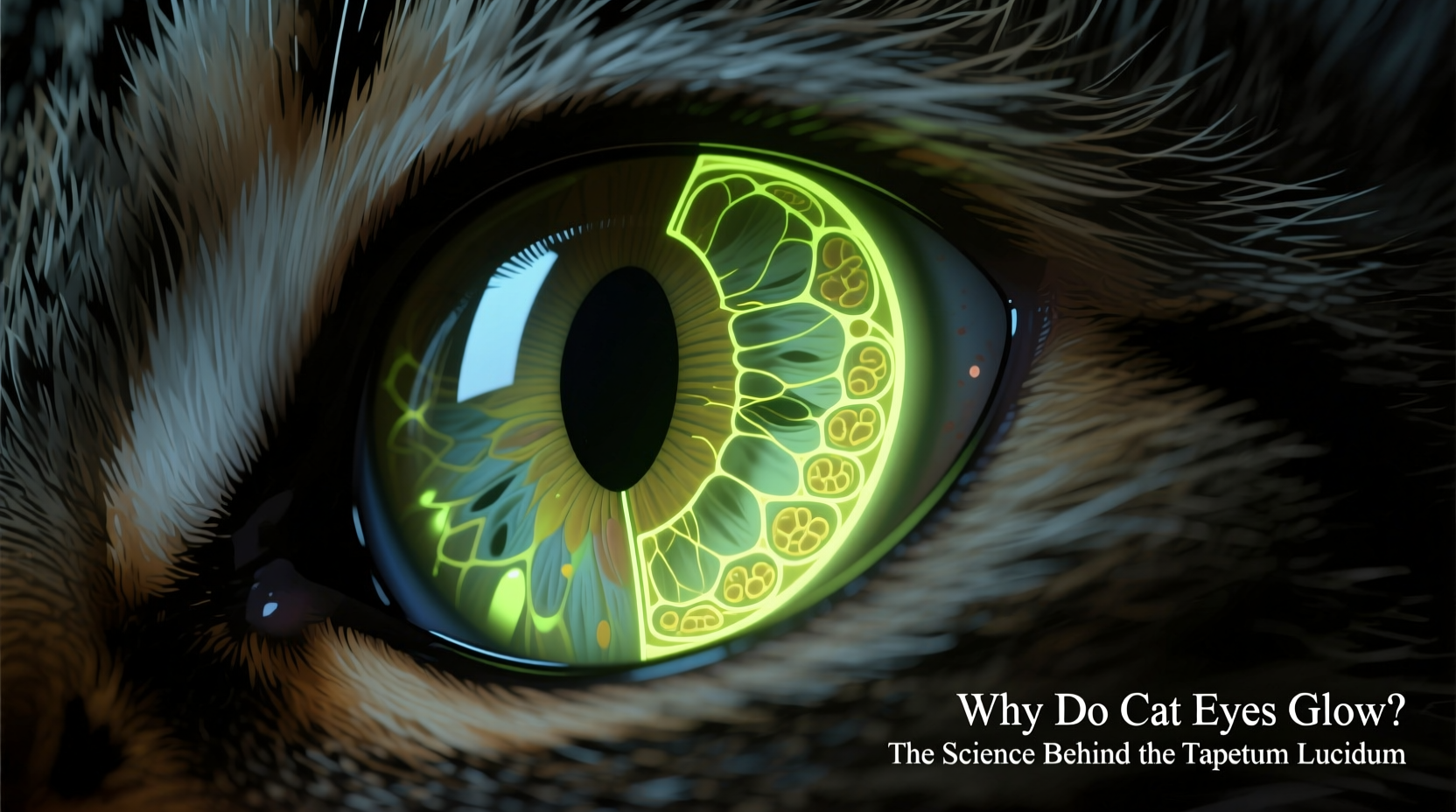
The cat’s eye is structurally similar to the human eye in many ways, with a cornea, lens, iris, and retina. However, one critical difference lies behind the retina: the tapetum lucidum. This thin, reflective layer sits between the retina and the choroid (a blood vessel-rich tissue that nourishes the eye). When light enters the eye, it passes through the retina, where photoreceptor cells convert it into neural signals. In most mammals, any unabsorbed light is lost. But in cats, the tapetum lucidum reflects that unused light back through the retina, giving photoreceptors a second chance to detect it.
This double-pass system dramatically increases light sensitivity. Studies suggest that cats require only about one-sixth the amount of light that humans need to see clearly. That’s why your cat can navigate a dark room with ease while you stumble over furniture. The trade-off? Slightly reduced visual acuity in bright light, as the reflected light can scatter and blur the image. But for a predator active at twilight, enhanced low-light performance is far more valuable than perfect daylight clarity.
How the Tapetum Lucidum Creates the Glow Effect
The glowing effect seen in photos—commonly referred to as “eyeshine”—occurs when a camera flash or other bright light source shines directly into a cat’s eyes. The light travels through the pupil, hits the tapetum lucidum, and is reflected straight back toward the camera lens. Because the tapetum contains crystalline structures rich in riboflavin and zinc, it reflects specific wavelengths of light, typically in the green, yellow, or blue spectrum.
The exact color of the glow varies depending on several factors:
- Breed and genetics: Some cats have more zinc in their tapetum, producing a golden-yellow reflection, while others with higher riboflavin levels may show greener tones.
- Age: Kittens under eight weeks old often don’t exhibit strong eyeshine because the tapetum lucidum isn’t fully developed.
- Pigmentation: Cats with blue eyes or albinism may show red or pink reflections due to less melanin in the retina, allowing blood vessels to be visible.
Interestingly, the angle of the light and the position of the camera relative to the subject affect whether the glow appears. If the flash is off-axis or ambient lighting is sufficient, the tapetum’s reflection may not be visible at all.
“Eyeshine isn't just a photographic quirk—it's evidence of a highly evolved visual system designed for survival in low-light conditions.” — Dr. Lena Patel, Veterinary Ophthalmologist
Comparative Eyeshine Across Species
The tapetum lucidum isn’t unique to cats. Many nocturnal and crepuscular animals—including dogs, deer, raccoons, and owls—possess this feature. However, the composition and positioning of the tapetum vary across species, resulting in different colors and intensities of eyeshine.
| Animal | Typical Eyeshine Color | Tapetum Type | Function & Notes |
|---|---|---|---|
| Cat | Green, yellow, or blue | Cellular tapetum | Enhances night vision; common in domestic and wild felines |
| Dog | Yellow-green or blue | Fibrous tapetum | Often stronger than in cats; some breeds show blue due to lack of pigment |
| Deer | White or silver | Tapetum nigrum | Extremely bright; helps detect motion at night |
| Horse | Blue or green | Coarse fibrous | Larger tapetum due to wide field of vision |
| Human | Red-eye (no tapetum) | None | Red reflection comes from blood vessels in retina |
This variation underscores how evolution has fine-tuned the tapetum lucidum to suit each species’ ecological niche. For example, deep-sea fish often have silver or red eyeshine to match the dim, filtered light of ocean depths, while terrestrial predators like cats benefit from broad-spectrum reflection.
Practical Implications for Pet Owners
Understanding the tapetum lucidum isn’t just academic—it has real-world applications for cat owners, especially when it comes to photography, health monitoring, and nighttime safety.
For instance, sudden changes in eyeshine—such as one eye glowing differently than the other or a loss of glow altogether—can indicate underlying issues like cataracts, retinal detachment, or inflammation. Similarly, persistent red-eye in flash photos (unusual in cats) might suggest uveitis or other ocular diseases.
Moreover, knowing how sensitive cats are to light helps in creating better living environments. Bright LED lights at night can disrupt their natural rhythms, even if they appear unfazed. Using dim, warm-toned lighting in the evening supports both their vision and circadian health.
Step-by-Step: Reducing Unwanted Eyeshine in Photos
If you want to capture clear, glowing-free images of your cat, follow these steps:
- Avoid direct flash: Use natural light or indirect lighting instead of a built-in camera flash.
- Use a diffuser: Attach a soft flash diffuser to scatter the light and reduce intensity.
- Enable red-eye reduction mode: Though designed for humans, this setting pre-flashes to shrink pupils, minimizing reflection.
- Shoot from a lower angle: Position the camera below eye level so the flash isn’t aligned with the pupil.
- Increase ISO and shutter speed: Adjust camera settings to capture more light without flash.
- Edit post-capture: Use photo software to manually reduce or remove eyeshine if needed.
Common Misconceptions About Cat Eye Glow
Despite being a well-documented biological trait, the glowing eyes of cats are often misunderstood. Here are three myths worth dispelling:
- Myth: Glowing eyes mean a cat is sick or possessed.
Reality: Eyeshine is completely normal and indicates a healthy, functional tapetum lucidum. - Myth: All cats glow the same color.
Reality: Eye color, coat color, breed, and age all influence the hue of the reflection. - Myth: Only cats have glowing eyes.
Reality: Many animals exhibit eyeshine; even some birds and reptiles have versions of the tapetum.
Another misconception is that the glow itself produces light. It doesn’t. The tapetum lucidum merely reflects existing light—it’s passive, not luminescent. This is why cats don’t glow in total darkness; there must be some ambient light for the reflection to occur.
Mini Case Study: Detecting Health Issues Through Eyeshine
Sarah, a cat owner from Portland, noticed that her 7-year-old tabby, Milo, started showing asymmetrical eye glow in photos—one eye glowed bright green, the other appeared dull and cloudy. Concerned, she brought him to a veterinary ophthalmologist. After an examination, the vet diagnosed early-stage cataracts in the affected eye. Thanks to the subtle change in eyeshine, the condition was caught early, and Sarah was able to manage it with diet adjustments and regular checkups before vision loss progressed.
This case illustrates how routine observations—like photographing your pet—can serve as informal health screenings. While not a substitute for professional exams, consistent visual monitoring can alert owners to potential problems long before obvious symptoms arise.
FAQ: Your Questions About Cat Eye Glow Answered
Why don’t humans have glowing eyes like cats?
Humans lack a tapetum lucidum. Instead, when light hits the back of our eyes, any unabsorbed light is absorbed by the melanin in the choroid. Without a reflective layer, there’s no second pass of light—so no glow. However, in flash photography, we often see “red-eye,” which occurs when light reflects off blood vessels in the retina.
Can the color of a cat’s eye glow change over time?
Yes. As cats age, the composition of the tapetum can shift slightly, altering the reflection. Additionally, medical conditions such as glaucoma, retinal degeneration, or inflammation can change or diminish eyeshine. A sudden or asymmetric change should prompt a veterinary visit.
Do all cats have a tapetum lucidum?
Virtually all healthy cats do. However, albino cats or those with certain genetic mutations may have underdeveloped or absent tapeta, leading to reduced night vision and unusual reflections (like red or pink glow). These cats may also be more sensitive to bright light.
Conclusion: Appreciating Nature’s Design
The glowing eyes of cats are more than a quirky photo effect—they’re a window into a sophisticated evolutionary adaptation. The tapetum lucidum exemplifies nature’s ingenuity, turning limited resources into survival advantages. By reflecting scarce light back through the retina, it enables cats to thrive in environments where visibility is minimal.
As pet owners, understanding this mechanism deepens our appreciation for our feline companions. It also empowers us to monitor their health, improve our photography, and create living spaces that support their natural behaviors. The next time you see those luminous eyes staring back at you in the dark, remember: it’s not magic—it’s millions of years of evolution, shining brightly.




 浙公网安备
33010002000092号
浙公网安备
33010002000092号 浙B2-20120091-4
Comments
No comments yet. Why don't you start the discussion?