
Every December, a familiar holiday drama unfolds: a glittering tree stands proudly in the living room—until a flick of a tail, a sudden pounce, and a cascade of shattered glass or dangling tinsel interrupts the festive calm. It’s not mischief for mischief’s sake. When your cat bats at, knocks over, or shreds a Christmas ornament, it’s expressing deeply rooted biological imperatives shaped by evolution, sensory wiring, and domestic context. Understanding *why* this happens—not just how to stop it—is the first step toward a safer, calmer, and more harmonious holiday season for both feline and human family members.
The Evolutionary Roots: Why Ornaments Trigger Instinct
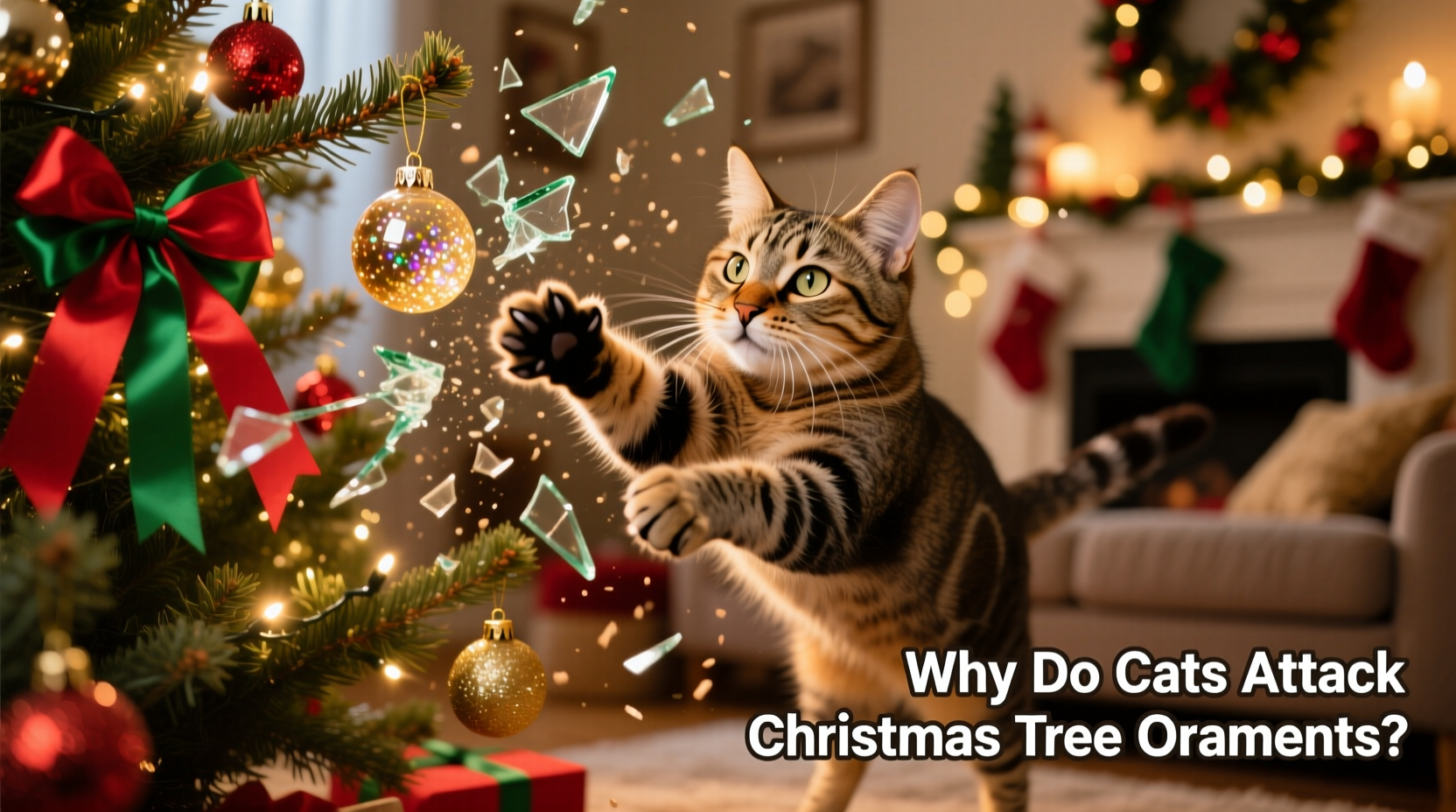
Cats are obligate predators whose nervous systems remain finely tuned to movement, contrast, and novelty—even in the comfort of a heated home. Ornaments present an irresistible convergence of stimuli that activate ancient neural pathways:
- Motion sensitivity: Hanging ornaments sway with air currents, footsteps, or even HVAC drafts. To a cat’s visual system—which detects motion six times faster than humans’—this mimics the tremor of prey.
- Reflective surfaces: Metallic baubles, mirrored balls, and iridescent ribbons create unpredictable flashes of light. These reflections resemble the glint of eyes or scales—evolutionary cues associated with small, skittish animals.
- Novelty and unpredictability: Unlike static furniture or familiar toys, ornaments appear suddenly, change position without warning, and produce unfamiliar sounds (tinkling, clinking, shattering). For a species that thrives on environmental predictability, novelty demands investigation—and often, interaction.
- Texture contrast: Glass, plastic, wood, and fabric ornaments offer varied tactile feedback. A cat’s whiskers and paw pads are exquisitely sensitive; the cool smoothness of a glass ball or the crinkle of foil may trigger exploratory pawing or biting.
This isn’t “bad behavior.” It’s biologically coherent behavior misaligned with our seasonal decor. As Dr. Sarah Heath, veterinary behaviorist and co-author of Behavioural Medicine of the Cat, explains:
“Cats don’t distinguish between ‘decor’ and ‘prey.’ Their predatory sequence—orient, stalk, chase, pounce, bite—can be triggered by any object that moves unexpectedly, reflects light, or makes noise. A Christmas tree is essentially a multi-sensory hunting ground installed in their territory.” — Dr. Sarah Heath, FRCVS, European College of Veterinary Behavioural Medicine
Environmental Triggers: What Makes Your Tree Especially Tempting
Not all trees provoke equal interest. The intensity of ornament-directed behavior depends heavily on three interlocking factors: tree placement, household routine, and individual cat temperament.
Consider these common amplifiers:
- Tree location near high-value zones: Trees placed beside windows (where birds fly), near cat trees or shelves (offering launch points), or in narrow hallways (creating ambush corridors) dramatically increase engagement.
- Lack of alternative enrichment: During holidays, routines shift—fewer play sessions, altered feeding times, guests limiting access to favorite spots. Boredom compounds novelty-seeking.
- Unsupervised access during peak activity hours: Cats are crepuscular. Dawn and dusk—when many owners are preparing breakfast or winding down—are prime pouncing windows. If the tree is unattended then, incidents multiply.
- Ornament type and placement: Low-hanging ornaments (within 18 inches of the floor), lightweight items (easy to bat off branches), and those with dangling elements (ribbons, bells, strings) invite manipulation far more than heavy, high-mounted, matte-finish pieces.
Practical, Evidence-Based Solutions: From Prevention to Redirection
Effective intervention combines environmental design, behavioral redirection, and consistent reinforcement—not punishment, which erodes trust and increases anxiety. Below is a step-by-step guide grounded in applied feline ethology and veterinary behavior recommendations.
Step-by-Step Holiday Safety Protocol
- Week 1 (Pre-Tree Setup): Introduce new toys and rotate existing ones weekly. Begin daily 10-minute interactive play sessions using wand toys (e.g., Da Bird) to satisfy predatory drive. End each session with a small meal to mimic the “hunt-eat-groom-sleep” sequence.
- Tree Installation Day: Set up the tree *without ornaments* first. Let your cat explore it for 48 hours while supervised. Reward calm sniffing or sitting nearby with treats—but never reward pawing or batting.
- Ornament Application: Hang only non-breakable, matte-finish ornaments above 3 feet. Reserve lower branches for sturdy pinecones, felt stars, or wooden shapes secured with twist-ties (not hooks). Avoid anything with strings, tinsel, or loose ribbons.
- Ongoing Management: Use motion-activated deterrents (e.g., Ssscat spray) *only* on the base perimeter—not the tree itself—to avoid associating the tree with fear. Pair with positive alternatives: place a cat tree or perch 3 feet from the tree with a cozy bed and dangling toy.
- Evening Wind-Down: Conduct a 7-minute “calm-down” play session at dusk using slow, deliberate movements. Follow with gentle brushing and quiet time. This reduces nocturnal arousal near the tree.
Do’s and Don’ts: A Quick-Reference Safety Table
| Category | Do | Don’t |
|---|---|---|
| Ornament Choice | Use shatterproof acrylic, felt, wood, or fabric ornaments. Prioritize matte finishes and secure mounting. | Hang glass, mercury glass, or fragile ceramic ornaments—especially within reach. Avoid anything with glitter, tinsel, or string. |
| Tree Security | Anchor the tree to a wall stud with flexible straps. Use a weighted base (sandbags work well). Keep the stand filled with water + 1 tsp lemon juice (deters licking). | Rely solely on a stand or decorative skirt for stability. Use water additives like aspirin or sugar—they encourage bacterial growth and attract cats. |
| Behavior Response | Redirect with a toy *before* pouncing. Reward stillness near the tree with treats or affection. Provide vertical alternatives (perches, shelves) nearby. | Yell, spray water, or use loud noises. These create negative associations with the *location*, not the behavior—and may increase stress-related marking or aggression. |
| Enrichment Strategy | Offer puzzle feeders at dawn/dusk. Rotate “holiday-themed” scent games (e.g., cinnamon-dusted cardboard boxes). Add catnip or silvervine to designated play zones. | Assume holiday busyness excuses reduced playtime. Skipping daily predatory outlets increases frustration-based ornament targeting. |
Real-World Example: How the Chen Family Reduced Incidents by 92%
The Chens adopted Luna, a 2-year-old domestic shorthair, in October. By early December, she’d knocked down 11 ornaments—including three breakables—in under two weeks. Instead of banning the tree, they implemented a targeted plan:
- They moved the tree away from the sunlit bay window (eliminating bird-viewing temptation) and anchored it to a wall stud.
- They installed a 3-foot-wide cat perch 4 feet from the tree’s base, complete with a fleece pad and a dangling feather toy on a spring base.
- They replaced all lower ornaments with hand-painted pinecones wired tightly to branches and hung only acrylic spheres above eye level.
- They instituted twice-daily 10-minute play sessions using laser pointers *followed immediately* by treat dispensers to complete the hunt sequence.
Within 10 days, Luna’s focus shifted entirely to the perch and its toy. Over the next three weeks, she approached the tree only to sit quietly on the adjacent rug—observing, not interacting. Total ornament losses dropped from 11 to 1 (a single pinecone dislodged during enthusiastic tail-swishing). Crucially, Luna’s overall confidence increased—she began using the perch for naps and bird-watching, transforming a problem zone into a valued resource.
Frequently Asked Questions
Will my cat outgrow this behavior?
No—not inherently. While kittens exhibit heightened curiosity, adult cats retain full predatory capacity. What changes is *opportunity* and *habituation*. With consistent management, most cats learn the tree is not interactive—but this requires proactive training, not passive waiting. Unchecked early behavior often becomes ritualized.
Are certain breeds more likely to attack ornaments?
Not breed-specifically—but individual temperament matters. Cats with high prey drive (often seen in Bengals, Abyssinians, and random-bred hunters), high energy levels, or histories of limited early enrichment tend to engage more persistently. However, even sedentary seniors may investigate if novelty or movement is strong enough.
Can I use citrus or essential oils to deter my cat from the tree?
No. Citrus peels or oils (e.g., orange, lemon, eucalyptus) are toxic to cats if ingested or absorbed through skin. Even diffused oils can cause respiratory distress or liver damage. Safe, non-toxic alternatives include double-sided tape around the base (cats dislike sticky paws) or aluminum foil (unpleasant texture and sound).
Long-Term Mindset Shift: Beyond the Holidays
Treating ornament attacks as isolated “Christmas problems” misses a larger opportunity: refining your understanding of feline needs year-round. The same instincts driving holiday mischief—curiosity, predatory drive, need for control over environment—shape every aspect of your cat’s daily life. When you invest in predictable play, safe exploration, and respectful boundaries during December, you’re also building resilience against stress, boredom, and redirected aggression in January and beyond.
That shimmering glass ball isn’t just decoration—it’s a mirror reflecting your cat’s unmet needs. The swaying ribbon isn’t just festive—it’s a siren call for stimulation your home may lack. Addressing the root causes doesn’t diminish holiday magic; it deepens it—by honoring the intelligence, sensitivity, and wild heart beating gently beneath the purr.




 浙公网安备
33010002000092号
浙公网安备
33010002000092号 浙B2-20120091-4
Comments
No comments yet. Why don't you start the discussion?