
It’s a familiar scene in many homes: your cat proudly trots over to their food bowl, drops a crumpled toy mouse beside it, then sits back as if expecting applause. This quirky habit—common yet mysterious—leaves many cat owners wondering: why do cats bring toys to their food bowl? Far from random or whimsical, this behavior is deeply rooted in feline instincts shaped by evolution, social dynamics, and emotional expression. Understanding it reveals not just how cats think, but how they relate to their environment—and to you.
The Evolutionary Roots of Toy-Dropping Behavior
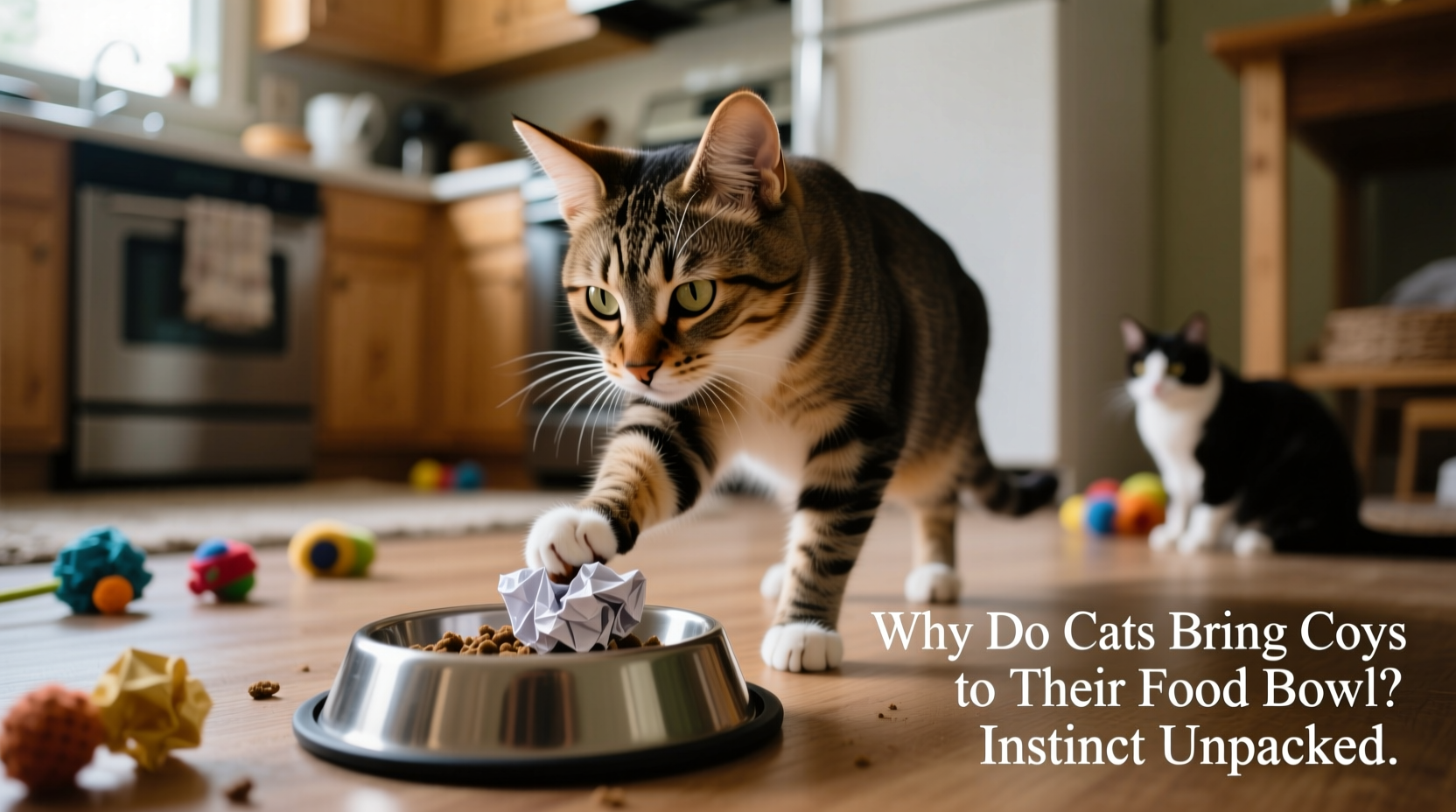
Cats are solitary hunters by nature. In the wild, their ancestors hunted small prey such as rodents, birds, and insects. After capturing their catch, a cat would often carry it to a safe location before consuming it. This instinct persists in domesticated cats, even when they no longer need to hunt for survival.
When a domestic cat brings a toy to its food bowl, it’s mimicking the act of transporting prey to a secure feeding site. The food bowl, already associated with nourishment and safety, becomes the symbolic “den” where meals are consumed. By placing their toy there, the cat is essentially saying, “This is my kill, and I’m eating it where I feel safest.”
This behavior reflects a blend of predatory programming and environmental security. Even though the toy isn’t edible, the cat treats it as surrogate prey. The ritual of capture, transport, and presentation reinforces neural pathways linked to hunting success, satisfying deep-seated psychological needs.
“Cats don’t outgrow their hunter identity—even well-fed indoor cats retain the full behavioral repertoire of their wild counterparts.” — Dr. Sarah Thompson, Feline Ethologist at the International Cat Behavior Institute
Social Signaling and Bonding Rituals
Beyond instinct, toy delivery near the food bowl can be a form of social communication. Cats view their human caregivers as part of their social group—albeit a strange, hairless, non-hunting kind of cat. When a cat drops a toy near your dinner table (or their own), they may be attempting to share resources, a behavior observed in feral colonies where mothers teach kittens to eat or adults share surplus prey.
In multi-cat households, dominant cats sometimes leave toys or actual prey near communal feeding areas to assert control or signal abundance. A domestic cat doing the same may be expressing confidence in its environment and trust in its human. It’s a subtle way of saying, “I provide. We eat here. This is our space.”
Interestingly, some cats only perform this ritual with specific people—often those who feed them or engage in play. This selectivity underscores the social dimension: the act isn’t just about food or instinct, but about relationship-building through symbolic gifting.
Environmental Triggers and Routine Reinforcement
A cat’s daily rhythm plays a significant role in shaping this behavior. Many cats become highly attuned to feeding schedules. As mealtime approaches, their arousal level increases—not unlike the anticipation predators feel before a hunt. This heightened state can trigger instinctive sequences: stalk, pounce, capture, retrieve.
If playtime precedes feeding, the cat may naturally transition from simulated hunting (with toys) to eating, carrying the toy as a transitional object. Over time, this sequence becomes a learned routine: play → capture → bring to food zone → eat. The food bowl acts as both a physical and psychological anchor for the conclusion of the “hunt.”
Changes in environment—such as a new feeding location, different bowl type, or altered schedule—can disrupt or redirect this behavior. Some cats may begin dropping toys elsewhere, like on laps or doorways, until the new routine stabilizes.
Common Environmental Influences on Toy-Bowl Behavior
| Factor | Effect on Behavior | Owner Response |
|---|---|---|
| Fixed Feeding Time | Strengthens routine; increases toy delivery predictability | Maintain consistency to reduce anxiety |
| Interactive Play Before Meals | Triggers hunting sequence leading to toy retrieval | Use as enrichment tool; follow with meal |
| New Bowl Location | May cause temporary confusion or redirection of toy placement | Gradually transition; allow adjustment period |
| Presence of Other Pets | Can increase guarding or sharing behaviors around food zone | Ensure individual feeding spaces |
Psychological Fulfillment and Cognitive Enrichment
Cats require mental stimulation as much as physical exercise. Without adequate outlets, they may develop repetitive or displaced behaviors—like excessive grooming, fabric sucking, or inappropriate elimination. Bringing toys to the food bowl can serve as a healthy cognitive release, allowing cats to complete a natural behavioral sequence from pursuit to “consumption.”
This completion loop is psychologically satisfying. It mirrors the fulfillment wild cats experience after a successful hunt. For indoor cats, whose lives lack real predation opportunities, such rituals help maintain emotional balance. The food bowl, as the endpoint of the imagined hunt, symbolizes closure and reward.
Owners who incorporate structured play sessions—mimicking the hunt-catch-kill-eat cycle—often observe reduced stress and fewer behavioral issues. Ending a play session by guiding the cat toward its food bowl reinforces this cycle, making the toy-drop behavior more purposeful and less compulsive.
Step-by-Step: Creating a Healthy Hunt-to-Eat Routine
- Initiate play with a wand toy to simulate prey movement (5–10 minutes).
- Allow your cat to “catch” the toy, then let them bite and shake it briefly.
- Remove the toy calmly while offering verbal praise (“Good job!”).
- Immediately guide your cat to their food bowl and serve a meal or treat.
- Repeat daily to reinforce the natural behavioral arc.
This routine satisfies the cat’s predatory drive while preventing fixation on a single object or location. Over time, it can reduce obsessive toy-hoarding or nighttime vocalizations linked to unmet hunting needs.
When the Behavior Crosses Into Compulsion
While bringing toys to the food bowl is generally normal, it can become problematic if it turns compulsive. Signs include:
- Carrying toys constantly, refusing to drop them
- Aggression when the toy is removed
- Loss of appetite despite toy placement at the bowl
- Excessive vocalization tied to the ritual
In such cases, the behavior may indicate underlying stress, insecurity, or medical issues like dental pain or gastrointestinal discomfort that make eating unpleasant. A cat might associate the bowl with discomfort and displace hunting behavior there without actually feeding.
“When a cat stops eating but continues to bring toys to the bowl, it’s a red flag. The ritual remains, but the biological function breaks down.” — Dr. Lena Ruiz, Veterinary Behaviorist, Chicago Feline Wellness Center
If compulsive patterns emerge, consult a veterinarian or certified animal behaviorist. Environmental enrichment, dietary adjustments, or anti-anxiety interventions may be necessary.
Mini Case Study: Luna and the Red Feather Toy
Luna, a three-year-old domestic shorthair, lived in a quiet apartment with her owner, Mark. Every evening at 6:30 PM, she would fetch her favorite red feather toy, carry it to her stainless steel food bowl, drop it with a soft chirp, and wait patiently for her dinner.
Mark initially found the behavior odd and would remove the toy before serving food. Over time, he noticed Luna becoming increasingly agitated—meowing persistently and pawing at the empty bowl. After consulting a cat behavior consultant, he learned that Luna was completing a self-driven hunt-eat sequence. The toy represented her “kill,” and removing it disrupted her sense of closure.
He adjusted his approach: after playtime, he allowed Luna to place the toy beside the bowl. He then served her meal while verbally acknowledging her effort: “You caught dinner! Now it’s time for yours.” Within days, her anxiety decreased, and she began eating more readily.
This small change transformed their routine, illustrating how understanding instinctual behavior fosters better human-cat relationships.
FAQ: Common Questions About Cats and Toy-Bowl Behavior
Why does my cat bring toys to the food bowl but not play with them afterward?
The act of delivering the toy completes the behavioral sequence. Once the “prey” is placed at the feeding site, the cat may lose interest because the psychological goal—securing the meal location—has been achieved. This mirrors wild cats who abandon uneaten prey after transport.
Is it okay to let my cat leave toys in the food bowl?
Temporarily, yes. However, remove non-food items before feeding to prevent contamination or accidental ingestion. Consider designating a small mat or basket next to the bowl as a “trophy zone” for accepted toys.
Do all cats do this, or is it breed-specific?
No breed is exclusively prone to this behavior, though individual personality and early life experiences play a larger role. Cats with strong prey drives—often seen in active breeds like Bengals or Abyssinians—may exhibit it more frequently, but it occurs across all types, including laid-back Persians and mixed breeds.
Practical Checklist: Supporting Healthy Toy-Bowl Behavior
- ✅ Schedule daily interactive play sessions ending near feeding time
- ✅ Use wand toys to simulate realistic prey movements
- ✅ Allow your cat to “capture” and carry the toy to their preferred zone
- ✅ Acknowledge the behavior positively without over-rewarding
- ✅ Monitor for signs of obsession or stress
- ✅ Keep food bowls clean and separate from toy storage areas
- ✅ Provide multiple toy options to prevent fixation on one object
Conclusion: Honoring the Hunter in Your Home
The sight of a cat dropping a toy at their food bowl is more than a cute quirk—it’s a window into a complex mind shaped by millennia of survival. This behavior bridges instinct and emotion, blending ancient hunting logic with modern companionship. By recognizing its roots in predation, social bonding, and psychological fulfillment, we deepen our understanding of feline needs.
Rather than discouraging the ritual, consider supporting it within healthy boundaries. Structure play to mirror the natural hunt-eat cycle, respect your cat’s symbolic gestures, and watch for changes that signal distress. In doing so, you don’t just manage behavior—you honor the essence of what it means to live with a cat.




 浙公网安备
33010002000092号
浙公网安备
33010002000092号 浙B2-20120091-4
Comments
No comments yet. Why don't you start the discussion?