
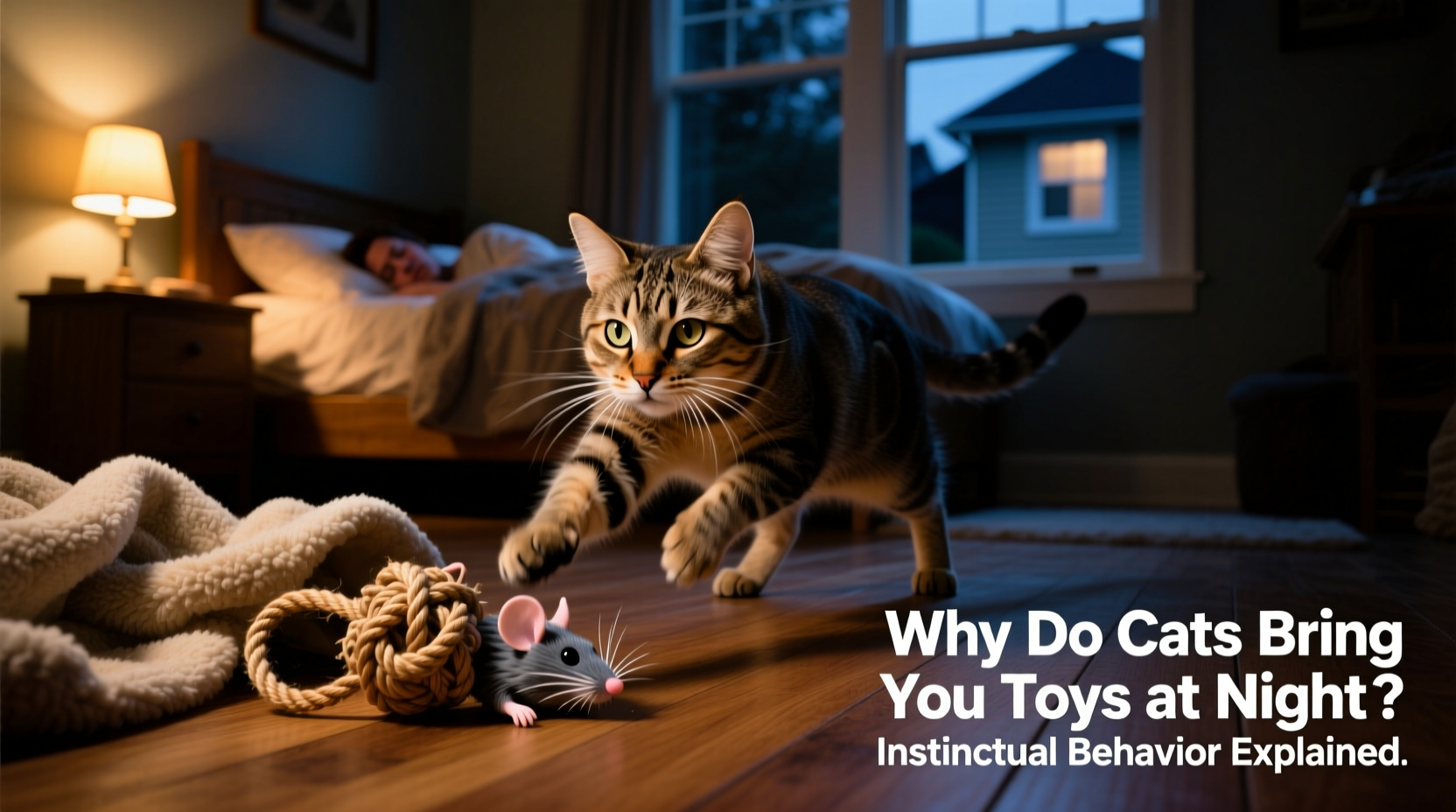
It’s a familiar scene for many cat owners: just as you’re drifting off to sleep, your cat gently places a crumpled mouse or feathered wand beside your pillow. Sometimes it’s delivered with pride; other times, it’s dropped dramatically before launching into a series of chirps and trills. While endearing, this nighttime ritual often leaves people wondering—why do cats bring you toys at night? The answer lies deep in their evolutionary history, social instincts, and unique relationship with humans.
Cats are crepuscular by nature, meaning they're most active during dawn and dusk. But domestication has subtly shifted their rhythms, especially when living alongside humans who work daytime schedules. As a result, many indoor cats adapt their hunting energy to the quieter hours of the evening and early night—when their human companions are winding down. This timing coincides perfectly with the delivery of “gifts,” which are not random acts of affection but purposeful expressions of deeply ingrained behavior.
The Evolutionary Roots of Gift-Giving
To understand why cats bring toys at night, we must first look back to their wild ancestors. In the wild, solitary hunters like the African wildcat—the progenitor of the domestic cat—rely on stealth, precision, and opportunistic feeding patterns. Hunting isn’t just about sustenance; it’s also a learned skill passed from mother to kittens. Mother cats teach their young how to hunt by bringing them live prey, allowing them to practice capture techniques in a controlled environment.
This teaching instinct doesn't vanish in domesticated cats. Even though today’s housecats don’t need to hunt for survival, the drive remains encoded in their DNA. When your cat brings you a toy at night, they may be treating you as part of their social group—possibly even as an inexperienced hunter in need of instruction.
“Cats don’t see us as fellow cats, but they often apply feline social rules to their interactions with us. Bringing toys is an extension of caregiving or mentoring behavior seen in maternal lines.” — Dr. Sarah Ellis, Feline Behavior Researcher, University of Lincoln
In multi-cat households, experienced hunters have been observed bringing injured prey or toys to younger or subordinate cats. This reinforces the idea that gift-giving is less about dominance and more about inclusion and training. Your cat may view you as a clumsy member of the family unit who could benefit from a demonstration—or at least some encouragement.
Nocturnal Activity and Hunting Simulation
Nighttime toy delivery is also closely tied to your cat’s natural activity cycle. Despite years of domestication, cats retain strong circadian rhythms aligned with low-light conditions. During twilight hours, their senses—especially vision and hearing—are at peak performance. Indoor environments lack real prey, so cats redirect their predatory sequence (stalk, chase, pounce, kill) toward toys.
The act of capturing a toy becomes a full simulation of a successful hunt. But unlike actual prey, toys can be reused. After \"killing\" the toy under the couch or in a corner, your cat seeks a place of safety to present it. That place is often where you are—your bed, your lap, or near your head. To your cat, this spot represents security and social bonding.
Social Bonding and Trust Expression
Beyond instinct, bringing you toys is one of the highest forms of trust a cat can express. In the animal kingdom, sharing resources—especially food or captured prey—is a sign of strong social bonds. By offering you a toy (a symbolic stand-in for real prey), your cat is acknowledging you as a trusted companion within their inner circle.
This behavior is particularly common in cats that were hand-raised or formed close attachments early in life. They may vocalize, nudge your hand, or sit expectantly after dropping the toy, seeking acknowledgment. Responding positively—even with a simple “Good job!” or gentle pet—reinforces the bond and satisfies your cat’s need for social feedback.
Interestingly, studies show that cats who bring gifts to their owners tend to have higher attachment scores in behavioral assessments. These cats display more proximity-seeking behaviors and are more likely to greet their owners after separations, suggesting that gift-giving is intertwined with emotional connection.
Why Toys—and Why at Night?
The choice of object matters. Cats typically select soft, small items that mimic the size and texture of typical prey: stuffed mice, crinkle balls, feather wands. Some cats even favor specific colors or movements, indicating individual preferences shaped by experience.
But why the nighttime emphasis? Several factors converge:
- Reduced household noise: Fewer distractions allow your cat to focus on play and hunting simulations.
- Human availability: You’re stationary and accessible, making you an ideal audience.
- Energy accumulation: Many cats nap throughout the day and build up physical and mental energy for evening activity.
- Mimicking natural cycles: Wild cats hunt when predators are less active and prey emerges—dawn and dusk.
Additionally, if your cat spends the day alone, they may save their “best” behaviors for when you return home or settle in for the night. It’s their way of reconnecting, sharing their accomplishments, and inviting interaction.
When Gift-Giving Becomes Excessive
While occasional toy drops are normal, some cats become obsessive gift-givers, amassing collections of toys around your sleeping area or demanding attention repeatedly through the night. This can indicate underlying issues such as:
- Understimulation during the day
- Lack of appropriate outlets for predatory behavior
- Anxiety or attention-seeking due to environmental changes
In such cases, modifying the environment and routine can help reduce nighttime disruptions without discouraging healthy expression of instincts.
Step-by-Step Guide to Managing Nighttime Toy Delivery
- Establish a pre-sleep play routine: Engage your cat in 10–15 minutes of interactive play using wand toys to simulate a complete hunt—end with a “kill” and a treat or meal substitute.
- Rotate toys weekly: Novelty maintains interest and prevents fixation on a single item.
- Provide puzzle feeders or solo-hunt toys: Hide treats inside for independent play during quiet hours.
- Avoid reinforcing unwanted timing: Don’t respond enthusiastically to middle-of-the-night offerings; wait until morning to praise.
- Create a designated “hunting zone”: Place toys and scratchers away from the bedroom to redirect activity.
| Behavior | Instinctual Cause | Recommended Response |
|---|---|---|
| Brings toy to bed at 2 a.m. | Hunting cycle peaks at night; seeks social validation | Play earlier in the evening; ignore nighttime drop-offs |
| Drops toy and stares | Waiting for feedback or interaction | Praise during the day; avoid eye contact at night |
| Hoards multiple toys near owner | Treating space as safe cache location | Allow it unless unsanitary; provide storage basket |
| Brings same toy every night | Attachment to object or repetitive compulsion | Introduce new toys gradually; monitor for stress |
Mini Case Study: Luna and the Midnight Mouse Parade
Luna, a 3-year-old rescue tabby, began bringing her owner three different plush mice to the bedroom every night shortly after adoption. Her owner, Maria, found the behavior sweet but exhausting, especially when Luna would meow insistently until acknowledged.
After consulting a veterinary behaviorist, Maria implemented a structured evening routine: a 7 p.m. play session with a feather wand ending in a treat, followed by a food puzzle placed in the living room. Within two weeks, Luna’s nighttime visits decreased significantly. She still occasionally brought a toy—but only once per week, and usually during waking hours.
The change wasn’t due to suppression of instinct, but rather fulfillment of it. By completing the full predatory sequence before bedtime, Luna no longer felt the need to reenact the hunt in the middle of the night.
Checklist: Is Your Cat’s Gift-Giving Healthy?
Use this checklist to assess whether your cat’s toy-bringing behavior falls within normal ranges:
- ✅ Occurs occasionally, primarily at dawn or dusk
- ✅ Involves clean, undamaged toys (not fabric scraps or dangerous items)
- ✅ Stops after brief interaction or acknowledgment
- ✅ Doesn’t interfere with your sleep or daily functioning
- ✅ Cat appears relaxed and satisfied afterward
- ❌ Happens dozens of times per night
- ❌ Includes non-toy items (e.g., socks, paper, plants)
- ❌ Accompanied by excessive vocalization or pacing
If three or more “❌” items apply, consider consulting a veterinarian or certified feline behavior consultant to rule out anxiety, OCD-like behaviors, or medical causes.
Frequently Asked Questions
Is it normal for cats to bring toys at night?
Yes, it is completely normal. Cats are naturally active during low-light periods, and bringing toys mimics ancestral hunting and teaching behaviors. As long as the behavior isn’t disruptive or obsessive, it’s a healthy expression of instinct.
Should I discourage my cat from bringing me toys?
Not necessarily. Discouraging the behavior entirely may damage trust. Instead, redirect it by encouraging play earlier in the evening and minimizing attention during nighttime drop-offs. Never punish your cat for bringing toys—it may suppress natural behaviors and increase stress.
Why does my cat bring me toys but not play with them?
Your cat may be focused on the act of delivery rather than play itself. For some cats, the reward is your reaction—not the toy. Others may use the toy as a symbolic offering, similar to how wild cats leave prey at den entrances.
Conclusion: Embracing the Quirks of Feline Instinct
The sight of a toy mouse left beside your pillow at midnight might seem odd, but it’s a testament to your cat’s complex inner world. Far from random, this behavior reflects millions of years of evolution, finely tuned social intelligence, and a deep bond with you. Rather than viewing it as a nuisance, consider it a compliment—a sign that your cat sees you as family, worthy of shared success and protection.
By understanding the reasons behind nocturnal toy delivery, you can support your cat’s natural needs while maintaining peaceful nights. Structure their environment, honor their rhythms, and respond with patience. In doing so, you don’t just manage behavior—you deepen the mutual respect between species.




 浙公网安备
33010002000092号
浙公网安备
33010002000092号 浙B2-20120091-4
Comments
No comments yet. Why don't you start the discussion?