
Every December, a familiar scene unfolds in homes across the country: a glittering fir stands proudly in the corner—until a stealthy feline launches a vertical assault, sending ornaments clattering and tinsel fluttering like confetti from a startled squirrel. It’s equal parts hilarious and heart-stopping. But dismissing it as “just cat behavior” overlooks something important: climbing isn’t random mischief. It’s a convergence of evolutionary drive, sensory opportunity, and unmet environmental needs. Understanding why cats scale Christmas trees—not just that they do—is the first step toward solutions that preserve both holiday cheer and household harmony. This isn’t about punishment or exclusion; it’s about thoughtful redirection, proactive setup, and respecting your cat’s nature while safeguarding your traditions.
The Instinct Behind the Ascent: Why Cats Target Christmas Trees
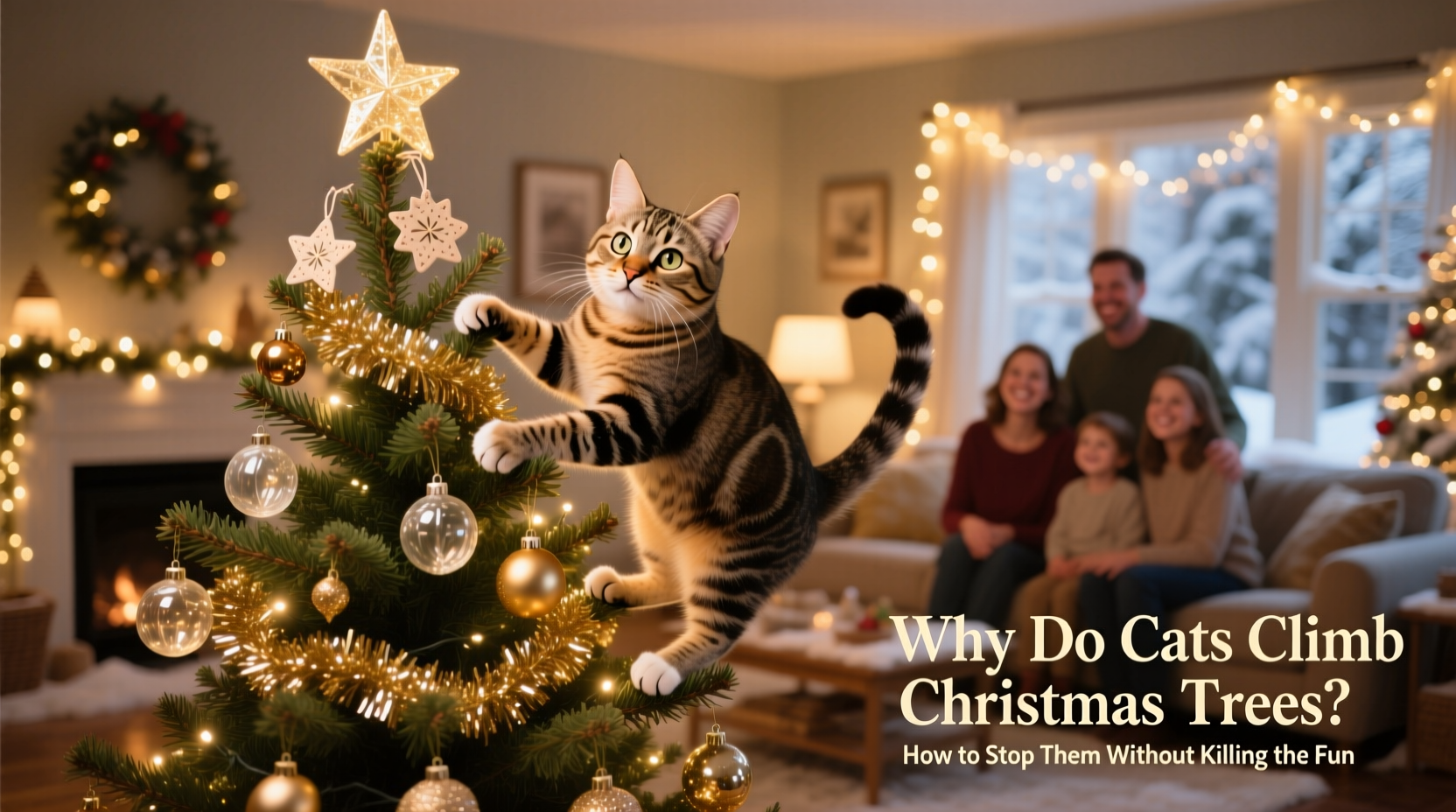
Cats don’t climb Christmas trees because they dislike holidays. They climb because the tree is, from a feline perspective, an irresistible convergence of stimuli. Evolutionarily, domestic cats retain strong arboreal instincts—even indoor cats descend from tree-dwelling ancestors who used elevation for surveillance, escape, and thermoregulation. A Christmas tree replicates key elements of that ideal perch: vertical structure, textured bark-like trunk (especially on real trees), dangling objects that mimic prey movement, and novel scents that trigger investigative behavior.
Research published in Applied Animal Behaviour Science confirms that novelty-seeking and object-directed play peak during environmental changes—like the sudden appearance of a 6-foot evergreen adorned with reflective baubles and swaying ribbons. The tree also emits terpenes (natural compounds in pine resin) that many cats find mildly stimulating—similar to the response triggered by catnip, though less intense and more variable between individuals.
Crucially, climbing often signals unmet needs. A cat that spends hours perched atop the tree may be seeking stimulation absent elsewhere: insufficient vertical space, limited interactive play, or underutilized predatory outlets. In multi-cat households, the tree can become a contested resource—a high-value territory offering vantage points over human activity and potential rivals.
Humane, Effective Prevention: What Works (and What Doesn’t)
Many well-intentioned strategies backfire. Spraying citrus or vinegar on branches may deter some cats—but risks damaging ornaments, irritating respiratory systems, and teaching the cat to associate the tree *area* with unpleasant sensations, potentially increasing anxiety. Similarly, shouting, startling, or physical correction creates negative associations with the entire holiday environment and erodes trust.
Effective prevention rests on three pillars: environmental enrichment, physical tree security, and consistent positive reinforcement. It’s not about making the tree “off-limits.” It’s about making alternatives *more compelling* and the tree *less accessible*—without compromising aesthetics or safety.
A Step-by-Step Tree-Safe Setup Plan
Start preparation early—ideally 3–5 days before final decoration. Rushed setups invite lapses in consistency and increase stress for both humans and cats.
- Anchor the tree securely. Use a heavy, wide-based stand filled with water (for real trees) and attach guy wires to wall anchors or sturdy furniture. Test stability by gently rocking the trunk at shoulder height—no visible wobble should occur.
- Install a low-profile barrier. Place a 24-inch diameter ring of smooth, rigid plastic (e.g., repurposed storage bin lid) around the base, weighted with sandbags or books. Avoid spiky mats—they’re ineffective and ethically questionable.
- Strategically place alternative perches. Position sturdy cat trees or window perches within 6 feet of the Christmas tree, each topped with a favorite blanket and a new feather wand toy. Rotate toys every 48 hours to sustain interest.
- Decorate with intention. Hang breakable or small ornaments above 3 feet. Use shatterproof balls below that height—but only if your cat ignores them. Avoid tinsel, ribbon, and edible decorations entirely; these pose ingestion hazards regardless of climbing behavior.
- Implement “tree time” supervision. For the first 72 hours after full decoration, spend 15 minutes twice daily near the tree engaging your cat in focused play—using a wand toy to direct their attention *away* from branches and toward you. End each session with a food puzzle or treat-dispensing toy placed near their preferred perch.
Do’s and Don’ts: A Practical Comparison
| Action | Do | Don’t |
|---|---|---|
| Tree Stability | Use wall-mounted brackets and a weighted base. Test weekly. | Rely solely on a standard stand—even a “heavy-duty” one—without anchoring. |
| Enrichment | Provide 3+ vertical spaces (cat trees, shelves, window perches) at varying heights. | Offer only floor-level toys and ignore climbing needs until the tree appears. |
| Play Timing | Engage in 10-minute interactive sessions 2x/day, especially before dusk (peak feline activity). | Only play when the cat approaches the tree—this inadvertently reinforces the behavior. |
| Odor Management | Wipe real tree trunks with diluted apple cider vinegar (1:10) once pre-decorating—it deters without toxicity. | Spray essential oils (pine, citrus, eucalyptus) near the tree—many are toxic to cats if inhaled or ingested. |
| Supervision | Use baby monitors with motion alerts to check on unsupervised rooms remotely. | Assume “out of sight” means “out of mind”—climbing often happens during quiet moments. |
Real-World Success: A Case Study from Portland, OR
Maya, a veterinary technician and owner of two indoor cats—Luna (3 years, Siamese mix) and Jasper (7 years, domestic shorthair)—faced annual tree-toppling chaos. In 2022, her 7-foot Fraser fir lost three ornaments and tilted 15 degrees within 48 hours of setup. Frustrated but committed to humane solutions, she implemented a modified version of the step-by-step plan: she installed a custom-built 4-foot-tall cat tower beside the tree, added sisal-wrapped posts wrapped with LED string lights (cat-safe, low-heat), and scheduled daily “pre-dinner play blitzes” using a motorized feather toy mounted on a tripod.
By day five, both cats were regularly napping atop their tower, watching the tree like silent sentinels. Luna occasionally batted at low-hanging ornaments—but only when Maya held the wand toy nearby, redirecting her paws. Jasper never attempted ascent. Total cost: $89 (tower modification + toys). Time invested: 20 minutes daily for one week. Result: Zero fallen ornaments, no stress-related vomiting episodes (a prior issue during holidays), and a tree that stayed upright through New Year’s Day. “It wasn’t about stopping the climbing,” Maya shared. “It was about giving them better jobs to do.”
Expert Insight: What Veterinary Behaviorists Emphasize
“Cats don’t climb trees to annoy us—they’re solving problems we’ve unintentionally created. A cat that climbs is often asking for more vertical territory, predictable play schedules, or safer outlets for predatory sequence behaviors. Punishment doesn’t teach alternatives; it teaches fear. Redirecting with enrichment builds confidence and strengthens the human-animal bond—especially during high-stress periods like the holidays.” — Dr. Lena Torres, DACVB, Board-Certified Veterinary Behaviorist, Cornell Feline Health Center
Frequently Asked Questions
Can I use a spray bottle to deter climbing?
No. Spray bottles cause fear-based avoidance, not learning. Your cat may stop approaching the tree only when you’re present—and may develop redirected aggression or anxiety around water sounds. Positive reinforcement and environmental design yield longer-lasting, trust-preserving results.
Will a fake tree solve the problem?
Not necessarily. While fake trees lack pine scent and sap, many have textured trunks and dangling branches that still trigger climbing instincts. Some synthetic materials even emit volatile organic compounds (VOCs) that irritate sensitive feline airways—potentially increasing restlessness. Focus on setup and enrichment regardless of tree type.
What if my cat is already injured from a fall?
Seek immediate veterinary evaluation—even if no obvious wounds exist. Cats often mask pain, and falls from height can cause internal injuries, spinal misalignments, or dental trauma. After recovery, consult a certified feline behavior consultant (IAABC or ACVB) to assess underlying drivers (e.g., anxiety, boredom, medical discomfort) before reintroducing holiday decor.
Conclusion: Celebrate Without Compromise
Your Christmas tree doesn’t need to be a battleground. Nor does your cat need to be excluded from the season’s warmth and wonder. When you understand climbing as communication—not defiance—you shift from frustration to collaboration. Every anchored branch, every strategically placed perch, every timed play session is a quiet act of respect: for your cat’s biology, for your own peace of mind, and for the joyful spirit of the holidays. These strategies require minimal investment but deliver profound returns: fewer emergency vet calls, deeper mutual trust, and the quiet satisfaction of watching your cat choose the sunlit windowsill over the tinsel-laden apex—because it feels safer, more interesting, and more *theirs*. Start now—not when the first ornament hangs, but when the first box comes out of storage. Your tree will stand tall. Your cat will thrive. And your holidays? They’ll feel genuinely merry, not merely managed.




 浙公网安备
33010002000092号
浙公网安备
33010002000092号 浙B2-20120091-4
Comments
No comments yet. Why don't you start the discussion?