
Cats have a reputation for being graceful, intelligent creatures—yet they also seem to possess an inexplicable urge to swipe objects off tables, shelves, and countertops. A water glass here, a phone there, or even a carefully arranged stack of books—all are fair game. This behavior frustrates many cat owners, leading to broken items, daily cleanup, and confusion: Why would a creature so attuned to balance and precision engage in such seemingly destructive acts? More importantly, can it be stopped?
The truth is, knocking things over isn’t random mischief. It’s rooted in instinct, curiosity, and communication. Understanding the motivations behind this behavior is the first step toward managing it effectively—without punishing your cat or stifling their natural tendencies.
The Instinctual Roots of Object-Knocking Behavior
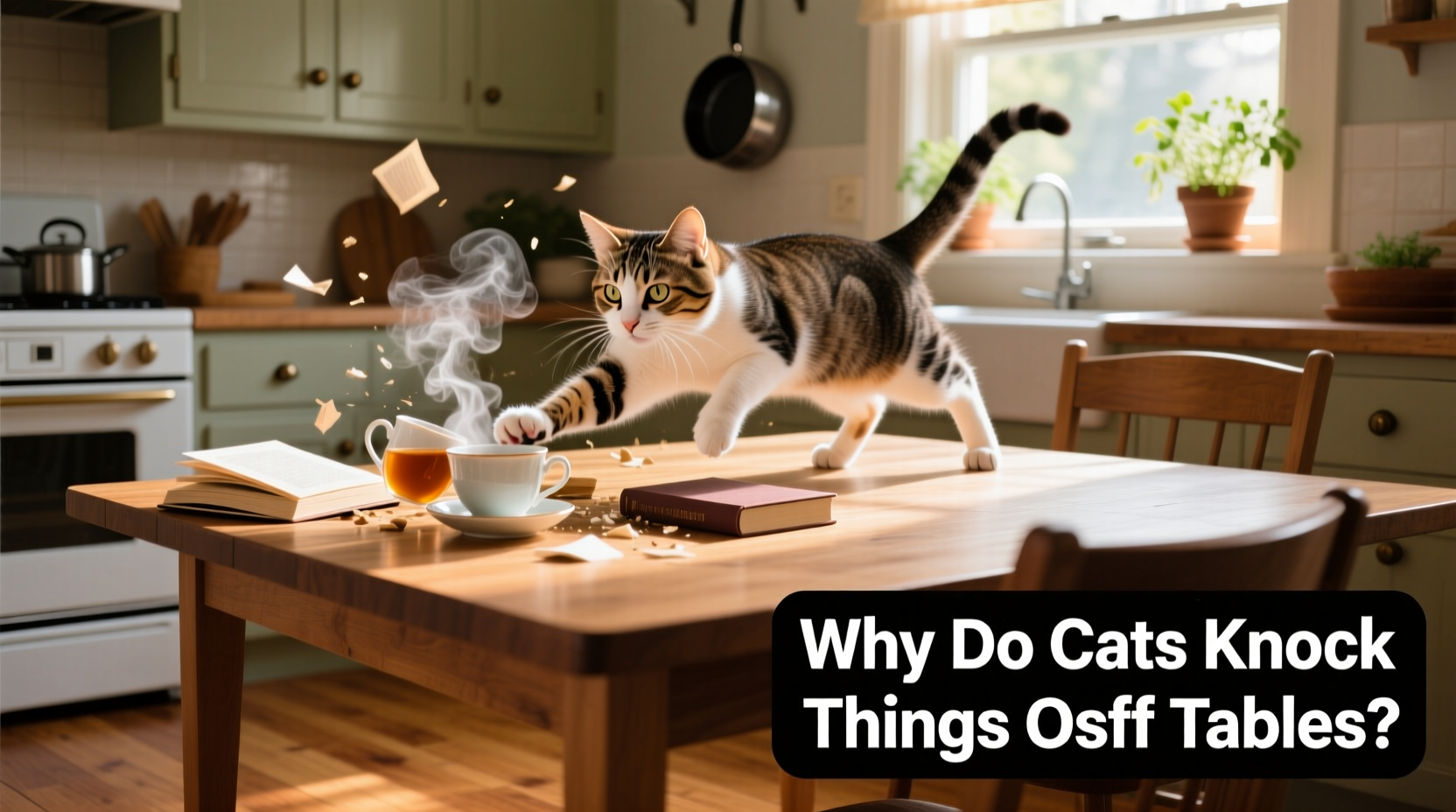
Cats are predators by nature. Even well-fed indoor cats retain the hunting instincts of their wild ancestors. When a cat sees an object on a table—especially one that moves slightly when tapped—it may trigger their prey drive. The motion, sound, or unpredictability of the falling item mimics the movement of small animals like mice or birds. In essence, the act of knocking something down becomes a simulated hunt.
This behavior often begins in kittenhood. Young cats use their paws to explore their environment, testing textures, stability, and reactions. An object that falls with a clatter provides immediate sensory feedback—sound, motion, and sometimes even reward (like seeing you rush over). Over time, this feedback loop reinforces the action, turning it into a habit.
Curiosity and Environmental Enrichment
Cats are highly curious animals. Their world is experienced through touch, sound, and movement. An object sitting still on a table offers little stimulation—until it moves. The moment a cat bats at it and sees it fall, they gain information: “This thing responds to pressure,” “It makes noise,” “It rolls.” Each reaction adds to their understanding of cause and effect.
In homes with limited environmental enrichment, object-knocking can become a form of self-entertainment. Cats left alone for long periods may resort to interactive behaviors with household items simply because there’s nothing else to do. This is especially common in intelligent, active breeds like Siamese, Bengals, or Abyssinians.
Environmental monotony leads to behavioral issues. A cat that lacks climbing structures, puzzle toys, or daily interaction may turn to knocking things over as a way to initiate engagement—even if the response is negative.
“Cats don’t knock things off tables to annoy us—they’re trying to interact with their world. When their environment doesn’t offer enough stimulation, they create their own.” — Dr. Sarah Thompson, Feline Behavior Specialist
Communication and Attention-Seeking
Sometimes, object-knocking is a calculated move. Cats are observant and quickly learn what actions get a reaction. If every time Mittens knocks a pen off the desk you respond—by gasping, rushing over, or even scolding her—she learns that this behavior brings attention.
Even negative attention is still attention. For cats that feel under-stimulated or lonely, any interaction is better than none. This creates a cycle: knock → reaction → repeat. The behavior becomes reinforced not by the fall itself, but by the social consequence.
In multi-pet households, some cats may knock things over to assert dominance or redirect energy. Others do it during high-arousal moments, like when their owner is working or on the phone—a subtle way of saying, “I’m here, and I want your focus.”
How to Redirect the Behavior: A Step-by-Step Guide
Instead of trying to eliminate the behavior entirely—which goes against a cat’s natural instincts—the goal should be redirection. Here’s a proven sequence to help manage and minimize unwanted object-knocking:
- Assess the environment. Identify high-risk zones (desks, nightstands, shelves) and remove fragile or valuable items.
- Increase mental stimulation. Introduce puzzle feeders, treat-dispensing toys, and rotating toy sets to keep your cat engaged.
- Provide alternative outlets. Set up a “knock zone” with safe, noisy toys (like plastic balls in a tray) where batting is encouraged.
- Engage in daily play sessions. Use wand toys to simulate hunting for 10–15 minutes twice a day, ending with a meal or treat to satisfy the “kill-eat” sequence.
- Ignore attention-seeking knocks. When your cat knocks something non-essential off a surface, avoid reacting. Wait until they’re calm before offering affection or play.
- Use deterrents strategically. Apply double-sided tape or aluminum foil to surfaces you want to protect—cats dislike the texture.
Do’s and Don’ts: Managing Table-Knocking Behavior
| Do’s | Don’ts |
|---|---|
| Rotate toys weekly to maintain novelty | Punish your cat for knocking things over |
| Use vertical space with cat shelves and perches | Leave fragile or dangerous items within paw’s reach |
| Encourage play with interactive toys | Yell or grab your cat mid-action |
| Provide scratching posts and climbing towers | Ignore signs of boredom or stress |
| Reinforce calm behavior with treats and praise | Assume the behavior will disappear on its own |
A Real-Life Example: Luna and the Office Desk
Sarah, a remote worker from Portland, struggled with her 3-year-old tabby, Luna, who had developed a habit of swiping her coffee mug off the desk every morning. At first, Sarah thought it was accidental. But after replacing two mugs and nearly losing her laptop, she realized it was intentional.
She consulted a feline behaviorist who suggested tracking Luna’s activity. They discovered that the knocking occurred consistently at 10:15 a.m.—right after Sarah had been typing for 45 minutes without interacting with her cat.
The solution? Sarah introduced a scheduled play session at 10:00 a.m. using a feather wand, followed by a treat. She also moved her mug to a back shelf and placed a soft toy mouse on the edge of the desk. Within a week, Luna redirected her pouncing instincts to the toy. The mugs stayed put, and Sarah regained her morning focus.
This case illustrates how timing, predictability, and redirection can resolve seemingly chaotic behaviors.
Can You Prevent It Completely?
Complete prevention is unlikely—and perhaps unnecessary. Knocking things over is a natural expression of a cat’s curiosity and predatory skills. Rather than aiming for total elimination, focus on harm reduction and healthy outlets.
Some cats will always test boundaries. But with proper enrichment, consistent routines, and a cat-safe environment, the frequency and impact of these actions can be dramatically reduced.
Checklist: Cat-Proofing Your Home Without Sacrificing Style
- ✅ Remove breakables from ledges and tabletops
- ✅ Install cat shelves or wall-mounted perches to redirect attention upward
- ✅ Rotate toys every 5–7 days to maintain interest
- ✅ Use feeding puzzles instead of bowls to stimulate problem-solving
- ✅ Designate a “safe knock” area with durable, noisy toys
- ✅ Schedule two 10-minute play sessions daily
- ✅ Avoid leaving food, liquids, or electronics unattended on accessible surfaces
Frequently Asked Questions
Is it normal for cats to knock things off tables?
Yes, it’s very common and considered normal feline behavior. It stems from curiosity, hunting instincts, and environmental exploration. As long as the cat isn’t harming itself or others, it’s typically not a cause for concern.
Could this behavior indicate a health problem?
In rare cases, sudden changes in behavior—such as increased impulsivity or obsessive knocking—can signal underlying issues like hyperthyroidism, cognitive dysfunction, or pain. If the behavior appears compulsive or is accompanied by other symptoms (vocalization, restlessness, litter box avoidance), consult a veterinarian.
Will my cat grow out of this habit?
Some cats reduce the behavior with age and proper enrichment, but many continue into adulthood. Early intervention with training and stimulation increases the chances of moderation. However, occasional swatting at dangling cords or moving objects may persist as part of their natural investigative routine.
Conclusion: Understanding Over Suppression
Cats knock things off tables not out of malice, but because they are intelligent, curious, and instinct-driven animals living in human-designed spaces. Instead of viewing this behavior as defiance, see it as a window into your cat’s mind—an attempt to interact, investigate, and survive in a world full of mysterious objects.
The key to managing it lies not in suppression, but in redirection. By enriching your cat’s environment, engaging their senses, and respecting their natural needs, you can coexist peacefully with fewer shattered mugs and more mutual understanding.




 浙公网安备
33010002000092号
浙公网安备
33010002000092号 浙B2-20120091-4
Comments
No comments yet. Why don't you start the discussion?