
Cats have long been admired for their grace, curiosity, and independence. Yet, one of their most baffling behaviors—knocking objects off tables, shelves, and counters—can leave even the most devoted cat owners exasperated. Whether it’s a ceramic mug tumbling to the floor or a carefully placed phone being nudged into oblivion, this behavior seems both deliberate and destructive. But is it truly mischief? Or is there a deeper, scientifically grounded explanation?
Far from random acts of chaos, these actions are rooted in feline instincts, sensory processing, and communication strategies. By understanding the behavioral science behind this habit, owners can respond with empathy rather than frustration—and even redirect the behavior constructively.
The Evolutionary Roots of Object Manipulation
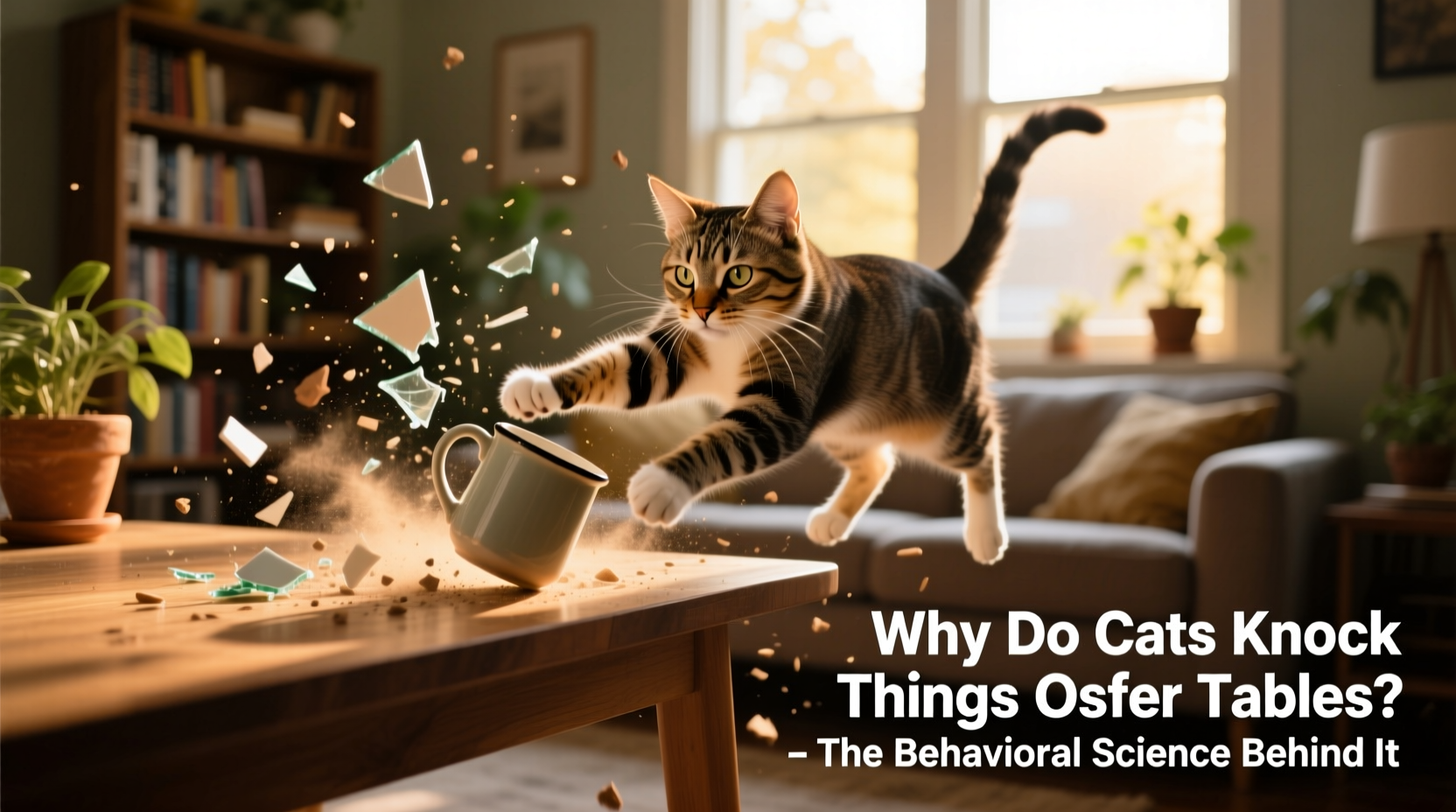
To comprehend why cats interact with objects the way they do, we must first consider their evolutionary background. Domestic cats (Felis catus) descended from solitary hunters who relied on stealth, precision, and environmental awareness to survive. In the wild, manipulating objects—such as leaves, pebbles, or prey—helps kittens develop motor skills and hunting techniques.
When a kitten bats at a hanging leaf or pounces on a rolling stone, it's practicing essential survival behaviors. These playful interactions refine coordination, depth perception, and timing—all crucial for catching fast-moving prey. Even in domestic settings, where food comes from a bowl, this instinct remains hardwired.
Knocking items off surfaces may simulate the act of dislodging prey from branches or testing whether something is alive. A wobbling cup that falls with a crash mimics movement and sound—stimuli that trigger a cat’s predatory sequence: orient, stalk, pounce, and manipulate.
Sensory Exploration: How Cats \"See\" With Their Paws
Cats rely heavily on tactile feedback, especially through their paws and whiskers. Unlike humans, who primarily use vision to assess objects, cats often use touch to gather information. When a cat taps or nudges an object, it’s not just playing—it’s investigating texture, weight, stability, and reaction.
This form of exploration is particularly important because cats have limited close-up vision. Objects within 30 centimeters become blurry, making direct paw contact a more effective method of inspection. The resulting fall or noise provides additional data: Did it roll? Was it soft? Did it make a sound? Each response helps the cat categorize the item.
Moreover, the auditory feedback from a falling object can be inherently stimulating. Many cats are drawn to sudden noises, which mimic the sounds of scurrying rodents or birds. This explains why some cats repeat the action multiple times—they’re not only exploring but also enjoying the cause-and-effect dynamic.
“Cats don’t knock things over out of malice; they’re conducting experiments. Every push is a hypothesis tested: ‘What happens if I move this?’” — Dr. Sarah Ellis, Feline Behavior Scientist, University of Lincoln
Communication and Attention-Seeking Behavior
In multi-species households, cats often adapt their communication to human responses. If a cat knocks over a glass and the owner rushes in, shouting or cleaning up, the cat learns that this action yields attention—even if it’s negative.
From the cat’s perspective, any reaction reinforces the behavior. This is operant conditioning in action: the consequence (attention) strengthens the likelihood of repetition. Over time, object-knocking can become a reliable strategy for initiating interaction, especially in homes where owners are busy or less physically engaged with their pets.
Some cats are more prone to this due to personality traits. Bold, socially motivated individuals may use object displacement as a form of “conversation.” Others, particularly those with separation anxiety or under-stimulated environments, may resort to it out of boredom or stress.
| Motivation | Behavioral Sign | Owner Response That Reinforces It |
|---|---|---|
| Curiosity | Single tap, then disinterest | Reacting loudly or chasing the object |
| Hunting Practice | Pouncing, biting, repeated batting | Leaving tempting items within reach |
| Attention-Seeking | Repetition when owner is nearby | Yelling, picking them up, or cleaning dramatically |
| Boredom/Stress | Frequent knocking, lack of other play | Inconsistent routines or lack of enrichment |
Environmental Enrichment: Redirecting Natural Instincts
Rather than trying to eliminate the behavior entirely—which would go against natural feline drives—a more effective approach is redirection. Environmental enrichment allows cats to express normal behaviors in acceptable ways, reducing frustration and household casualties.
A well-enriched environment includes vertical space (cat trees), hiding spots, rotating toys, and interactive feeding systems. These elements keep cats mentally and physically engaged, decreasing the need to invent their own stimulation by toppling belongings.
For cats particularly fond of knocking things down, consider introducing designated “knock zones”—areas with safe, noisy, or moving objects they are encouraged to interact with. Examples include:
- Plastic balls in a shallow bin
- Clicking rattles or crinkle toys on low shelves
- Toy-filled terrariums or activity boxes
These spaces give cats a sense of agency while protecting fragile household items. Importantly, enrichment should be rotated every few days to maintain novelty, as cats quickly habituate to static stimuli.
Step-by-Step Guide to Reducing Unwanted Knocking
- Assess the Environment: Identify high-risk areas where valuable or dangerous items are within paw’s reach.
- Remove Temptations: Clear ledges, nightstands, and coffee tables of loose objects cats might target.
- Introduce Alternatives: Place engaging toys or puzzles nearby to redirect interest.
- Use Positive Reinforcement: Reward your cat with treats or affection when they interact appropriately with toys.
- Minimize Reaction: If an item is knocked over, avoid immediate response. Wait until calm before cleaning up.
- Enrich Daily Routine: Schedule two 10-minute play sessions daily using wand toys to simulate hunting.
- Monitor Progress: Track frequency of incidents weekly to assess improvement.
Mini Case Study: Luna and the Midnight Mug Incident
Luna, a three-year-old Siamese mix, lived with her owner Maria in a small apartment. Every night around 2 a.m., Maria would wake to the sound of breaking ceramic. For months, a favorite mug sat precariously on the kitchen counter—until one morning, it was gone, shattered on the tile floor.
Frustrated, Maria considered restricting Luna’s access to the kitchen. Instead, she consulted a feline behaviorist, who asked about Luna’s daytime routine. Maria worked long hours, and Luna spent most of her day alone with minimal toys.
The assessment revealed classic signs of under-stimulation. Luna wasn’t acting out of spite—she was bored and seeking engagement. The mug, slightly loose on its handle, had become her nightly entertainment.
Following the consultant’s advice, Maria installed a window perch overlooking a bird feeder, introduced a timed treat dispenser, and began daily interactive play sessions. Within three weeks, the midnight knocking stopped. The mug was returned to the counter—untouched.
Luna’s case illustrates how seemingly destructive behavior often stems from unmet needs rather than defiance.
FAQ: Common Questions About Cats Knocking Things Over
Is my cat knocking things over to annoy me?
No. While it may feel personal, cats don’t act out of spite or revenge. Their behavior is driven by instinct, curiosity, or learned outcomes—not emotional retaliation.
Should I punish my cat for knocking things down?
No. Punishment creates fear and damages trust. It also fails to address the root cause. Instead, focus on environmental management and positive reinforcement for desired behaviors.
Are certain breeds more likely to do this?
Some breeds, like Siamese, Bengals, and Abyssinians, are more active and curious, making them more prone to manipulative behaviors. However, individual personality and environment play larger roles than breed alone.
Expert Insight: What Research Tells Us
Recent studies in feline cognition support the idea that cats are highly sensitive to cause-and-effect relationships. A 2020 study published in *Animal Cognition* found that cats show surprise when objects defy physical expectations—such as failing to fall when pushed. This suggests they possess a rudimentary understanding of gravity and object permanence.
Dr. John Bradshaw, honorary research fellow at the University of Bristol and author of *Cat Sense*, explains:
“Cats are not just reflexive hunters. They’re problem solvers. When they knock something over, they’re testing the rules of their world. We mistake curiosity for mischief, but what we’re seeing is intelligence in action.” — Dr. John Bradshaw, Anthrozoologist
This cognitive engagement underscores why suppression doesn’t work. Cats need outlets to explore, predict, and influence their surroundings. Depriving them of this leads to stress-related behaviors like overgrooming, aggression, or inappropriate elimination.
Conclusion: Embracing the Quirks of Cat Intelligence
The next time your cat sends a pen rolling off your desk, resist the urge to scold. Instead, recognize it as a window into their mind—an expression of curiosity, instinct, and intelligence shaped by thousands of years of evolution.
By applying insights from behavioral science, owners can transform frustration into opportunity: enriching environments, strengthening bonds, and supporting natural feline behaviors in harmonious ways. The goal isn’t a perfectly tidy home, but a fulfilled cat living authentically within a shared space.




 浙公网安备
33010002000092号
浙公网安备
33010002000092号 浙B2-20120091-4
Comments
No comments yet. Why don't you start the discussion?