
Cats have a reputation for being graceful, mysterious, and occasionally mischievous. One of the most common—and frustrating—behaviors many cat owners experience is their feline companion deliberately knocking objects off tables, shelves, or countertops. A water glass topples over at 2 a.m. A framed photo crashes to the floor just after you’ve arranged it. It’s easy to interpret this as spite or chaos for chaos’ sake, but the truth is far more nuanced. This behavior stems from deep-rooted instincts, sensory exploration, and communication strategies hardwired into your cat’s biology. Understanding the \"why\" behind the push can transform frustration into empathy and help foster a more harmonious home environment.
The Evolutionary Roots of Object-Pushing Behavior
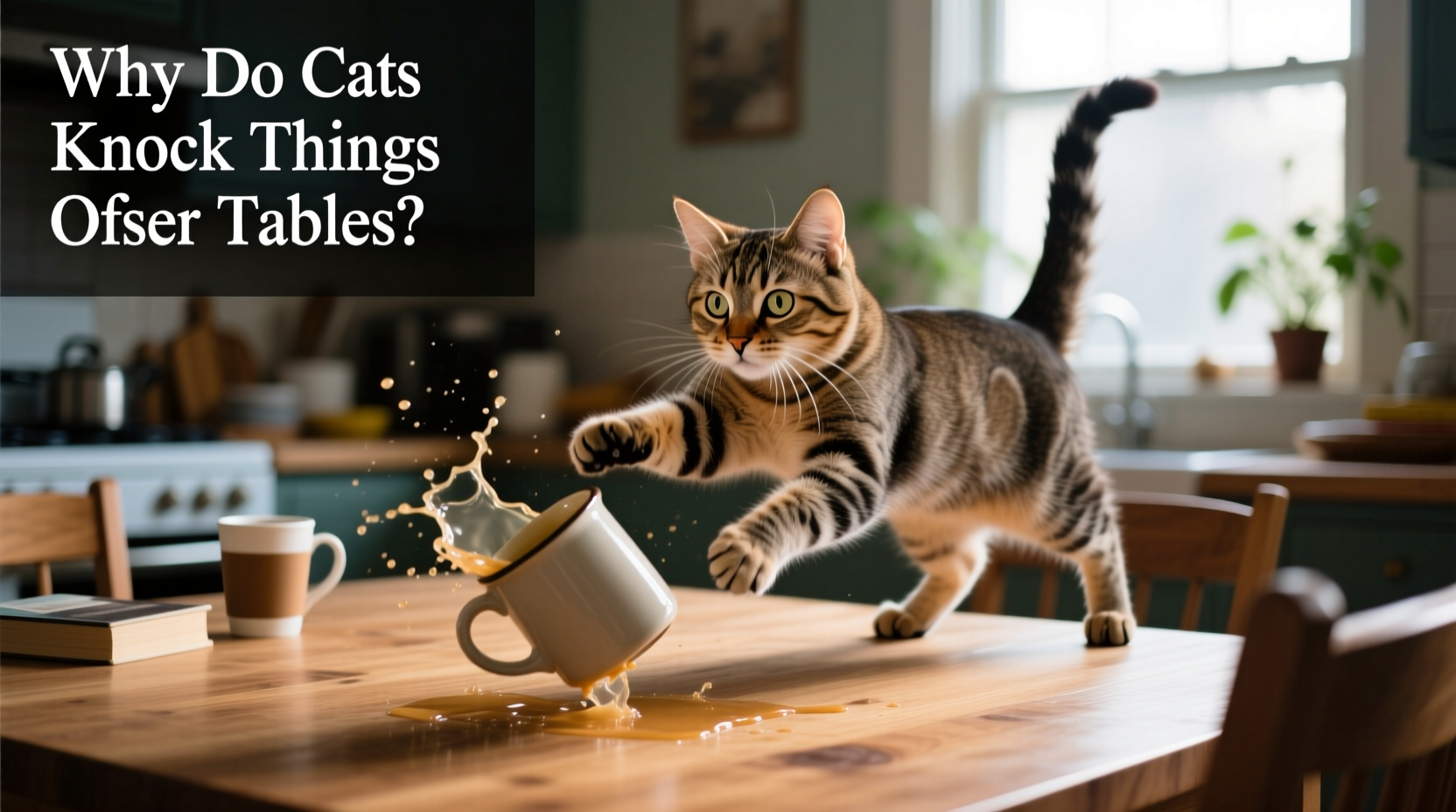
Cats are natural predators, evolved from solitary hunters who relied on stealth, precision, and environmental awareness to survive. In the wild, felines assess their surroundings constantly—not just for threats, but for opportunities. The act of nudging or batting an object may seem trivial in a domestic setting, but it mirrors behaviors seen in hunting sequences: testing movement, gauging reactions, and practicing pounce mechanics.
When a cat pushes something off a surface, it’s often engaging in what ethologists call “object play.” This mimics the way kittens practice hunting by swatting at leaves, feathers, or moving shadows. Adult cats retain this behavior because it provides mental stimulation and satisfies predatory instincts—even when no prey is present.
“Cats don’t knock things over out of malice. They’re conducting physics experiments with their paws.” — Dr. Sarah Ellis, Feline Behavior Scientist, University of Bristol
This instinctual testing of cause and effect helps cats understand their environment. If they nudge something and it moves, rolls, or falls with a sound, that feedback reinforces neural pathways related to coordination and consequence. It’s not destruction—it’s investigation.
Sensory Exploration: How Cats \"See\" With Their Paws
Cats rely heavily on tactile feedback, particularly through their whiskers and paw pads. These areas are rich in nerve endings, making them highly sensitive instruments for gathering information. When a cat approaches an unfamiliar object on a table, it may not trust its eyes alone—especially if lighting is dim or the item is stationary. A gentle tap allows the cat to assess texture, weight, temperature, and stability without fully committing to interaction.
Interestingly, cats have limited close-up vision. Objects within six inches of their face are blurry, which means they can’t inspect small items visually at point-blank range. Instead, they use their paws to manipulate and explore. What appears to be random mischief might actually be a methodical attempt to “touch-see” an object.
Why Movement Triggers the Pounce Reflex
Motion is one of the strongest stimuli for cats. Even the slightest wobble of a pushed object can trigger their innate prey drive. The moment an item begins to slide, the cat’s brain registers movement—similar to how a mouse might scurry across the floor. This activates the pounce sequence: focus, stalk, strike. Once the object falls and makes noise, the auditory feedback further rewards the behavior, reinforcing the action in the cat’s mind.
Items that dangle slightly over the edge of a table or sway when touched are especially tempting. Pens, mugs with handles, dangling cords, or even the corner of a napkin can become targets simply because they offer the promise of motion.
Communication Through Chaos: What Your Cat Is Trying to Tell You
While instinct plays a major role, cats also use object-knocking as a form of communication. Many indoor cats live in environments that lack sufficient mental stimulation. When bored or under-exercised, they may resort to attention-seeking behaviors. Knocking something over guarantees a reaction—whether it’s you rushing into the room, raising your voice, or cleaning up the mess. To the cat, any response is better than none.
In multi-pet households, this behavior can also serve as social signaling. A dominant cat might displace items near shared resources (like food bowls or favorite perches) to assert control. Alternatively, a shy cat might test boundaries by pushing something near a high-traffic area to gauge reactions from humans or other animals.
The Role of Curiosity and Problem-Solving
Cats are intelligent creatures with strong problem-solving abilities. Studies have shown that cats can understand basic principles of gravity and object permanence—the idea that something still exists even when out of sight. When a cat knocks a cup off a table and watches it fall, it’s not just playing; it’s learning.
Researchers at Kyoto University found that cats show surprise when objects defy expected physical laws—such as passing through solid barriers or floating mid-air. This suggests they form mental models of how the world works. Pushing things off surfaces may be part of their ongoing cognitive development, especially in younger cats.
Environmental Factors That Encourage the Behavior
Not all cats exhibit this behavior equally. Several environmental factors influence how often and why a cat knocks things over:
- Lack of enrichment: Cats without access to toys, climbing structures, or interactive play are more likely to seek stimulation destructively.
- High vantage points: Cats love elevated spaces. Tables, shelves, and counters give them a panoramic view, but these areas often double as human storage zones—creating conflict.
- Unpredictable routines: Cats thrive on consistency. Sudden changes in schedule or environment may increase anxiety-driven behaviors, including object displacement.
- Surface clutter: The more items on a surface, the greater the temptation. Reflective, shiny, or dangling objects are particularly attractive.
| Factor | Effect on Behavior | Mitigation Strategy |
|---|---|---|
| Low mental stimulation | Increases frequency of object-knocking | Daily puzzle feeders and rotating toys |
| Elevated surfaces with clutter | Provides opportunity and temptation | Designate cat-free zones or use secure shelving |
| Noise sensitivity | Some cats enjoy the sound of breaking or clattering | Replace fragile items with soft alternatives |
| Owner attention patterns | Rewarding the behavior with reaction | Respond calmly or ignore minor incidents |
| Kittenhood habits | Early play behavior becomes ingrained | Redirect early with appropriate toys |
How to Redirect the Urge: Practical Solutions
You can’t eliminate a cat’s natural curiosity, nor should you. But you can guide it toward safer, more constructive outlets. The goal isn’t to suppress behavior, but to redirect it appropriately.
Step-by-Step Guide to Managing Object-Knocking
- Assess the environment: Identify high-risk areas where your cat frequently knocks things over. Note patterns—time of day, type of object, presence of people.
- Clear and secure: Remove fragile or hazardous items from ledges and tables. Use museum putty or non-slip mats to stabilize remaining objects.
- Provide alternatives: Place sturdy, noisy, or movable toys nearby—such as plastic balls in a shallow bin or bell-filled plush mice.
- Introduce vertical space: Install cat shelves or perches away from human-use surfaces so your cat can observe without interfering.
- Engage daily: Spend 10–15 minutes twice a day using wand toys to simulate hunting. This reduces pent-up energy that fuels destructive play.
- Use positive reinforcement: Reward calm behavior near tables with treats or affection. Never punish—this increases stress and worsens the issue.
- Rotate enrichment: Change toys and activities weekly to prevent boredom. Puzzle boxes, treat-dispensing balls, and DIY obstacle courses work well.
Mini Case Study: Luna the Apartment Explorer
Luna, a two-year-old Siamese mix living in a small urban apartment, developed a habit of knocking over her owner’s coffee mug every morning. Her owner, frustrated, tried scolding and even covering the table—but the behavior persisted. A feline behavior consultant observed that Luna spent most of her day alone while her owner worked, with minimal stimulation beyond a single scratching post.
The solution wasn’t punishment, but enrichment. The owner introduced a daily routine: five minutes of laser pointer play before leaving, a bird feeder placed outside the window for visual entertainment, and a rotation of three puzzle toys swapped every Monday. Within two weeks, the mug-knocking stopped entirely. Luna wasn’t acting out of defiance—she was seeking engagement. Once her needs were met, the disruptive behavior faded naturally.
FAQ: Common Questions About Cats Knocking Things Over
Is my cat knocking things over to get back at me?
No. Cats do not operate on revenge or spite. Their actions are driven by instinct, curiosity, or a desire for interaction—not emotional retaliation. Attributing human motives to feline behavior leads to misunderstanding.
Should I punish my cat for knocking things off tables?
No. Punishment creates fear and damages trust. Yelling, spraying water, or tapping the nose may stop the behavior temporarily but often leads to increased anxiety and secretive actions. Focus instead on environmental management and positive redirection.
Are certain breeds more prone to this behavior?
Yes. Highly intelligent, active breeds like Siamese, Bengals, and Abyssinians tend to exhibit more exploratory and manipulative behaviors due to their intense curiosity and energy levels. However, any cat can develop the habit if under-stimulated.
Checklist: Preventing Destructive Pushing Behavior
- ✅ Remove fragile or dangerous items from elevated surfaces
- ✅ Provide at least two interactive play sessions per day
- ✅ Install cat shelves or perches in safe locations
- ✅ Use puzzle feeders to stimulate problem-solving
- ✅ Rotate toys weekly to maintain interest
- ✅ Observe and record when the behavior occurs
- ✅ Respond calmly—avoid loud reactions that reinforce attention-seeking
- ✅ Consult a certified feline behaviorist if the behavior escalates
Conclusion: Embracing the Quirks of Feline Nature
The urge to push objects off tables is not a flaw in your cat’s character—it’s a window into their evolutionary past and cognitive richness. Rather than viewing this behavior as annoying, consider it a sign of a healthy, curious mind at work. With thoughtful environmental design, consistent enrichment, and empathetic understanding, you can coexist peacefully with your four-legged physicist.
Start today by auditing one high-risk surface in your home. Clear it, secure what remains, and replace temptation with opportunity—for play, for learning, for connection. Your cat isn’t trying to ruin your day. They’re inviting you into their world. All you need to do is respond with patience and purpose.




 浙公网安备
33010002000092号
浙公网安备
33010002000092号 浙B2-20120091-4
Comments
No comments yet. Why don't you start the discussion?