
Cats are graceful, intelligent creatures—yet one moment they’re delicately grooming themselves, and the next, a ceramic mug lies shattered on the floor. If you’ve ever watched your cat deliberately bat an object off a table with laser focus, only to ignore it once it lands, you're not alone. This common behavior baffles many pet owners, but far from being random or destructive, this feline habit is rooted in instinct, curiosity, and communication. Understanding why cats engage in this seemingly mischievous act offers insight into their complex minds and helps strengthen the bond between cats and their humans.
The Evolutionary Roots of Feline Curiosity
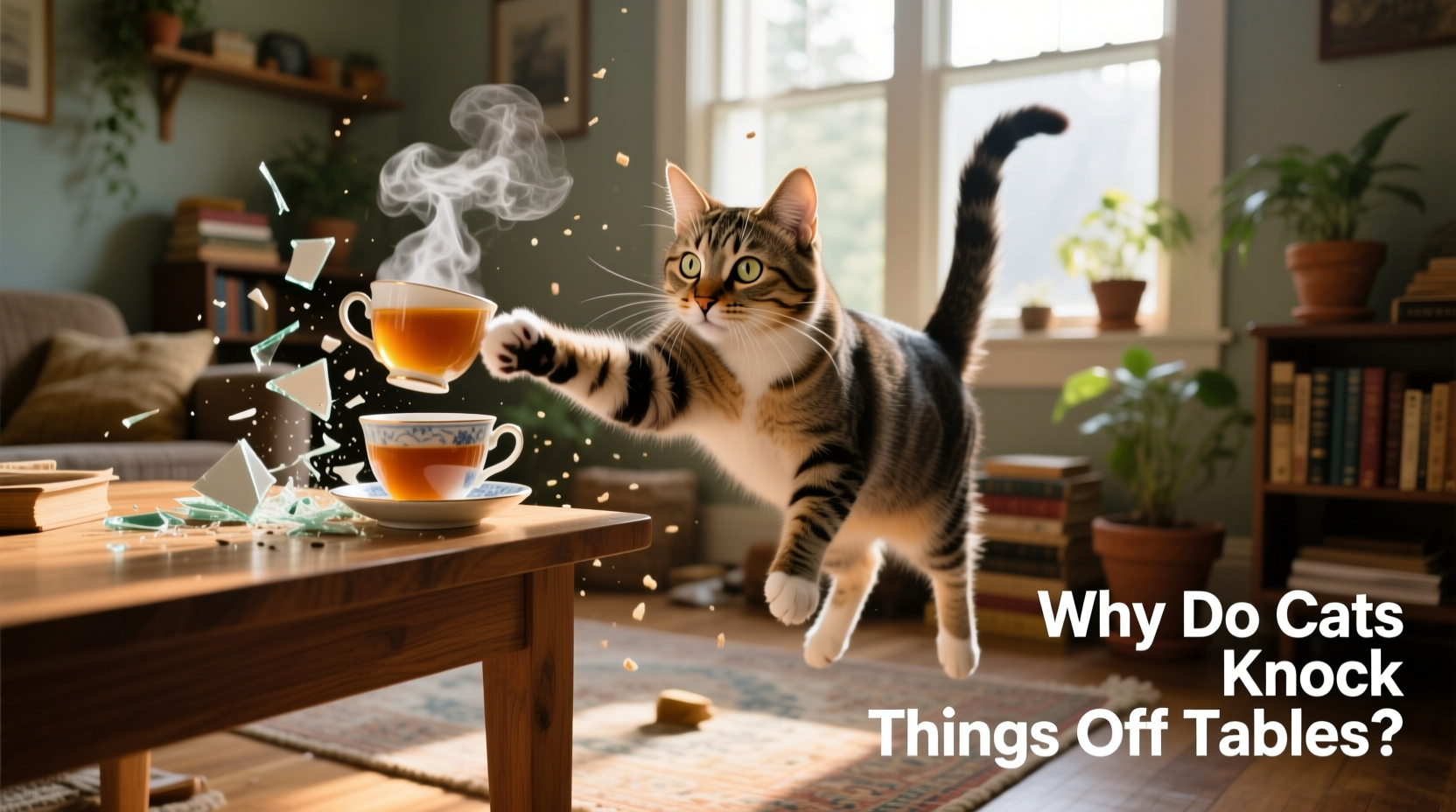
Cats are natural predators. Even domesticated housecats retain the instincts of their wild ancestors—creatures that relied on stealth, precision, and environmental awareness to survive. In the wild, observing movement is crucial. A twitching leaf could signal prey; a shifting shadow might mean danger. When a cat knocks something off a surface, it’s often testing its environment. The fall, sound, and motion trigger sensory feedback that satisfies their innate need to explore cause and effect.
This behavior mimics hunting patterns. Stalking, pawing, and capturing mimic real-world scenarios where a cat would manipulate prey. Objects falling create unpredictable movement—something that captivates a cat’s attention far more than a static toy. It’s not about destruction; it’s about engagement. For a species that evolved to respond to motion, a tumbling pen or clinking glass provides immediate, stimulating results.
Communication Through Chaos
While instinct plays a major role, cats also use physical actions to communicate. Knocking things over can be a deliberate way to get attention—especially if the owner reacts strongly. A loud crash often brings immediate response: voices rise, footsteps approach, and suddenly the cat is the center of focus. Over time, cats learn that certain actions yield predictable human reactions.
In multi-pet households or homes where owners are frequently busy, cats may resort to disruptive behaviors to assert presence. What seems like mischief might actually be a cry for interaction. Cats don’t experience guilt as humans do, but they are highly perceptive. They notice when their actions lead to consequences—and if those consequences involve attention, even negative attention, the behavior is reinforced.
“Cats aren’t trying to annoy us—they’re responding to unmet needs. Whether it’s stimulation, play, or social contact, knocking things over is often a symptom, not the problem.” — Dr. Sarah Thompson, Feline Behavior Specialist
Environmental Enrichment: Is Your Cat Bored?
Boredom is one of the most common drivers of unwanted feline behavior. Indoor cats, especially those without access to outdoor exploration, rely heavily on their environment for mental and physical stimulation. Without adequate outlets, they create their own entertainment—often at the expense of household objects.
A lack of vertical space, interactive toys, or scheduled playtime can leave cats under-stimulated. This leads to repetitive or compulsive behaviors, including pawing at items on counters, shelves, or desks. Unlike dogs, cats don’t naturally seek out structured routines, so it's up to owners to provide variety and challenge.
Signs Your Cat May Be Understimulated
- Excessive grooming or self-directed aggression
- Waking you at night for play
- Redirected aggression toward other pets
- Frequent item displacement (e.g., knocking pens, phones, or cups off surfaces)
- Over-grooming or fabric sucking
Step-by-Step Guide to Reducing Table-Topping Tendencies
Managing this behavior isn’t about punishment—it’s about redirection and prevention. Follow these steps to minimize incidents while supporting your cat’s psychological well-being:
- Assess the Environment: Walk through each room from your cat’s eye level. Identify high surfaces with tempting objects. Are there fragile or hazardous items within reach?
- Remove Temptation: Clear valuable or breakable items from ledges, coffee tables, and countertops. Use double-sided tape or aluminum foil on surfaces you want to discourage access to (cats dislike the texture).
- Provide Alternatives: Introduce stable platforms, cat trees, or window perches. Cats love elevation—it gives them a sense of security and control.
- Engage Daily: Use interactive toys like feather wands, motorized mice, or treat-dispensing puzzles. Mimic prey movement: erratic, quick, then “capture” and pause.
- Train with Positive Reinforcement: Reward calm behavior near tables. Clicker training can teach commands like “off” or “leave it,” though consistency is key.
- Rotate Toys Weekly: Novelty sustains interest. Store half your toys and swap them every 7–10 days to keep things fresh.
- Monitor Triggers: Note when knocking occurs—is it during work hours, late at night, or when guests arrive? Adjust routines accordingly.
Do’s and Don’ts When Addressing the Behavior
| Do | Don't |
|---|---|
| Provide climbing structures and safe exploration zones | Yell, hit, or spray water as punishment |
| Use puzzle feeders to stimulate problem-solving | Ignore repeated behavior—underlying issues may worsen |
| Play with your cat before leaving for work or bedtime | Leave small, noisy objects unattended on edges |
| Reward calm behavior near restricted areas | Assume the cat “knows better”—they act on instinct, not defiance |
| Consult a vet or behaviorist if behavior escalates | Blame the cat—focus on solutions, not blame |
Mini Case Study: Luna and the Office Desk
Maria, a freelance writer in Portland, struggled with her 3-year-old tuxedo cat, Luna, who had developed a habit of knocking over her coffee mug, phone, and notebooks every morning. Initially frustrated, Maria tried deterrents like sticky mats and verbal corrections, but Luna remained undeterred.
After consulting a feline behavior consultant, Maria realized Luna was acting out during Maria’s longest work stretches—often 3–4 hours without interaction. The knocking coincided with times when Luna felt ignored. The solution wasn’t discipline, but scheduling.
Maria began starting her day with a 12-minute play session using a wand toy shaped like a bird. She placed a cat tree beside her desk and added a bird feeder outside the adjacent window. Within two weeks, Luna’s knocking decreased by 80%. She still occasionally batted at pens—but now only during designated “play breaks.”
The change wasn’t due to fear or correction, but fulfillment. Luna no longer needed to create chaos to feel seen.
Medical and Psychological Considerations
While most cases stem from behavioral causes, sudden onset or aggressive knocking can sometimes indicate underlying health issues. Hyperthyroidism, cognitive dysfunction in older cats, or vision loss can alter behavior. A cat with declining eyesight may misjudge distances, leading to accidental swipes. Neurological conditions might impair impulse control.
If your cat’s behavior changes abruptly—especially if accompanied by vocalization, disorientation, or litter box avoidance—a veterinary checkup is essential. Blood tests and physical exams can rule out medical triggers before assuming purely behavioral causes.
Frequently Asked Questions
Is my cat being malicious when it knocks things over?
No. Cats don’t act out of spite or malice. Their behavior is driven by instinct, curiosity, or unmet needs—not a desire to upset you. Labeling it as “bad” reinforces misunderstanding. Instead, view it as communication or exploration.
Will my cat grow out of this behavior?
Some kittens are more prone to playful swiping, and the behavior may lessen with age. However, adult cats can continue the habit if it remains rewarding. Proactive enrichment and consistent routines are more effective than waiting for “maturation.”
Can I train my cat to stop knocking things over?
You can’t eliminate natural instincts, but you can redirect them. Training focuses on reinforcing desired behaviors (like playing with toys) rather than suppressing innate ones. Positive reinforcement, environmental management, and scheduled engagement are far more effective than punishment.
Conclusion: Embracing the Quirks of Cat Ownership
Cats will always surprise us—with their agility, independence, and mysterious habits. Knocking things off tables isn’t rebellion; it’s an expression of their nature. By understanding the reasons behind the behavior, we shift from frustration to empathy. We stop seeing messes and start seeing motivations.
Instead of asking, “Why does my cat do this?” try asking, “What does my cat need?” The answer often lies in simple fixes: more play, better spaces, or just a few minutes of focused attention. When we meet those needs, the falling objects become less frequent, not because we’ve suppressed the cat, but because we’ve understood it.




 浙公网安备
33010002000092号
浙公网安备
33010002000092号 浙B2-20120091-4
Comments
No comments yet. Why don't you start the discussion?