
Cats have long fascinated humans with their enigmatic behaviors—pouncing at invisible prey, batting objects off tables, and, perhaps most famously, squeezing into cardboard boxes that seem far too small for them. But even more curious is when a cat chooses to sit in a box significantly larger than its body. At first glance, it appears inefficient or even illogical. Why would a cat occupy a space much bigger than necessary? The answer lies not in whimsy, but in deep-rooted feline instincts, psychological comfort, and environmental adaptation. This article explores the behavioral science behind this common yet puzzling habit, drawing on animal cognition research, ethology, and veterinary expertise.
The Evolutionary Basis of Enclosed Spaces
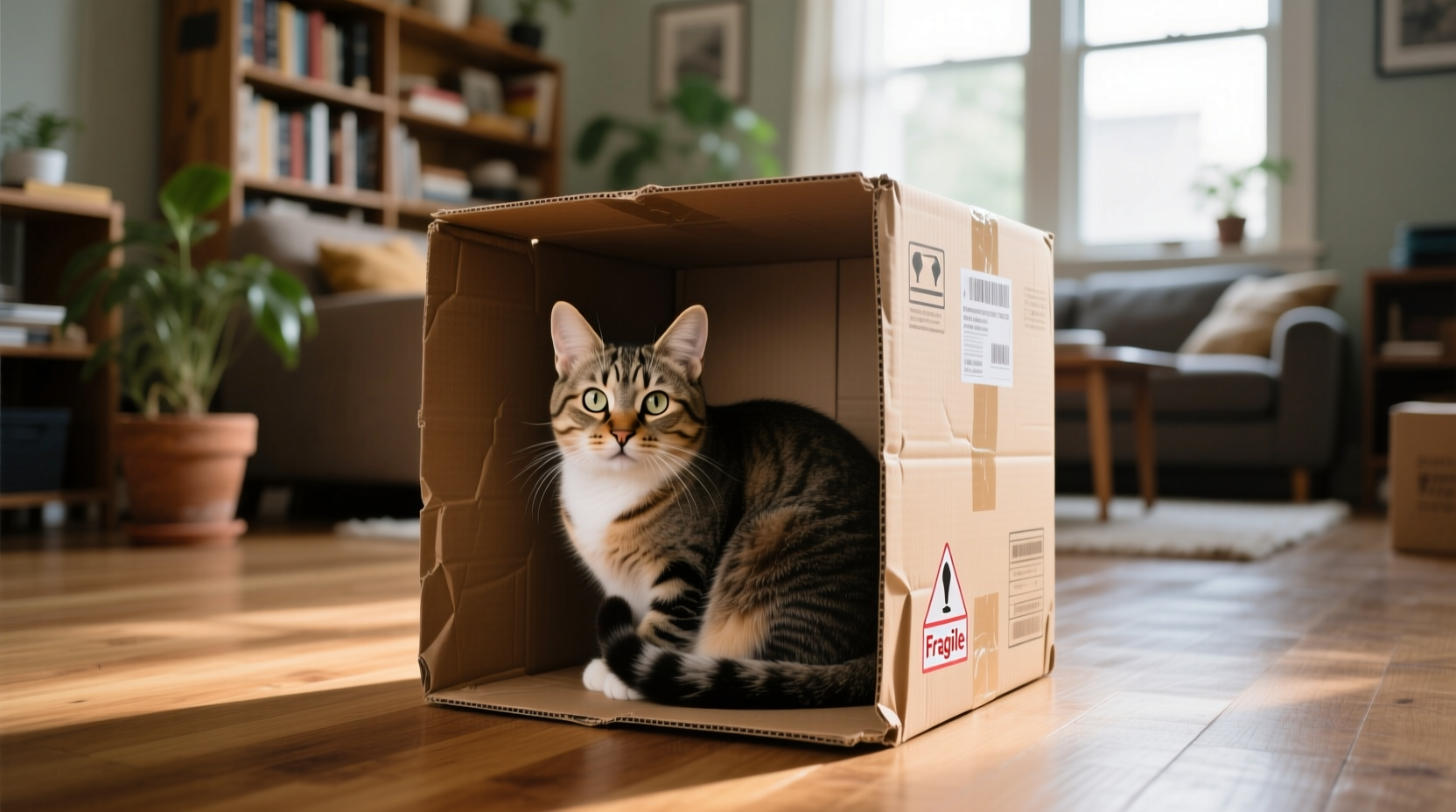
Domestic cats (Felis catus) are descendants of solitary desert-dwelling ancestors who relied on stealth, concealment, and temperature regulation for survival. In the wild, finding shelter meant protection from predators, harsh weather, and competing animals. Enclosed spaces such as rock crevices, hollow logs, or dense brush provided security and thermal insulation. These evolutionary pressures shaped a preference for confined environments—a trait retained in modern housecats despite generations of domestication.
Boxes, regardless of size, mimic these natural shelters. Even if a box is oversized, its walls create a psychological boundary. The presence of vertical edges gives the cat a sense of enclosure, reducing exposure to potential threats. From an evolutionary standpoint, being surrounded on multiple sides—even partially—triggers a neurological response associated with safety.
“Cats don’t just seek warmth or hiding spots—they seek control over their environment. A box, large or small, offers predictability in an otherwise unpredictable world.” — Dr. Sarah Ellis, Feline Behavior Scientist, University of Bristol
This need for environmental control is particularly important in multi-pet households or homes with frequent human activity. A large box may not be snug, but it still defines a personal zone where the cat can observe without being approached directly.
Thermoregulation and Comfort Preferences
Cats maintain a higher body temperature than humans—between 100.5°F and 102.5°F (38°C–39.2°C). To conserve energy, they prefer ambient temperatures around 86°F (30°C), which is warmer than most indoor settings. Cardboard, despite being thin, provides modest insulation. When a cat sits inside a box, especially one placed on a cool floor, the walls help trap body heat and reduce convective cooling.
Interestingly, studies conducted by the Netherlands’ Utrecht University found that shelter cats given access to cardboard boxes showed lower stress levels within the first week of arrival compared to those without boxes. While the study didn’t focus on box size, researchers noted that cats used boxes proportionally larger than their bodies, suggesting that spatial availability doesn’t negate perceived thermal benefit.
Even in oversized containers, cats often curl up in one corner, effectively creating a smaller micro-environment within the larger structure. This self-imposed confinement allows them to maximize contact with insulating surfaces while retaining visibility and escape routes.
Predatory Psychology and Observation Posts
Cats are ambush predators. Their hunting strategy relies on patience, concealment, and sudden bursts of movement. Even well-fed indoor cats retain these instincts. A box—especially one with open tops and clear sightlines—functions as a tactical observation post. From this vantage point, a cat can monitor room activity without committing to engagement.
A larger box may offer more flexibility in positioning. For example, a cat might sit near the front edge to track foot traffic, retreat to the back when startled, or stretch out after prolonged alertness. This adaptability makes oversized boxes functionally useful rather than inefficient.
In homes with dogs or active children, cats frequently use large boxes as neutral zones—spaces where they can remain present without feeling vulnerable. Unlike small enclosures that require full commitment to hiding, a spacious box allows partial visibility and quick exit options, balancing curiosity with caution.
Stress Reduction and Environmental Enrichment
Modern cat welfare emphasizes environmental enrichment—providing mental stimulation, physical outlets, and emotional security. Boxes contribute significantly to all three. Research published in *Applied Animal Behaviour Science* confirms that access to hiding places reduces cortisol levels in cats, improving overall well-being.
While tight-fitting boxes provide maximum tactile feedback (pressure along the sides mimicking social contact), larger boxes serve different psychological purposes:
- Choice and autonomy: Cats value decision-making. An oversized box allows them to choose how much space to occupy.
- Exploration: Large boxes may contain crumpled paper, toys, or scent markers, turning them into interactive zones.
- Transition zones: New environments (like vet clinics or foster homes) become less intimidating when large boxes are available, acting as temporary sanctuaries.
Veterinarians and shelter workers routinely use large cardboard containers during intake procedures. These aren’t meant to be filled completely; instead, they act as transitional safe spaces until the cat feels secure enough to explore freely.
Do’s and Don’ts: Using Boxes for Cat Well-Being
| Do | Don't |
|---|---|
| Provide multiple box sizes to allow choice | Use taped-shut boxes that limit escape routes |
| Place boxes in low-traffic, quiet corners | Put boxes in drafty or noisy areas |
| Add soft bedding or familiar scents | Force a cat into a box against its will |
| Rotate boxes weekly to maintain novelty | Leave deteriorating boxes (wet, torn) unattended |
| Observe body language to assess comfort level | Assume all cats automatically enjoy boxes |
Mini Case Study: Shelter Cat Adaptation
In a 2022 trial at the Amsterdam Animal Shelter, 40 newly arrived cats were divided into two groups. One group received standard cages with only bedding; the other was given identical cages plus a large cardboard box (approximately twice the length of the average cat). Over ten days, staff recorded vocalizations, hiding frequency, eating patterns, and human interaction readiness.
The results were striking. Cats with access to boxes began eating within 12 hours of arrival—on average six hours earlier than the control group. They also exhibited fewer stress-related behaviors such as excessive grooming or tail flicking. Notably, many cats chose to rest at the back of the oversized box rather than filling the entire space, indicating that perimeter security mattered more than spatial fit.
One female tabby, estimated to be two years old, initially refused food and hid under a blanket. After introducing a large shipping box with one side removed, she entered within minutes and settled in the far corner. By day three, she was approaching caregivers voluntarily. Staff concluded that the box provided both physical shelter and psychological scaffolding for recovery.
Understanding Feline Spatial Perception
Cats perceive space differently than humans. They rely heavily on whiskers (vibrissae) to gauge clearance, but this doesn’t mean they avoid oversized areas. Instead, they assess risk based on visibility, escape paths, and surface stability. A large box with high walls but no lid still qualifies as a “den” because it breaks line-of-sight from potential threats.
Moreover, cats often engage in what ethologists call “object affiliation”—forming attachments to specific items or locations due to positive associations. If a cat receives treats, petting, or undisturbed naps inside a particular large box, it becomes a preferred site regardless of dimensions. This learned behavior reinforces repeated use, even when smaller or cozier alternatives exist.
Interestingly, some cats display ritualistic entry patterns: circling the box, sniffing corners, or pawing at the interior before settling. These actions suggest spatial mapping and ownership marking, further emphasizing the cognitive significance of the container beyond mere utility.
Step-by-Step Guide: Creating an Ideal Box Environment
- Select the right material: Use clean, corrugated cardboard without ink residue or staples.
- Modify for accessibility: Cut one side down if needed, but ensure at least two full walls remain for security.
- Enhance comfort: Line the bottom with an old fleece blanket or towel (avoid slippery fabrics).
- Add enrichment: Tuck in crinkly paper, a worn T-shirt with your scent, or a non-edible toy.
- Position strategically: Place the box near a window, heater vent, or favorite resting area—but away from heavy foot traffic.
- Maintain hygiene: Replace or clean the box weekly; discard if damp or soiled.
- Monitor usage: Note how your cat uses the space—fully reclined, perched at edge, etc.—and adjust accordingly.
Frequently Asked Questions
Why does my cat sit in a huge box but ignore a custom cat cave?
Commercial cat caves may lack the sensory appeal of cardboard. The texture, smell, and sound of crinkling paper stimulate natural curiosity. Additionally, cardboard is porous and absorbs scents, making it feel more personalized over time. Some cats also dislike enclosed plush tents because they restrict airflow or feel too confining.
Is it normal for a cat to lie diagonally across a large box?
Yes. This posture indicates relaxation and confidence. When a cat sprawls outside the typical curled position, it signals low perceived threat. The box still serves as a psychological anchor—even partial occupancy reflects territorial claiming.
Should I be concerned if my cat suddenly stops using boxes?
Not necessarily. Changes in preference can reflect age, health, or environmental shifts. However, if accompanied by lethargy, reduced appetite, or avoidance of other safe spaces, consult a veterinarian. Sudden disinterest in previously favored spots may indicate pain or anxiety.
Actionable Checklist for Cat Owners
- ✅ Offer at least one cardboard box per cat in multi-cat homes
- ✅ Rotate boxes every 7–10 days to maintain novelty
- ✅ Observe whether your cat prefers high-walled or open-front containers
- ✅ Avoid plastic bins unless lined with breathable materials
- ✅ Introduce boxes gradually in new environments (e.g., after moving)
- ✅ Never use boxes as punishment or forced isolation tools
- ✅ Combine boxes with scratching posts or perches for enriched setups
Conclusion: Respecting the Complexity Behind a Simple Behavior
The sight of a cat lounging in a box far larger than its body may seem trivial, even comical. Yet beneath this everyday moment lies a complex interplay of evolution, neurology, and emotional intelligence. Cats don’t choose boxes merely because they’re cute or quirky—they do so because these simple structures fulfill fundamental needs: safety, warmth, control, and cognitive engagement.
By understanding why cats gravitate toward boxes—regardless of size—we gain deeper insight into their inner world. We also improve our ability to support their mental health, especially in stressful transitions or stimulating households. Rather than dismissing this behavior as odd, we should appreciate it as a window into feline resilience and adaptability.




 浙公网安备
33010002000092号
浙公网安备
33010002000092号 浙B2-20120091-4
Comments
No comments yet. Why don't you start the discussion?